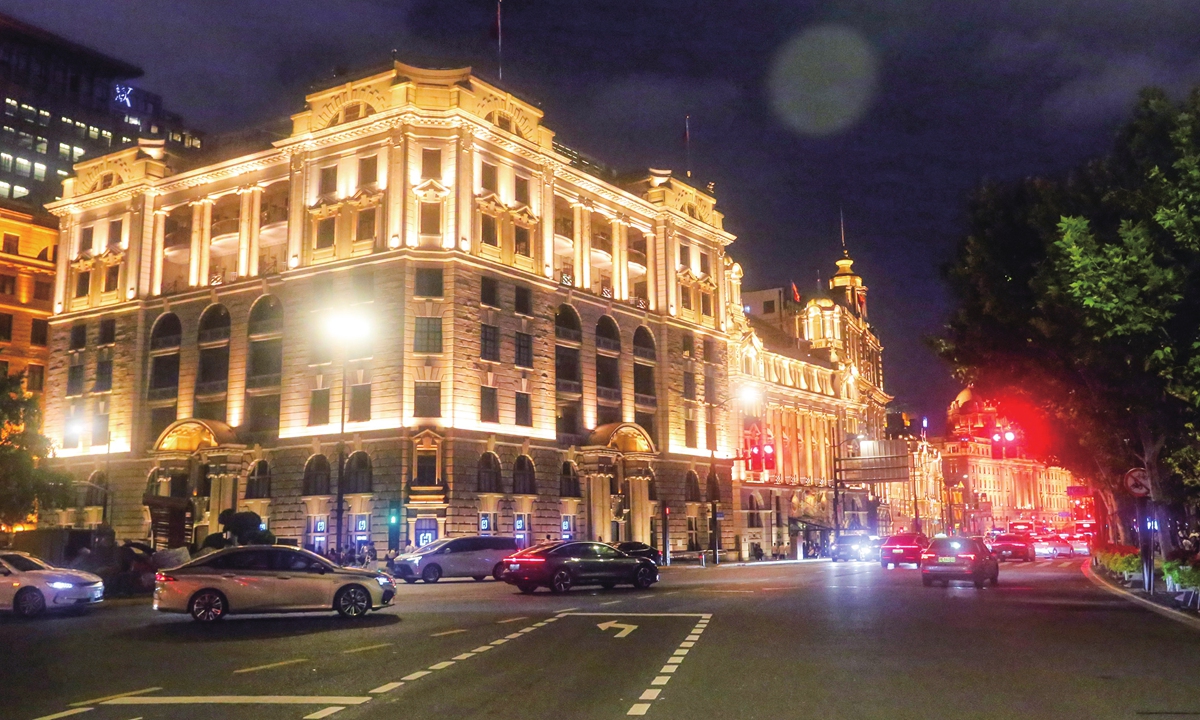
Cars pass by the Bund architectural complex in Shanghai. Photos: VCG
Walking along the Huangpu River in East China's Shanghai at sunset, I can see the century-old buildings of the Bund gradually light up under the winter night. Music drifts through the air and mingles with laughter, giving the historic district a renewed vibrancy.This lively atmosphere was amplified by the recently launched Bund Winter Carnival along the historic waterfront at the Bund Finance Center, where themed installations and street markets intertwined with performances and exhibitions. On the North Plaza, a 300-square-meter competition-grade ice rink has opened to the public, its lighting and artificial snowfall blending seamlessly with the riverside scenery.
Among the crowd stopping by the river to take photos was Emily Carter, a visitor from Australia. She had decided to visit the Bund after watching viral videos of dancers performing by the waterfront, and luckily, her visit happened to coincide with the Bund Winter Carnival.
The combination of the Bund's century-old skyline and the vibrancy of new activities made me reluctant to leave. she told the Global Times.
"I had actually visited the Bund seven years ago. Back then, I thought it was spectacular but was kind of 'static,'" she said. "Now it feels much more dynamic, and in constant change. You never know what event you'll run into around the corner."
As visitors played on the ice rink, street performers' jazz and electronic music drifted through the air and soft laughter and clinking cups came from nearby cafés, everything seemed to suggest the same message: Here, history is being touched, lived, and reshaped.
Glowing city rhythm
As dusk settles over the city, the historic buildings along the river begin their gradual shift from dim to bright at around 6 pm each evening in winter.
"The Shanghai World Financial Center, the Shanghai Jinmao Tower, and the Shanghai Tower, the three landmarks we call the 'Bund's big three,' always attract a large number of visitors, especially when the lights are turned on," Jin Simiao, a Shanghai resident who works at a tech company, told the Global Times.
In August, the Huangpu district optimized the Bund's waterfalls by improving water flow and outlet structures, and upgrading to high-color-rendering, high-brightness, light-emitting diodes (LEDs) fixtures.
Thanks to locally developed technology that increases the refresh rate, the waterfall lighting appears more uniform and delicate, according to the official website of Huangpu District People's Government.
On the riverside promenade, pedestrians stop to admire the historic facades being sculpted by light; the reflections on the Huangpu merge with the glow to form a quiet ribbon of illumination along the river.
"In recent years, people have praised how beautiful the Bund's lighting is, but what matters more is that it's become an experience you can literally walk through," Jin noted.
"You can stroll, take photos, catch a pop-up performance. The atmosphere changes completely when the lighting blends with night markets, music, and small events."
"This 'light-and-night-economy' approach is what keeps even longtime locals coming back," she said.
In Jin's view, the growth of nighttime activities is not about "creating noise," but about allowing this century-old district to be re-experienced and continued in a contemporary way while preserving its historic character.

Pedestrians check out the splendid urban scenery on the North Bund of Shanghai on November 13, 2025.
Timeless architectural majesty
The Bund Historical and Cultural Area is defined by the area enclosed by the Huangpu River, Yan'an Road East, and neighboring streets, covering roughly 101 hectares. Formed in the first half of the 20th century, it is the largest historic district in downtown Shanghai and home to the greatest concentration of protected heritage buildings, according to Shanghai Urban Planning and Natural Resources Bureau.
It was among the first 12 historical and cultural conservation zones approved by the Shanghai municipal government in November 2003. In April 2015, it was also included in the first batch of China's national historical and cultural districts for its distinctive reputation as an "expo of world architecture."
For more than one century, the Bund has been known as a showcase of global architectural styles. Buildings from different eras and design traditions stand side by side, capturing the turbulence and transformation of China's modern political, economic, and cultural development, according to Xinhua News Agency.
"Every person has their own particular version of the Bund in mind. It is a magnificent gallery of world architecture, the most iconic 'cover image' of Shanghai, and a major center of financial institutions," Wang Deyan, an aesthetics and cultural industry scholar, told the Global Times.
"Tracing the layers of architectural memory and urban texture, you can also read how Shanghai has grown through different eras," Wang said.
Alongside the iconic buildings, many century-old shops, ranging from teahouses and bakeries to traditional tailors, still operate in the Bund. These long-standing businesses have often been carefully preserved or restored under local heritage protection regulations, maintaining their original facades and interiors while adapting to modern needs.
"Preserving the century-old shops is key to sustaining the Bund's long-term appeal. These stores carry historical memory, and they give visitors a sense of warmth and everyday life beyond the architecture itself," Wang noted.
According to Wang, today, the Bund is not only a historic district with a hundred years of heritage, but it has also become a riverside cultural stage that travelers from around the world visit.
Under the gaze of global visitors, Band's historic buildings, neighborhood life, and contemporary events intertwine seamlessly along the winter riverfront, bringing the city's culture and rhythm vividly to life.