BRASIL 247 / MORE
Brazil moves to tackle historic tax injustice, Lula says
The President highlights new income tax law that shifts burden from workers to the super-rich
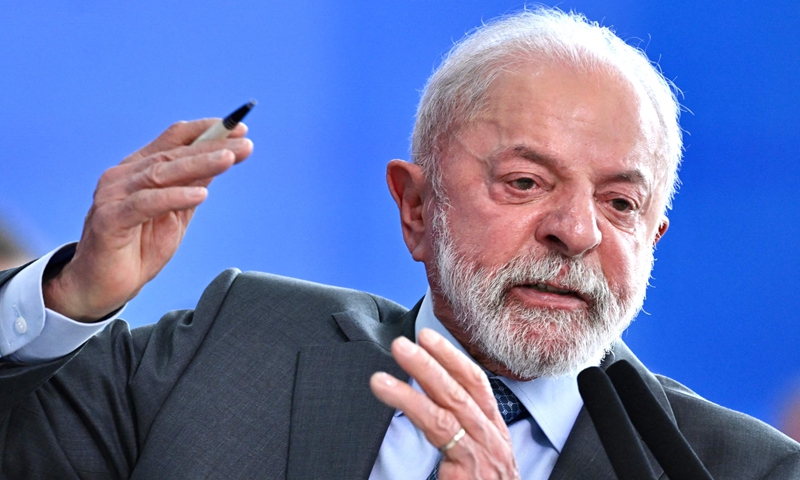
Brazil's President Luiz Inacio Lula da Silva gestures during the signing ceremony of the new Income Tax Law at the Planalto Palace in Brasilia. on November 26, 2025. Photo: CFP
By Brasil 247 - Brazil's President Luiz Inácio Lula da Silva said in a national address on Sunday night that the country is undergoing a historic shift by confronting what he described as a deeply rooted system of tax unfairness that has fueled inequality for centuries. The statements came after he signed into law a measure that will exempt all workers earning up to R$5,000 ($943) per month from the Income Tax starting in January 2026. The information was originally reported by Brasil 247.
Lula stressed that the reform targets the structural core of inequality. "More than just a correction to the income tax bracket, the new law attacks the main cause of inequality in Brazil: the so-called tax injustice," he said.
He contrasted the tax burden on workers with what high-income individuals pay. According to Lula, while employees may pay up to 27.5% in income tax, those who live off passive income pay on average just 2.5%. "Those who live in mansions, keep money abroad, collect imported cars, private jets and jet skis, pay ten times less than a teacher, a police officer or a nurse," he stated.
Lula also highlighted the degree of wealth concentration in the country. "Brazil has too much wealth concentrated in the hands of the super-rich," he said, noting that the richest 1% hold 63% of all wealth while half of the population owns only 2%.
He pointed out that the new law will also reduce taxes for those earning between R$5,000 and R$7,350 ($943 to $1,387). For a worker earning R$4,800 ($905), the exemption amounts to an annual savings of about R$ 4,000 ($755) — "almost a 14th salary," in Lula's words.
The president emphasized that the reform will not be financed by cuts to education or health. Instead, it will be funded by taxing individuals who earn more than R$1 million per year ($188,679) and currently pay, in Lula's description, "nothing or almost nothing." Under the new rule, this group — roughly 140,000 people, or 0.1% of the population — will pay a 10% tax on income. "140,000 super-rich people paying a little more so that millions stop paying," he explained.
He said the reform will have immediate economic effects, citing Federal Revenue estimates that the measure will inject R$28 billion ($5.28 billion) into the economy in 2026, boosting consumption, commerce, industry and services. "This relief means more money in people's pockets, greater purchasing power, more consumption and a stronger economic cycle," Lula said.
The president listed several social and economic policies implemented during his current term — from removing Brazil from the Hunger Map to strengthening the minimum wage policy and expanding support for family farming. Despite these gains, he argued, inequality remains "unacceptable."
Lula said the new income tax reform is only the first step of a broader agenda. "You can be sure we will not stop here. What we want is for the Brazilian people to have the right to the wealth they produce with the sweat of their labor," he declared, signaling that reducing inequality will remain central to his political project.
(Reported by Brasil 247 on December 1, 2025 )
