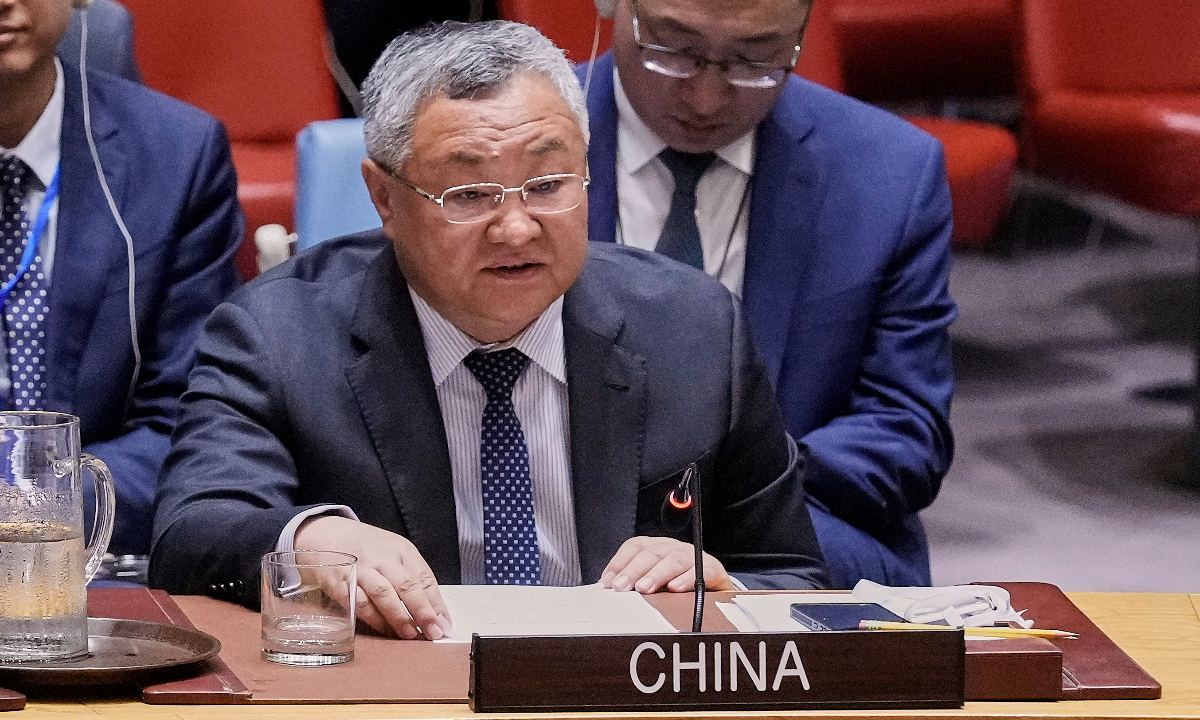
China UN Ambassador Fu Cong addresses a United Nations Security Council meeting on June 30, 2025. Photo: VCG
China has submitted a second letter to the UN secretary-general, firmly refuting the unreasonable arguments made by Japan's permanent representative to the UN, and elaborating on the position of the Chinese government regarding Japanese Prime Minister Sanae Takaichi's erroneous remarks on Taiwan and related matters.
The Chinese Foreign Ministry on Tuesday said the move was fully "justified and necessary," and reiterated China's firm opposition to Japan's actions of reversing the course of history, challenging the postwar international order, and honoring the militarists.
China's Permanent Representative to the UN Fu Cong sent another letter to UN Secretary-General António Guterres, firmly refuting the unreasonable arguments made by Japan's Permanent Representative to the UN, Kazuyuki Yamazaki, in his November 24 letter to the Secretary-General, and elaborating on the position of the Chinese Government, per the Chinese mission's website.
In the letter, Fu noted that Takaichi's provocative remarks during her Diet questioning on November 7 openly challenge the victorious outcomes of World War II and the post-war international order, and constitute a serious violation of the purposes and principles of the Charter of the United Nations.
Japan's permanent representative to the UN sent a letter to the UN secretary-general making unreasonable arguments, dodging the key issues, while groundlessly accusing China and seeking to shift blame. "China firmly opposes this," said Fu.
Fu also noted that it is abundantly clear that Japan is breaking free from the exclusively defense-oriented principle and re-arming itself. It is the Japanese side, not others, that has been "engaged in the prolonged expansion of military capabilities," attempting "unilateral changes to the status quo despite opposition from neighboring countries," and taking "coercive measures," said Fu.
On November 21, Ambassador Fu sent a letter to Guterres, elaborating on the Chinese government's position regarding Takaichi's erroneous remarks on the Taiwan region.
Japan then submitted a letter to the UN on November 24, defending the country's stance.
Lin Jian, a spokesperson of Chinese Foreign Ministry, said at a press conference on Tuesday that the letter by the Japanese side is full of erroneous views and lies. The Japanese side mentioned in the letter the so-called "consistent position" on the Taiwan question. But as to what exactly this "consistent position" is, the Japanese side has continued to evade the question and has yet to give China a direct answer.
The Japanese side claims that Japan adheres to a "passive defense strategy, which is exclusively defense-oriented," and asserts that Takaichi's remarks were grounded in this position. Taiwan is Chinese territory. How to resolve the Taiwan question is a matter for the Chinese ourselves and brooks no external interference. Yet Takaichi linked Japan's "survival-threatening situation" with a "Taiwan contingency," implying the use of force against China. Is this what the Japanese side's "passive defense strategy, which is exclusively defense-oriented," means? Lin asked.
The Japanese side also insinuates accusations regarding the defense development and "coercive measures" of other countries. This is nothing but blame-shifting. In fact, since Japan's defeat, right-wing forces within Japan have never ceased attempts to whitewash its history of aggression, Lin said.
This year marks the 80th anniversary of the victory of the Chinese People's War of Resistance Against Japanese Aggression and the World Anti-Fascist War. China firmly opposes the Japanese side reversing the course of history, challenging the postwar international order, and honoring the militarists, Lin said.
Firm rebuttal
"China's second letter gives a clear and firm rebuttal, exposing the myth of Japan's so-called exclusively 'defense-oriented' posture, grounding its case in documents such as the Cairo Declaration, and reminding all UN member states that Japan's Taiwan rhetoric undermines the outcomes of World War II and the post-war international order - and touches China's sovereignty red line," said Xiang Haoyu, distinguished research fellow at the Department for Asia Pacific Studies of the China Institute of International Studies.
Japan's letter to the UN attempted to muddy the waters, hide its push to break long-standing defense limits and accelerate military expansion, and cast itself as a victim to court sympathy. At the same time, Tokyo is seeking to weaken the restraint of the enemy state clauses of the UN Charter to reduce international pressure on its actions, Xiang told the Global Times on Tuesday.
Liu Jiangyong, vice dean of the Institute of Modern International Relations at Tsinghua University, told the Global Times that China's stance is just and its actions are necessary. The latest development shows Japan is doubling down on a hardline course with no sign of self-reflection.
Also on Tuesday, China Coast Guard (CCG) vessels took necessary law enforcement measures and ordered a Japanese fishing boat to leave after it illegally entered the territorial waters of China's Diaoyu Dao. CCG spokesperson Liu Dejun said the force will continue its patrols and firmly safeguard China's territorial sovereignty and maritime rights and interests.
The latest action underscores China's effective control over the Diaoyu Dao area. Zhou Yongsheng, a deputy director of the Japanese Studies Center at the China Foreign Affairs University, told the Global Times that following Takaichi's erroneous remarks, any further provocation by Japan around the Diaoyu Islands "will inevitably trigger stronger Chinese countermeasures."
Rising alarm
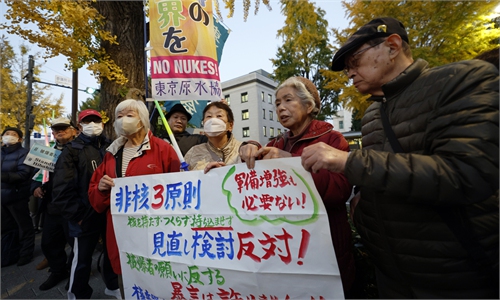
Amid Japan's dangerous revival of militarism, its Ministry of Defense has distributed a children's version of the defense white paper to elementary schools nationwide. In response, the educators' groups have criticized and appealed, "the government should stop unilaterally teaching children policies that promote the strengthening of military power," the Tokyo Shimbun reported Tuesday.
Japan's act of distributing booklets of the defense white paper to children is highly aberrant, underscoring the growing pervasiveness of its militarist ethos and the continuous drift of its right-wing agenda towards extremism. Meanwhile, Japanese authorities deny reviving militarism yet clandestinely advance relevant tendencies through concrete actions, exhibiting a trait of duplicity, experts noted.
On Monday evening, Takaichi held a 20-minute phone call with NATO Secretary-General Mark Rutte, who expressed support for her view that security in the Euro-Atlantic and the "Indo-Pacific" is "inseparable" and cooperation between Japan-NATO and NATO-IP4 - Japan, Australia, New Zealand and South Korea - is crucial, per media reports.
Takaichi's moves are a double provocation: damaging China-Japan relations and destabilizing Asia's security environment at first. Her outreach to NATO pushes the region toward "Asia-Pacific NATO-ization," effectively inviting external military forces into Asia, said Xiang.
"Such posture will only fuel regional tensions and ultimately undermine Japan's own security environment," said the expert.
Takaichi's provocative remarks have also drawn growing concern within Japan. In an article published Tuesday by Japan's Aera Digital, political and economic commentator Shigeaki Koga said Prime Minister Takaichi's remarks cannot be justified from any perspective. He added that her comments almost overturned the 1972 Sino-Japanese Joint Statement - the most important foundation of bilateral relations - leaving no room for excuses. It should have been withdrawn immediately.
Koga said Takaichi cannot withdraw her remarks, possibly because she failed to grasp the full magnitude of her mistake. Even now, she may still not comprehend its gravity.
In a report on Tuesday, Kyodo News cited multiple sources as saying that senior members of the cross-party Japan-China Friendship Parliamentarians' Union, including former Liberal Democratic Party (LDP) election chief Yuko Obuchi, conveyed to the Chinese side their request to send a delegation of lawmakers to China within the year.
In addition, Tsutsui Yoshinobu, chairman of the Japan Business Federation (Keidanren), has also recently conveyed a request to the Chinese side to dispatch a delegation to China, according to Kyodo News.
When asked about whether China will arrange their visits, Lin said on Tuesday that we noted the reports and also found that many visionary people in Japan are deeply concerned over the negative influence and grave consequences of Takaichi's erroneous remarks on Taiwan.
The Chinese side urges the Japanese side to do soul-searching, rectify its wrongdoings, retract Takaichi's erroneous remarks, stop harming the sentiments of the two peoples, take practical steps to honor its political commitments to China, and create necessary conditions for the normal exchanges between the two countries, Lin said, expressing hope that relevant Japanese organizations will play a more positive role in Japan.
Xiang noted that Takaichi's remarks on Taiwan have placed China-Japan relations under severe strain and even harmed Japan's own economic interests, triggering dissatisfaction at home.
RELATED ARTICLES