ARTS / CULTURE & LEISURE
2025 Top Ten Buzzwords in China unveiled, ‘resilience’ tops list

2025 Top Ten Buzzwords
On Tuesday, the Shanghai-based linguistic journal Yaowen Jiaozi, which has pioneered the tradition of selecting annual buzzwords in China since 2008, announced the Top Ten Buzzwords of 2025. "Renxing," meaning "resilience," topped the list.
Huang Anjing, editor-in-chief of the journal, told media that the editorial team continues to follow its long-standing "dual standard" principle, balancing sociological and linguistic criteria. The inclusion of certain terms indicates the year's major events and social hotspots that have attracted broad attention.
In its announcement for the Top Ten Buzzwords of 2025, the journal highlighted three major linguistic phenomena.
First, the full arrival of the AI era has rapidly expanded the Chinese lexicon, producing numerous new AI-related terms such as "jushen zhineng," meaning "embodied intelligence." This demonstrates that artificial intelligence is not only transforming the world but also reshaping the structure of language itself.
Second, the acceleration of new forms of productive capacity, along with industrial optimization and economic transformation, has created diverse means of employment, giving rise to matching new terms such as "guzi (economy)." Language has faithfully recorded the changes in social life throughout the year.
Third, language continues to reflect social attitudes, including people's values, emotional needs, and aesthetic preferences.
Regarding this year's top buzzword, "renxing," Wang Deyan, director of the Chinese Language Department at the School of Liberal Arts and Law of North China University of Technology, told the Global Times on Tuesday that the term originally referred to an object's ability to deform under external force without breaking. It has since been extended to mean "resilience," "recovery capacity," or "ability to withstand adversity."
"This year, 'renxing' has been widely used in social life," he said. "It not only describes the stability of the economy, industries, or technology, but also reflects individuals' tenacity when facing complex environments and challenges."
Wang explained that this word emphasizes the capacity to respond effectively to external disturbances and maintain sustainable development without altering one's fundamental state.
"From 'economic resilience' and 'supply chain resilience' to the everyday ability to adapt, this term reflects people's concern with and practice of continuously coping with change while maintaining stability," he added.
The second-ranked buzzword, "jushen zhineng," refers to embodied intelligence systems, such as humanoid robots that learn and evolve autonomously through dynamic interaction between their physical bodies and the environment, integrating perception, decision-making and action.
The emergence of embodied intelligence marks a new stage in the development of artificial intelligence. As technical pathways mature and application scenarios expand, embodied intelligence is expected to drive further growth in productive capacity across multiple sectors, according to The Paper.
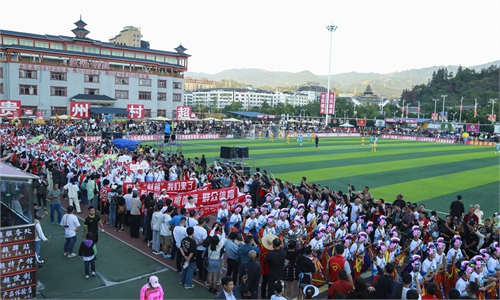
The third-ranked buzzword, "Suchao," the Chinese word short for the Jiangsu City Football League, refers to the regional football league launched on May 10. Since its debut, the league has quickly gained widespread popularity and become one of the hottest grassroots sports events in China in 2025.
The "Suchao" model has successfully combined regional culture with sports and tourism, inspiring imitation in multiple regions. It has become an innovative example of grassroots football development, showcasing the vitality and potential of China's mass sports events, and reflecting the achievements of the country's sports development strategy, according to the Yangtze Evening News.
The widely circulated expression "congcong rongrong, youren youyu; congcong mangmang, liangun daipa," or "taking things calmly and skillfully versus rushing and scrambling," also made the list.
The phrase originated from remarks made by a political figure of the Taiwan island, and was later adapted by a Chinese mainland musician into the viral song Good for Nothing, or Meichuxi in Chinese. The song quickly became an earworm across the internet and is often used to humorously highlight the gap between ideals and reality.
"Observing this year's Top Ten Buzzwords, one can see that they closely reflect the pulse of social life," Wang said.
According to Wang, these buzzwords not only record changes in economy, technology and culture but also reflect how ordinary people respond to daily life, seeking efficiency and enjoyment.
"Looking at the evolution of buzzwords over recent years, language has become an important window for observing the details of the era and understanding social change," he noted.
RELATED ARTICLES