ARTS / ART
Study traces ancient Xinjiang gold foils to early Eurasian trade routes
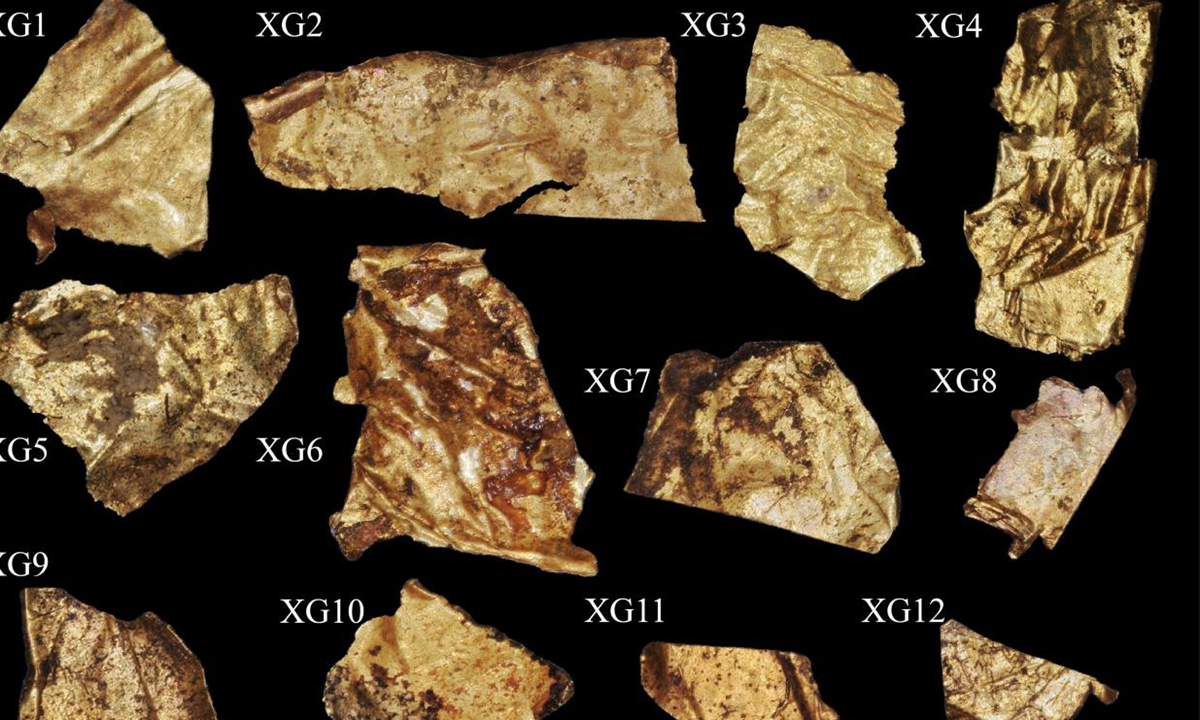
Artifacts of gold foil fragments Photo: Courtesy of Luo Wugan
A Chinese research team has used advanced scientific techniques to analyze foil artifacts dating to the 6th to 3rd centuries BC unearthed in Northwest China's Xinjiang Uygur Autonomous Region, revealing the hidden picture of raw-material circulation, craftsmanship characteristics, and cultural exchange behind these precious artifacts.
"This important scientific archaeological study not only represents a groundbreaking advance for Chinese scholarship in the provenance tracing of precious metals, but also provides key scientific evidence for understanding the early 'Golden Road' across the Eurasian continent," Luo Wugan, a professor at the University of Chinese Academy of Sciences (UCAS) and a member of the research team, told the Global Times on Wednesday.
The study, published in the journal Archaeological Research in Asia, examined 16 gold foil fragments. The artifacts were recovered from sites across Xinjiang, including Xinyuan county, Fuyun county and Qinghe county in the Altay prefecture.
The foils, originally used to decorate wooden horse gear, clothing and other objects, were extraordinarily thin, measuring only 40 to 50 micrometers. After more than two millennia, the organic materials have largely decayed, leaving crumpled sheets of precious metal behind.
The research team used scanning electron microscopy and laser ablation-inductively coupled plasma mass spectrometry, to analyze the surface morphology, elemental composition and lead isotope ratios.
Lead isotope analysis revealed distinct source regions: the Qiangkanhe gold likely originated from the Rudny Altai region in Russia, while the gold from Fuyun county and the Suodunbulake culture appears to derive from the Tianshan-Beishan region. These findings offer new insights into ancient gold craftsmanship, raw material procurement, and exchange networks within the Pazyryk culture and its neighboring groups, and lay the groundwork for further research into early Chinese gold artifacts, according to the paper.
High-precision observations show that the production of the foils was comparable to the techniques used in the Central Plains during the same period, suggesting possible technological exchange.
Remarkably, some foils from the Qiangkanhe site in Qinghe county contain exceptionally high endogenous mercury levels (some reaching up to 30 percent), ruling out artificial addition. Such high levels of naturally occurring mercury are extremely rare in published analyses of ancient gold artifacts worldwide.
The study marks a key step for China in provenance research on gold and other precious metals. In the past, research on early Chinese gold artifacts focused mainly on form, decoration and craftsmanship, with almost no systematic scientific investigation into the origins of their raw materials, according to a press release the UACS sent to the Global Times.
The paper's co-author Zhang Jie, a researcher at the Xinjiang Institute of Archaeology and Cultural Relics, said gold offers a unique lens for reconstructing prehistoric trade and social networks. He also noted that the study established an integrated approach combining morphological observation, elemental analysis and lead isotope tracing, providing a replicable analytical framework for future research into the origins and development of China's gold culture during the Xia, Shang and Zhou periods (2070BC-256BC).
According to Luo, future research will need to expand the sample range to sites in the Central Plains, the northern steppe and broader Central Asia, while building a more comprehensive geochemical database of major gold deposits across Eurasia.
"Only through larger-scale comparisons," he said, "can we more clearly map the dynamic network of the 'golden Silk Road' during prehistoric and early historic periods," Luo told the Global Times.
RELATED ARTICLES