ARTS / CULTURE & LEISURE
The ripple effect of cheering: from grassroots football stadiums to mass sports
Hearing the roar
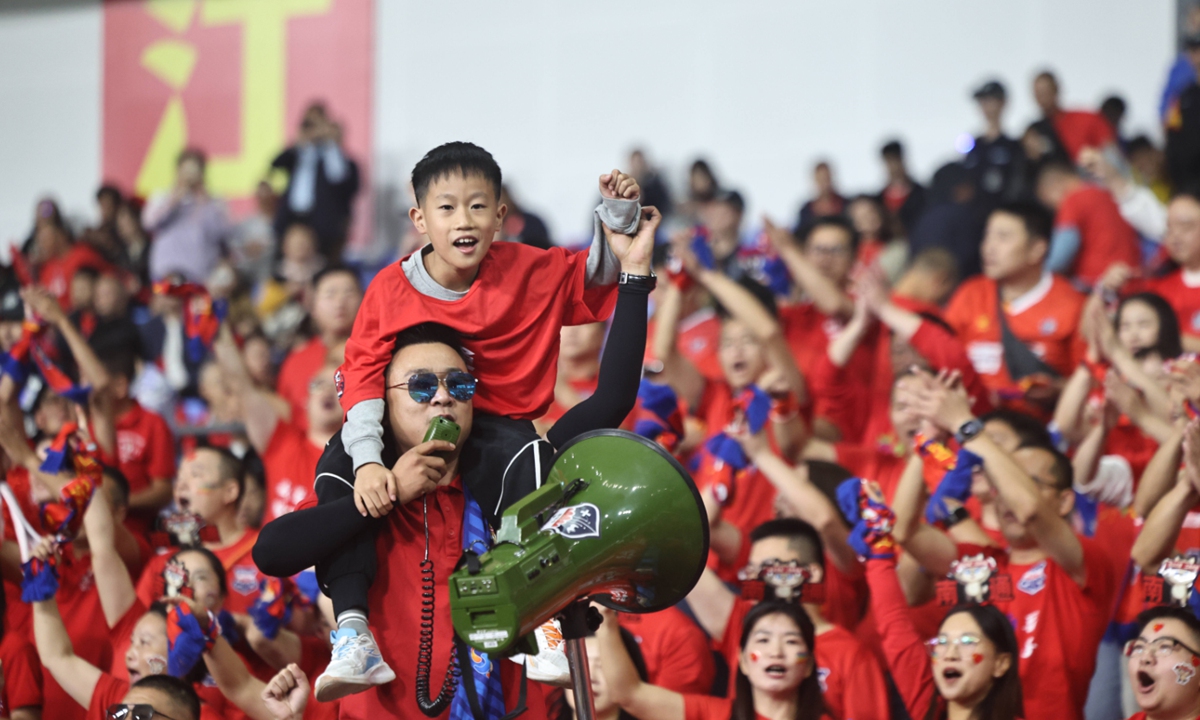
Supporters of the Nantong team cheer for their team during a Suchao match in Nantong, Jiangsu Province, on October 19, 2025. Photo: VCG
Editor's Note:Among the many descriptions of China seen from the outside, the country has gained an increasingly prominent image for itself in 2025 as a "cool" place to visit and live, as reflected in multiple global surveys and in foreign vloggers' videos and comments.
As the year draws to a close, we turn our gaze to the vibrant tapestry of China's new cultural forces - stories that have sparked surprises and pleasant experiences for both people living in the country and staying for a short visit, and even those who are only starting to get to know the true face of the country through online means - and explore why China has, seemingly in a short while, taken on a cool shape. To capture this dynamism, the Global Times is launching the "Cool China" series to approach the most iconic events and phenomena of the year through the five senses.
In this first installment let's hear the thunderous cheers from the pitches of the Jiangsu City Football League and the booming vitality of mass sports.
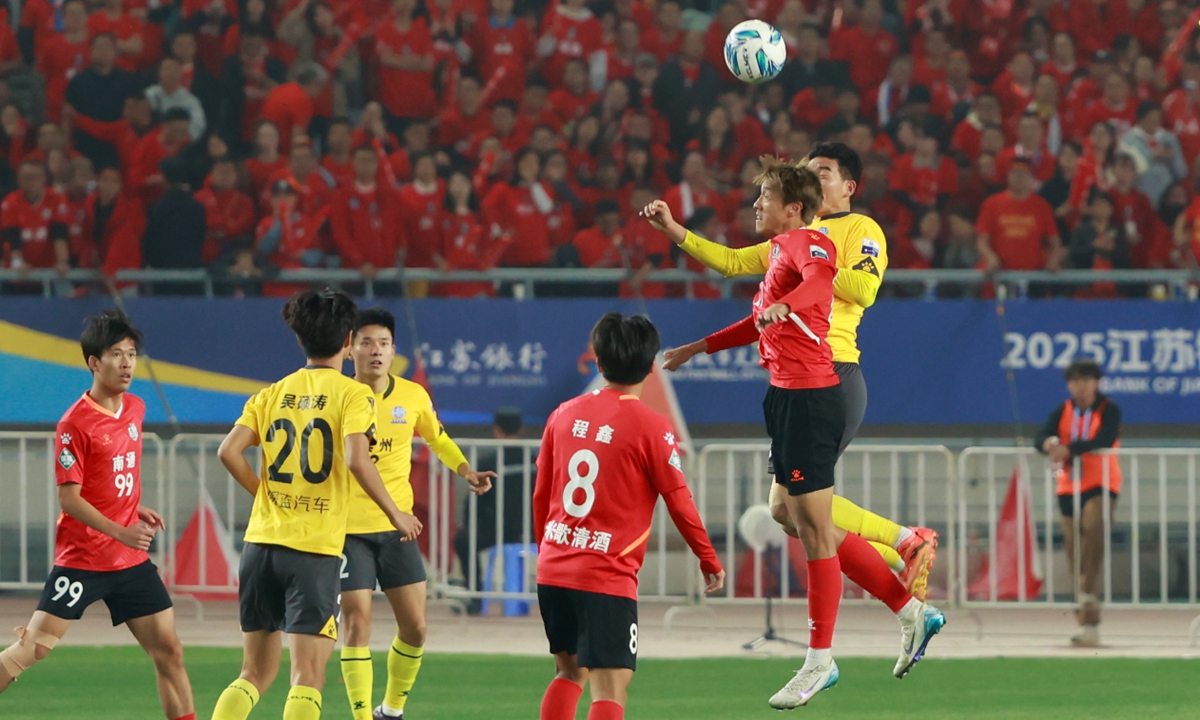
Players compete during the Suchao final match between Nantong and Taizhou in Nanjing, Jiangsu Province on November 1, 2025. Photo: VCG
Though it has been over a month since the final whistle was blown at the final of the Jiangsu City Football League, the impact of the league, more widely known as Suchao in China, still resonates across the country.Taizhou, whose city team won the maiden Suchao title on November 1 under the gaze of an audience of 62,329 people at the near-capacity Olympic Sports Center Stadium in Nanjing, East China's Jiangsu Province, has been experiencing the benefits of the win.
The Suchao trophy has since toured the city of Taizhou, attracting large crowds eager to take photos of it.
In an effort to further elevate local tourism, the authorities have now stepped up efforts to accelerate construction of high-speed infrastructure. Taizhou is currently the only city in Jiangsu without high-speed train services.
For Ju Li, a Nantong fan who watched her home team lose to Taizhou during the final, said Suchao has already changed her weekend routine.
"Technically I wasn't a football fan until this year. I used to go to a mall with friends on weekends, but this year I often went to the Nantong team's home games to chant with others and voice our support for the team," Ju told the Global Times.
Nantong supporters, ranging from office clerks, delivery drivers and students, waved banners and scarfs in their representative red color, while chants and drums dominated stadiums throughout the Suchao season.
"It is a pity that we failed to win the championship this year. But now Nantong has our own league, 'Tongchao,' to develop our squad depth for the next season. I am optimistic that we can do better next season," Ju said.
Behind the growing fan enthusiasm, Suchao's organizers said they did not expect such a rapid shift.
Wang Xiaowan, vice chief of the Jiangsu Football Association, which oversees the organization of Suchao, told the Global Times that they had not anticipated the league's explosive popularity in the beginning.
"Back in November 2024, there was a pilot football event between Nanjing and Suzhou that could later be seen as the prelude to Suchao. At the time we expected that the competition between the two pilot football cities would inspire other cities to develop football," Wang told the Global Times.
According to Wang, early planning of the Suchao tournament only required the host venues to have at least 2,000 seats. But by the second round, local hosts realized their venues were too small and had to switch to larger sports stadiums to accommodate the surging demand.
Riding on the provincial Suchao's momentum, county-level amateur leagues have emerged across Jiangsu. Provinces and municipalities including Hunan, Jiangxi, Sichuan and Chongqing have also launched their own regional leagues inspired by Suchao's success.
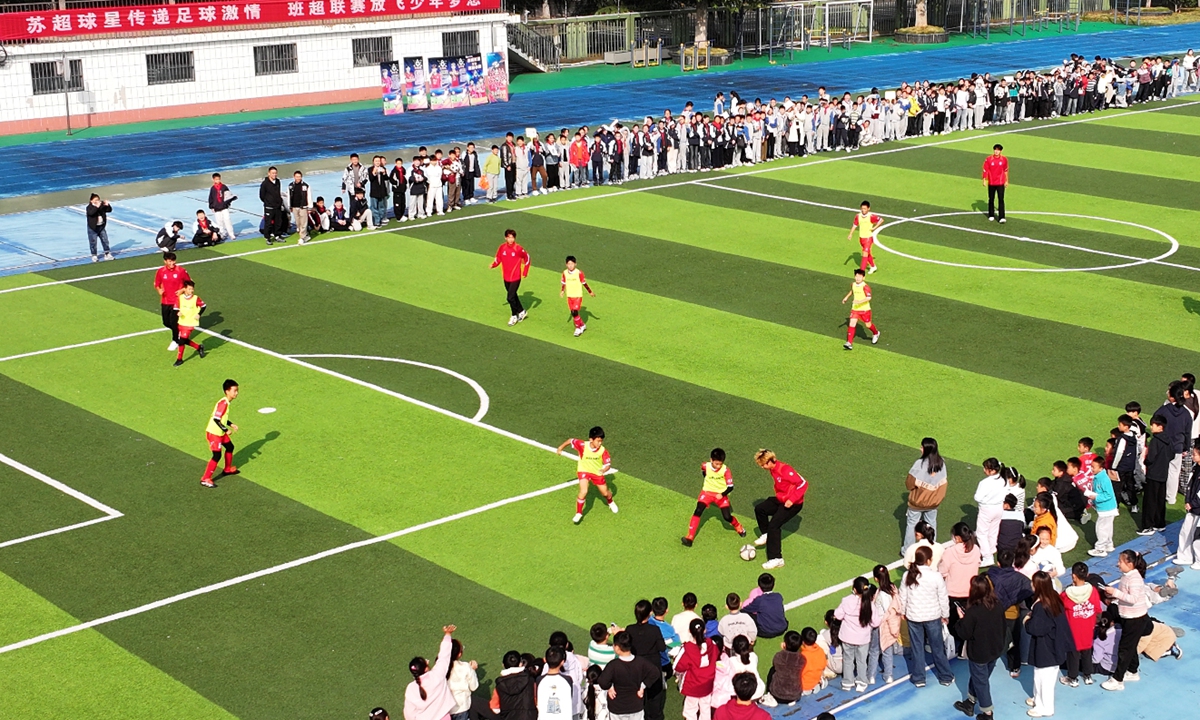
Players from Suchao's Huai'an team play football with primary school students on October 31, 2025. Photo: VCG
Nationwide phenomenonWhat started as a modest local experiment has grown into a nationwide phenomenon. A key innovation behind Suchao's rise is its model of linking match tickets with cultural and tourism resources.
A Suchao ticket stub often comes with discounts, and sometimes free entry, to major local attractions, creating a unique experience that blends football with tourism.
Liu Chang, a football enthusiast from Beijing who traveled to Nanjing to watch a Suchao match between Nanjing and Suzhou in July, told the Global Times that the match ticket offered many conveniences he had not expected.
"I always wanted to go to the Nanjing Museum, which is always fully booked so I hadn't visited. However, with the match ticket I could go to the museum without a booking on matchday," Liu recalled.
A typical Suchao ticket costs just 10 yuan ($1.4) and can also be used as a coupon for hotel stays and local dining.
According to statistics published on the Jiangsu provincial government website, tourist attractions across the province recorded 518 million visits during the Suchao period, generating 227.981 billion yuan in tourism consumption.
"Suchao's success shows that the fusion of watching games and tourism can turn a simple match into a full-blown cultural event," Zhang Bin, a Beijing-based sports commentator, told the Global Times.
"Even though Suchao tickets cost only a few yuan, the ripple effect for transportation, accommodation and dining have been far greater. It gives people affordable access to sports, brings stadiums back to life, revitalizes local economies and expands what 'sports' can mean."
Suchao is only one example of how sports events are reshaping public life across China. At the national level, major multi-sport events are following the same trend, transforming competitive platforms into inclusive, people-centered celebrations.
Deep integration
As "traveling for major sports events" becomes a new trend, this year's multi-sports events have also transformed their dividends into tangible benefits for the public, achieving deep integration between major events and improvements in people's livelihoods.
During the 15th National Games held in South China's Guangdong-Hong Kong-Macao Greater Bay Area in November, mass participation events across 23 major categories and 166 sub-events were organized and divided into competition and exhibition segments.
A total of 6,819 preliminary events, such as lion dance, dragon boat racing and Taijiquan, were held, with 16,556 athletes competing. Ultimately, 11,000 grassroots athletes advanced to the finals, boosting nationwide mass fitness, according to a report by the Guangdong Provincial Sports Bureau after the Games.
As China's sports vision broadens, the National Games has evolved from an elite event into an integrated celebration of sports, culture, tourism and regional cooperation.
The Chengdu World Games held in Southwest China's Sichuan Province in August propelled a comprehensive upgrade of the city's sports ecosystem.
A total of 130 "World Games Spaces" have popped up in neighborhoods across Chengdu, along with 77 newly built or renovated sports parks and 407 community fitness corners, making it easier for residents to take part in sports. All competition venues were opened to the public after the Chengdu World Games.
All purchased competition equipment is being allocated for training, youth talent development, public fitness programs, and the hosting of professional events, helping to support and advance the development of sports, according to the organizers of the Chengdu Games.
As of 2024, the total area of sports venues across China reached 4.23 billion square meters, an increase of 1.131 billion square meters compared with the end of the 13th Five-Year Plan period (2016-20).
China now has 3.71 million registered social sports instructors, and the share of people who exercise regularly has surpassed 38.5 percent, Gao Zhidan, director of the General Administration of Sport of China, said at an August press conference reviewing sports achievements during the 14th Five-Year Plan (2021-25).
One of the highlights of the achievements in the past five years is the rapid development of outdoor and winter sports across the country, Luo Le, a sports scholar at Beijing University of Chemical Technology, told the Global Times.
As of April, China had more than 400 million outdoor sports participants, making the sector a key driver of the sports economy, according to the China Outdoor Sports Industry Development Report released at the 2025 China Outdoor Sports Industry Conference in Dali, Southwest China's Yunnan Province.
The overall economic and social development of the country, the hosting of high-level international sporting events, and favorable government policies have all fueled the rapid growth of outdoor sports, Luo noted.
In terms of popular activities, participation is highest in ice and snow sports, mountain sports, and water-based activities, while marathons, cycling, triathlons, skiing, and rafting attract particularly strong attention, according to the report.
"The total scale of China's sports industry has grown at an average annual rate of over 10 percent in the past five years," said Yang Xuedong, head of the sports economy bureau at the General Administration of Sport, adding that China's ice and snow industry has grown from 381.1 billion yuan in 2020 to 970 billion yuan in 2024, the Xinhua News Agency reported in August.
The International University Sports Federation (FISU) announced in November that Changchun, capital of Northeast China's Jilin Province, will host the 33rd FISU Winter World University Games in 2027.
The continued hosting of major international sporting events, along with the vibrant growth of grassroots competitions across the country, will surely inject renewed momentum into China's journey toward becoming a global sporting powerhouse.
RELATED ARTICLES