ARTS / ART
Exploring tasty delights, living heritage of China’s rural markets in winter
Stories behind the steam
By Published: Dec 10, 2025 11:09 PM

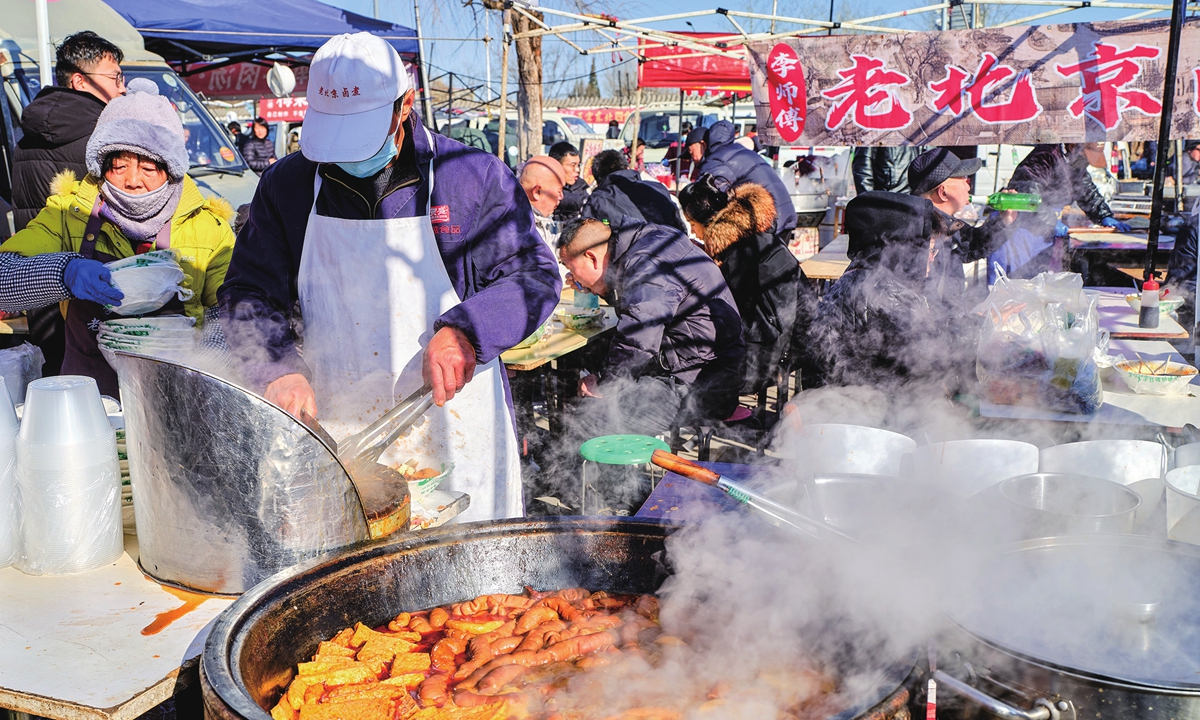
A cook prepares food at a stall at the Sunday Shahe Market in the Changping district of Beijing, one of the capital's largest open-air markets. Photos: VCG
At six in the morning, before the break of dawn, the aroma of food is already wafting through Caowa Market in Linyi, East China's Shandong Province. In an iron wok, pan-fried buns sizzle in the bubbling oil, their golden crusts covered in tiny blisters. Bite into one, and the hot, juicy filling makes visitors wince with the heat, but they cannot bear to let go. In the winter chill, steam rises from the stalls and drifts among the crowds.This is just one corner of Caowa Market as recently captured by video bloggers on Chinese social media platforms. Each time it opens, this rural market draws over 100,000 people, with visitors from East China's Jiangsu and Anhui provinces driving three hours across provinces to go shopping here. Online, over 400 million people have tuned in to "go to the market" virtually. Even travel agencies have caught on, launching one-day market tours as a new trend, with early-morning market visits by coach bus quickly becoming popular.
And it's not just in Shandong. Rural markets around Beijing - Shahe Market, Lishuiqiao Market, Erdaobaihe Market at the foot of Changbai Mountains - and Shiqiao Village Market in Xianning, Central China's Hubei Province, have all made it onto the weekend must-visit list for many young people.
Meng Yu, who lives in Beijing, sets an early alarm on weekends, bundles up in her down jacket, and heads out to stroll through Shahe Market.
"The earlier you go, the fresher and more diverse the goods are. I see vegetables with dirt still clinging to their roots, and I like brushing the soil off with my own hands - it just feels authentic," she told the Global Times.
"People's lifestyles are themselves an important part of tourism. The renewed popularity of going to rural markets reflects a nostalgia for the past and can serve as a supplement to traditional forms of tourism," Liu Simin, a research fellow at the Tourism Research Center of the Chinese Academy of Social Sciences, told the Global Times.
Warmth of winter market
Just inside the entrance to Shahe Market, Meng was stopped in her tracks by a stall making fresh whole-grain pancakes. The vendor scooped a ladle of batter and quickly spread it across a hot griddle; the paper-thin pancake formed in an instant. A farm egg was cracked on top, then sprinkled with green onion and pickled vegetables.
Many visitors come with family in tow, pulling small carts as they weave between stalls. They linger over fresh produce and daily necessities, carefully picking out what their family will need in the coming days. The sounds of bargaining blend with the calls of vendors and the clucks of live poultry, creating a bustling, lively scene.
The goods on offer are diverse and full of vitality. Homemade smoked sausages hang in front of the farmer's stall, glistening with oil, perfectly marbled with fat and lean. The vendor cuts off a piece for visitors to sample - savory, sweet, and aromatic. There is fresh sheep's milk, too, steaming in glass jars and fragrant to the taste.
The dried goods and spice stalls are the most aromatic. Star anise, cinnamon, and bay leaves are piled high in glossy brown mounds, with the vendor blending spices to order for stewing meat. Home-pickled radish and mustard greens are packed in coarse ceramic jars, crisp and fresh. There are also dried daylilies, white fungus, and wood ear mushrooms, perfect for soups and stews - nature's own umami.
"After spending so much time in an office, hearing the shouts of vendors and smelling the earth and food makes me feel completely relaxed," said Wan Fang from Wuhan, Hubei Province. For her, a weekend trip to a rural market has become a secret weapon for unwinding.
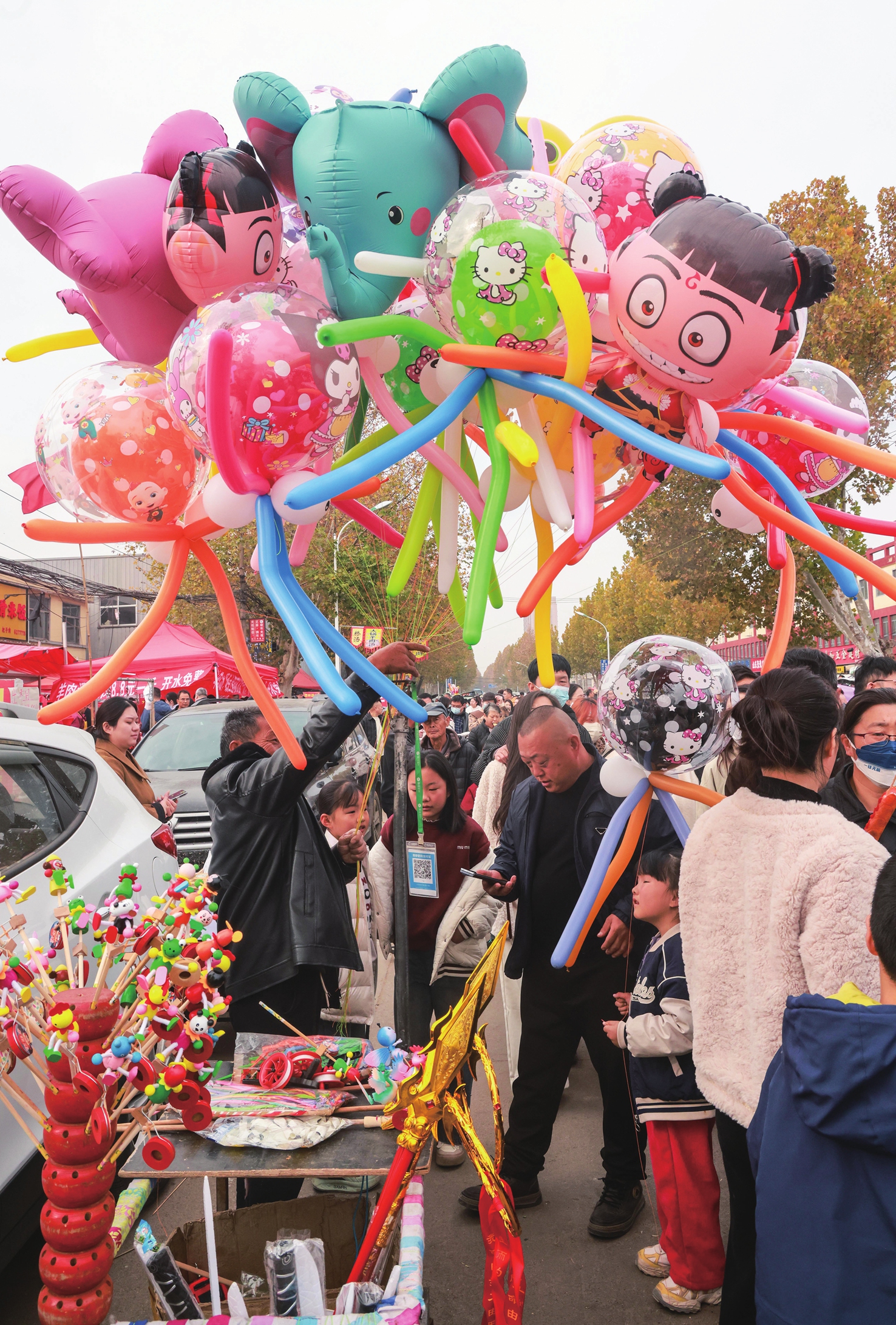
People explore Caowa Market in Linshu county, Linyi, East China's Shandong Province, on November 23, 2025.
Mobile 'folk museum'Beyond the lively atmosphere, rural markets are like "folk museums" visitors can take part in and take home.
In front of the intangible cultural heritage stalls, the 1,400-year-old craft of willow weaving dazzles the eye - willow branches twist and turn between the artisan's fingers, transforming in moments into flower baskets and storage bins.
Behind the screen of a Lunan shadow puppet booth, a puppeteer brings the story of the Monkey King Subdues White-Bone Demon, a well-known work based on the Chinese classic Journey to the West, to life, earning bursts of applause. These old crafts are thriving at the market.
Wearing the traditional clothing of the Uygur ethnic group, 63-year-old Li Yulan awaited her turn to perform on stage with her troupe from the Mori Kazak autonomous county in Northwest China's Xinjiang Uygur Autonomous Region for visitors from across China.
"While we perform on stage, traditional winter sports events from ethnic groups such as the Kazak and Uygur groups, including horse racing and guniangzhui (lit: girl chasing game) are also taking place. This increases visitors' interest in Xinjiang's ice and snow culture, which is enriched by the unique characteristics of its diverse ethnic groups," Li told the Global Times.
"Markets like Caowa, rich in culture and history, are especially attractive for visitors seeking authentic experiences. With their scale and variety, these markets are like bustling temple fairs - ideal places for locals to relive old memories and for outsiders to explore the region's genuine way of life," Liu noted.
As the sun sets, market-goers head home with their haul: fresh vegetables and snacks in their hands, willow baskets in their bags. From Linyi to Beijing, from the Changbai Mountains to Xinjiang, these vibrant rural markets demonstrate in the simplest way that the beauty of life is found in the warmth of steam rising from food, and in the richness and familiarity of the countryside.
RELATED ARTICLES