ARTS / CULTURE & LEISURE
Cervantes Institute in Beijing: Fostering civilizations’ mutual learning
Director sees potential in literary dialogue
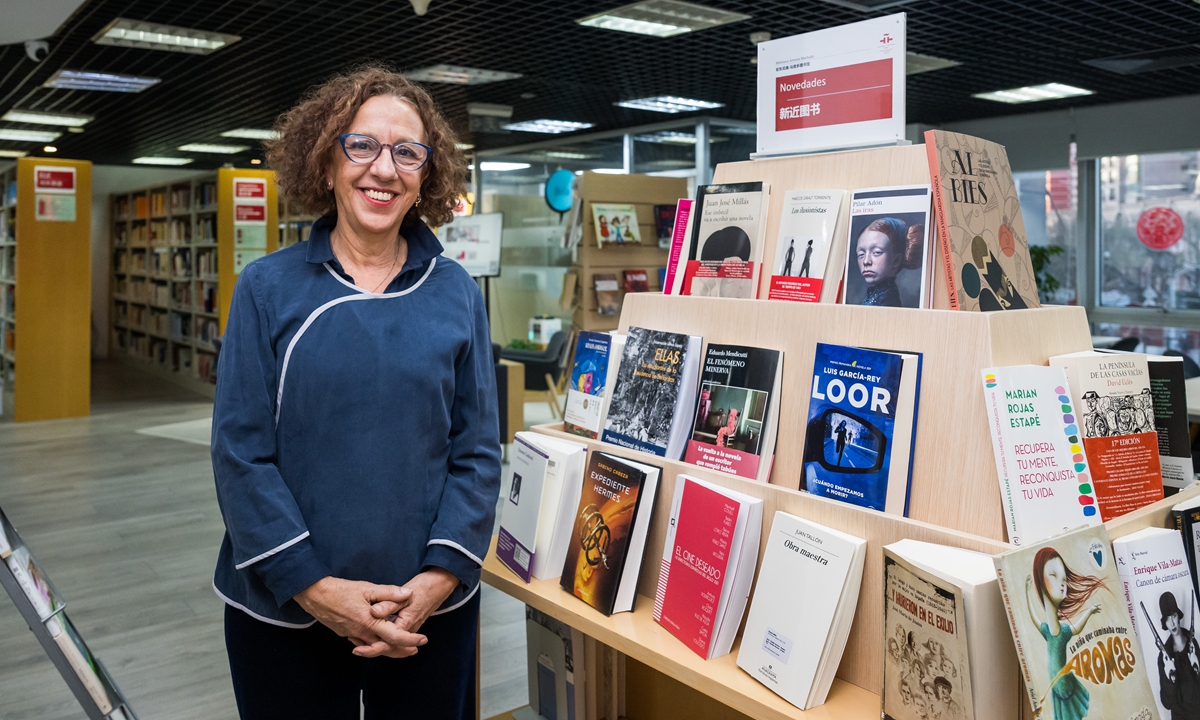
Isabel Cervera, director of the Cervantes Institute in Beijing Photo: Chen Tao/GT
On the occasion of King Felipe VI of Spain and his wife Queen Letizia's recent state visit to China, the Cervantes Institute organized a poetry-themed event dedicated to the poets Antonio Machado, an outstanding Spanish poet, and Xue Tao, one of "the four great female poets of the Tang Dynasty," in Chengdu, capital of Southwest China's Sichuan Province.Isabel Cervera, director of the Cervantes Institute in Beijing, gave a speech about the poet Machado. Of course, such a cultural exchange event is one in a slew of remarkable sessions the Cervantes Institute in Beijing hosts or jointly organizes. In an exclusive interview, Cervera told the Global Times that all these cultural events are aimed at building a bridge between China and Spain not only because we stand for the two cultures, but also because we live in a world, where we share the same ideas, feelings, and even problems.
In her view, everyone is a citizen of the world.
"That's why we need to share answers and solutions to these shared questions. With our cultural activities, we tried to let the participants realize there is no 'other'; we are one and we share one world," she said.
The shared challenges for the future generations could be sustainability, global peace, and cooperation.
From her own experience, after learning more about Chinese culture, she has gained more perspectives.
"I always realize that because I study Chinese and Chinese culture, now I know more about my own culture, because I have two points of view - mine and the other's. When I am here in China, I see my country in another way," Cervera elaborated.
Throughout history, books have been an important medium for disseminating knowledge and conducting exchanges between civilizations. Cervera told the Global Times that from her observation, one of the key challenges could be a limited talents pool.
As there is still space for growth in literary translation between Chinese and Spanish, given the two cultures' profound literary heritages.
However, Cervera finds that good interpreters and translators are limited in both China and Spain. Young people, especially students in universities, are unwilling to view translation as a promising career.
Analyzing the reason, she said that low pay could be one of the factors and translators' works have not gained enough recognition. Take published books for example.
"The translator's name is either printed in a smaller font, or relegated to the back cover of the books even if their role is very important," she stressed.
In some people's opinion, with AI technology emerging, it is possible to utilize AI to replace translators. However, Cervera does not think it is possible.
"Because to translate, you need to know a lot, including deep knowledge of the other culture of the writer or film director.
Translation is not only a technical issue, but also a very cultural, very personal issue. Suppose I selected a word, there is a reason behind the wording, but the digital translator won't understand that reason," she explained.
How can more people be encouraged to contribute to book translation or language interpretation? Cervera said that some programs need to be designed to support writers, editors, and translators.
"I think our countries should design programs such as national or international laurels between the Spanish and Chinese language to foster translation talents," she said.
When asked to name Spanish writers, Chinese readers might know writers such as Gabriel Garcia Marquez because his works are also in Spanish. They might say Don Quixote but they don't say Miguel de Cervantes.
"Talk is too easy. Many parties including publishing houses, education institutions, and writers' associations need to work together to walk the talk," she added.
Implementing a campaign at its headquarters, as a backdrop for cultural exchange and mutual learning of civilizations, the Cervantes Institute in Beijing has invited diplomats from the American and Latin American embassies in China to recommend three Spanish-language books each in a video clip - a quick 10-minute participation - to enrich the library's diverse collection and offer readers insights into diverse cultures.
Cervera assumed her role in 2020. Looking back, she said that the past five years have witnessed the Cervantes Institute in Beijing's adaption of new technologies for language teaching, as well as for dissemination and communication, changing strategy and enriching the collection in library activities. So far, the library has attracted readers of all ages.
"We have been able to showcase the works of young directors from Spain and Latin American countries, and we have been able to work on historical themes. We have also favored the works of translation through the interpretation of films, not because at the Cervantes Institute we teach language, but rather because we teach language through culture, linking language and culture," said Cervera.
Cervera first traveled to China in 1984. Over the past five years, she has enjoyed Chinese food such as Peking Duck and wonton or huntun, as well as traditional Chinese festivals such as the Mid-Autumn Festival and Dragon Boat Festival, which have impressed her.
RELATED ARTICLES