SPORT / FEATURE
Tech rewrites rules of accessibility at Para-Special Games
Opening up new possibilities
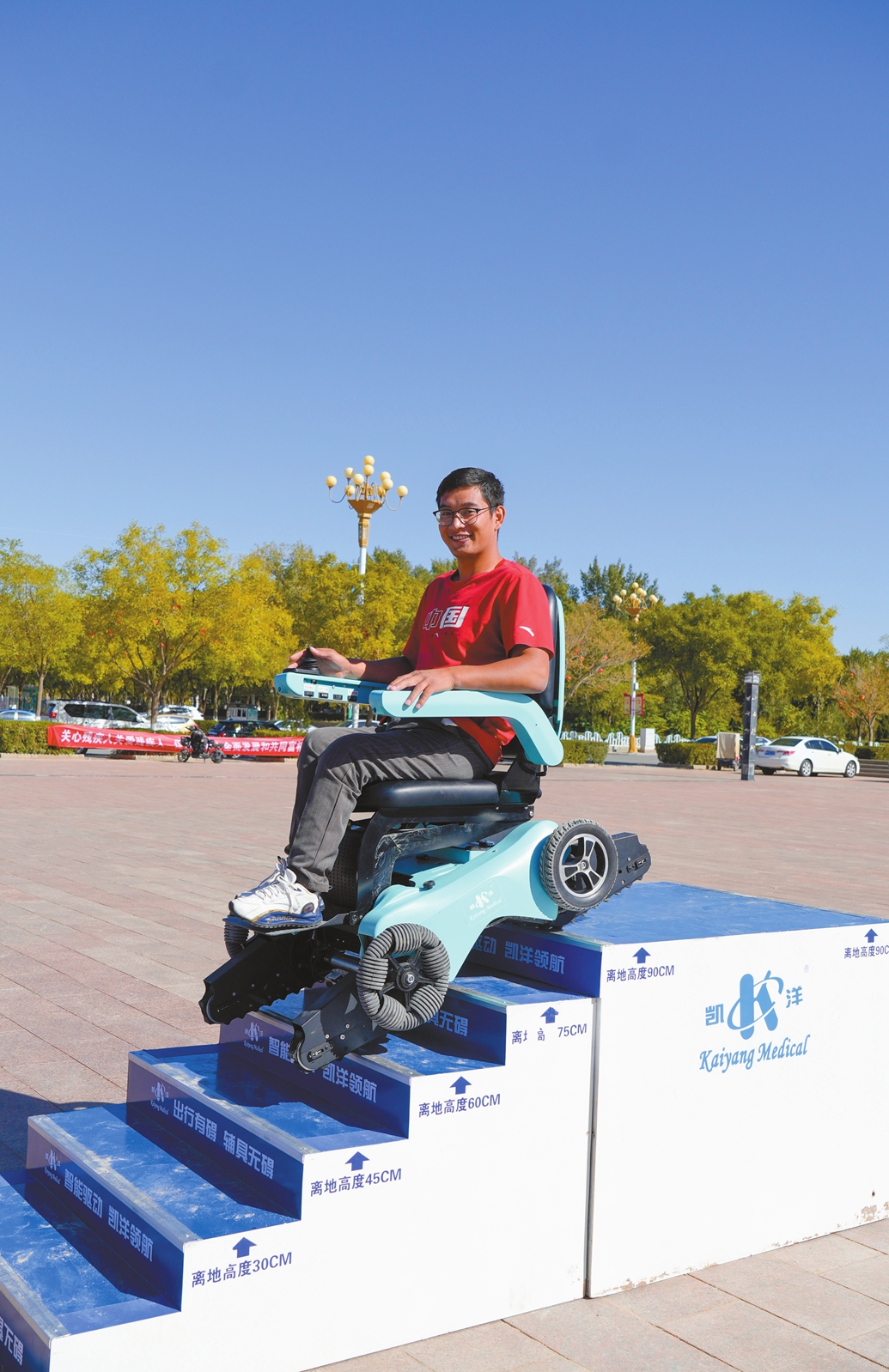
A volunteer tries out an intelligent wheelchair equipped with tank-like tracks. Photo: Courtesy of Liu Yi'an
On a cool morning at the Para-Special Olympics venue in Guangzhou, South China's Guangdong Province, spectators gathered around an unlikely celebrity: a six-legged robotic dog. The machine paced methodically along the edge of the javelin field, waiting for the next throw.When an athlete completed an attempt, the robot trotted forward, retrieved the javelin with a soft mechanical grip, and carried it back, steady and precise, almost gentle. It was a small gesture of support in a stadium filled with human grit, but it hinted at something larger: the subtle, transformative ways technology is beginning to stand beside people with disabilities, not as a spectacle but as a partner.
"It can lead athletes to venue entrances, rest areas, classification zones, even the assistive device center," Zhang Peng, a staff member with the Guangzhou organizing committee, told the Global Times on Wednesday. During breaks, it escorts athletes who need repairs for their equipment; in the evenings, it leads hotel guests back to their rooms like a dutiful metal attendant. "Compared with a biological guide dog, it should be more convenient, more affordable, and is equipped with radar coverage to reliably avoid obstacles," Zhang said.
The world has long talked about "assistive devices" in the dry language of medical necessity. Yet at this year's three-region Para-Special Games, the tools on display felt less like equipment and more like collaborators, extensions of athletes' confidence, dignity, and ease. It was a scene that the organizing committee said suggests a future in which assistive technology is not merely clever but companionable, an unspoken gesture toward dignity.
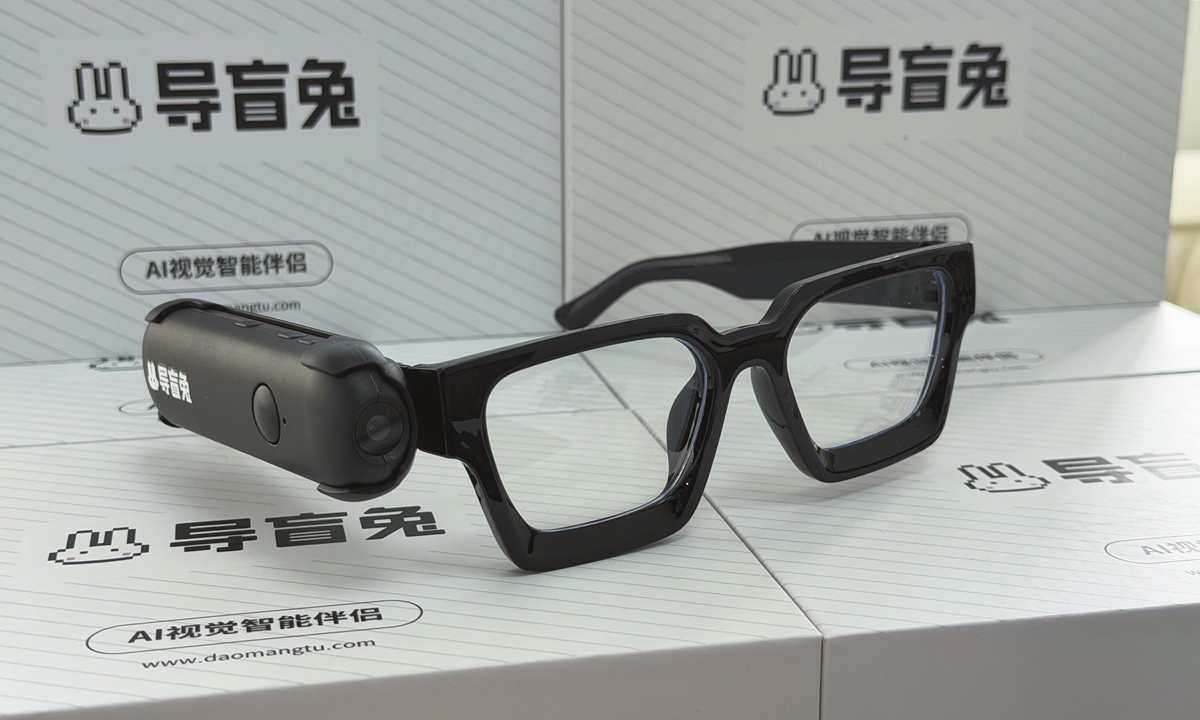
AI glasses for visually impaired athletes Photo: Courtesy of Bai Rui
Techs that reads, listens, and learnsAt the athletes' service and repair station, a Hebei athlete arrived with a concern familiar to anyone who uses a prosthetic limb: something didn't feel right. His prosthetic seemed a bit too short, the knee joint was loose. Technician Wang Kaipeng understood the issue intimately not because of his skills but as a user of a smart prosthesis. Within minutes, they had rebuilt the smart prosthesis leg until the alignment matched Wang's stride perfectly.
A circle of hands worked to ensure that the prosthesis, essentially a piece of wearable engineering, felt more like part of a body part that belongs wholly to its owner.
This is not the only example of intelligent assistive devices for mobility impairments. Elsewhere at the Games, another machine was drawing crowds: a wheelchair with tank-like tracks that allowed it to scale steps most athletes know too well as barriers.
"A regular electric wheelchair can't go over curbs or a couple of steps," Liu Yi'an, the wheelchair's lead developer from Foshan, South China's Guangdong Province, told the Global Times. "You have to take a long detour or simply give up. This one switches into a tracked mode. It can handle complex terrain and climb single steps up to 26 centimeters high, ascend approximately 1,120 steps in total, and travel up to 35 kilometers on flat ground."
Zhang Mengyu, a decathlete with physical disabilities from the Beijing team, told the Global Times after trying the smart wheelchair that it "opened up new possibilities for reducing his future training costs."
"It can climb stairs with its caterpillar tracks, handle gentle slopes, and even assist with lifting my legs," he said. "I think it will be immensely helpful for both my training and daily travel."
For athletes with intellectual disabilities, there is another variation of the smart wheelchair: the brain-controlled electric wheelchair. At the track-side service station and in the hotel where basketball players stay, athletes and visitors lined up to try a device that responds to brainwaves, eye signals, and tiny head motions.
Its lead developer, He Guanfeng, told the Global Times that the brain-controlled wheelchair offers a new way of moving. "You don't need your hands at all, you can move forward, backward, turn, even enter elevators or restrooms," said the engineer behind the project. While Stephen Hawking relied primarily on eye-tracking technology, these wheelchairs use a hybrid system, making them operable in minutes rather than weeks.
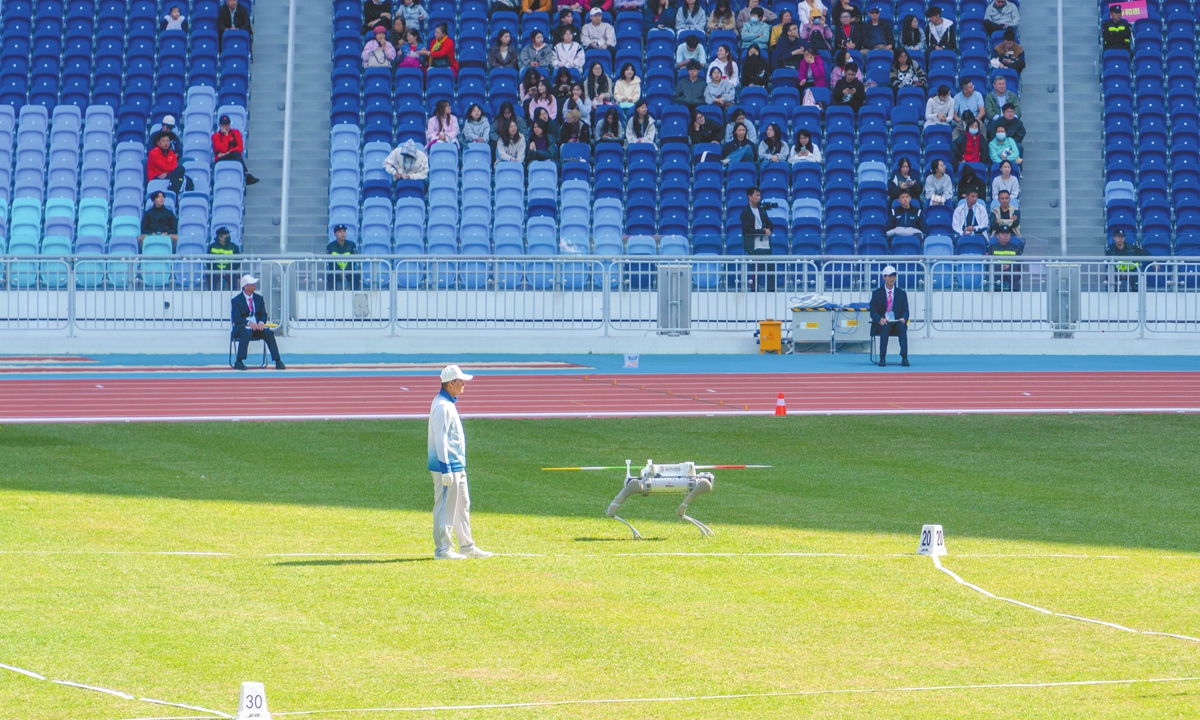
A robot dog serves as a "mechanical volunteer" responsible for retrieving thrown equipment in a track and field event during the games in Guangzhou, South China's Guangdong Province, on December 9, 2025. Photo: VCG
AI for accessibilityWhen these technologies are showcased at Para-Special Olympics venues, people inevitably wonder how much they can truly help people with disabilities in their daily lives.
According to public data from the Guangdong Provincial Disabled Persons' Federation, 204,552 people with disabilities have received assistive device services since the start of the 14th Five-Year Plan (2021-25), with the rates of basic rehabilitation services and assistive-device provisions reaching 99.46 percent and 99.75 percent, respectively.
"Technology is essential to the modernization of disability services," said Zhou Changkui, chairman of the China Disabled Persons' Federation.
However, companies developing these products say they are working hard to figure out how to lower costs so that more people can access the technology.
Most of the orders so far come from care institutions, not individuals, and the price, Liu admits, is still high. But a more affordable version, "40 percent cheaper but still meeting essential needs," is scheduled for release next month. If the six-legged robot hints at a future of guided independence, the stair-climbing wheelchair promises something more fundamental: freedom of movement across the uneven surfaces of ordinary life.
On this point, tech blogger and developer Bai Rui, who also collaborated on AI glasses for visually impaired users at the Para-Special Olympics, spoke from personal experience. The pair of AI glasses he invented has a small camera at the front and a button on the right temple. Press it, and the world begins narrating itself.
"It tells you what shops are nearby, finds a product on a shelf, reads the price, the name, the characteristics. Bus stops, subway signs - anything with text becomes accessible," said Bai.
He speaks of designing an independent system with less expense and better accessibility for the average disabled person. "No smartphone tethering, no complicated setup. Just a button. "It's used by disability federations and organizations, and for many people, it becomes part of their daily map of the world."
Bai also sees the inclusion of his AI glasses in the Para-Special Olympics experience as a valuable source of data. He hopes that wider use will generate more feedback to refine the AI models, break through remaining technical barriers, and ultimately make the glasses more affordable.
Encouragingly, these technologies are not without real-world adoption. Joyce, who oversees the Kai Tak Sports Park in the Hong Kong competition zone, told the Global Times that the venue uses digital dynamic Braille and tactile floor maps to guide visitors with visual impairments. During the Games, these services have assisted more than 100 people, she said, underscoring the strong momentum behind technology's role in empowering athletes and spectators with disabilities.
"Despite the high costs, accessible facilities across the venues are being rapidly developed, and assistive technologies are increasingly being deployed," Zhou told the Global Times. "Ensuring that people with disabilities share in technological progress should be a new global principle."
RELATED ARTICLES