ARTS / CULTURE & LEISURE
No longer a sideshow: China’s AAA action games command global attention
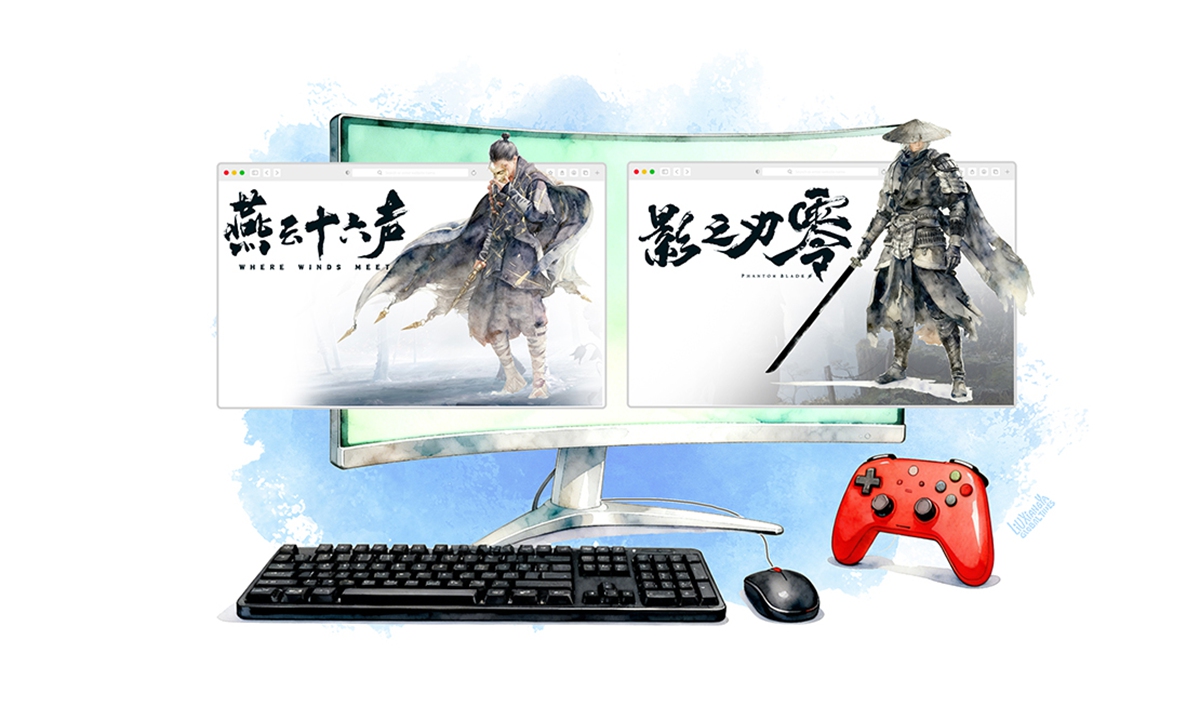
Illustration: Liu Xiangya/GT
Phantom Blade Zero, the latest Chinese AAA action game, debuted on Thursday at The Game Awards (TGA), an annual show in the video game industry similar to the Oscars, and it quickly drew international attention. By Monday, its newest trailer had surpassed 3.7 million views on YouTube, making it one of the most talked-about Chinese games recently.Phantom Blade Zero is a fusion of classic Wuxia ("martial arts chivalry" or "heroes" in Chinese) storytelling and exhilarating action. In the game, the player controls Soul, a warrior with only 66 days left to live, to fend off assassins, unravel world-ending conspiracies, and defend his values with his life.
Following Black Myth: Wukong, Chinese games are steadily building influence overseas, no longer just a fleeting "viral" phenomenon.
AAA games, typically defined as requiring a lot of money, a lot of time and a lot of resources, are high-cost, high-quality, large-scale single-player titles.
In the trailer's comment section, many overseas players shared concrete and direct feedback. Rodrigues, a gamer from Portugal, said he had played a one-hour demo of Phantom Blade Zero at Gamescom, one of the world's largest trade fairs for computer and video games annually held in Cologne, Germany, and found it "so good that I queued twice."
"Combat is fast-paced but always controlled; the parry/dodge system is incredibly fluid, and the animations are like a martial arts movie," he commented. "Enemies are incredibly cinematic, and they have some metal music mixing at some parts which makes the game look and sound unbelievably cool. Hype is deserved."
This attention is not limited to a single title.
Previously, another Chinese action game, Where Winds Meet, saw over 500,000 overseas players within just 40 minutes of the release. The free-to-play game reached the Top 5 on the world biggest gaming platform Steam's global "Most Played" list, peaking at over 140,000 concurrent players, and ranking second on Twitch's live-viewing charts.
Observers generally agree that the sustained success of Chinese games stems first from their overall maturity in gameplay and game development.
"Chinese developers have accumulated substantial experience in fast-paced action gameplay," Liu Mengfei, a gaming industry analyst at Beijing Normal University and former vice-chair of the Digital Games Research Association, told the Global Times. "From control feedback and combat rhythm to overall visual and audio polish, these games have reached international mainstream standards, which is immediately apparent to overseas players."
Liu said in the past, Chinese studios primarily excelled in consumer-oriented or turn-based games, but today some teams can treat a game as a complete, self-contained work rather than just a continuously monetized product. This capability is a crucial foundation for why Chinese games are now taken seriously overseas.
On this basis, industrial maturity not only ensures high playability and quality but also provides a solid foundation for naturally integrating cultural elements.
"This generation of games does not treat 'cultural dissemination' as a task that must be emphasized or explained. Instead, culture is seamlessly woven into gameplay and world building, allowing players to understand and discover it organically during the play, and to explore it further driven by their own curiosity," Li Chen, a gaming industry analyst based in Beijing, told the Global Times. "This approach is more intuitive and effective for cross-cultural acceptance."
Yet despite strong player enthusiasm, Where Winds Meet received relatively conservative scores from some Western media outlets. Global gaming outlet IGN gave its international release a 6 out of 10, describing it as a theme park overloaded with attractions, each running at half speed.
The review immediately sparked backlash from players. Streamer Asmongold, who has over 7 million followers, responded, "Don't listen to this! Game as an 8 or 9 and it's free."
His comment quickly garnered more than 30,000 likes, with countless fans echoing his sentiment in the comments noting that the arrogance of media critics is increasingly disconnected from the players' real experiences.
"Differences in reception between players and some Western media outlets are not only simply a matter of whether the game is fun," Liu Mengfei notes. "They reflect differing evaluative perspectives and understanding."
Some Western outlets still rely on familiar narrative frameworks and evaluation metrics when judging Chinese martial arts chivalry stories, often struggling to fully understand core elements such as qinggong (lightness skills), dianxue (pressure-point strikes), or the intricacies of Jianghu social order.
However, Where Winds Meet is not without flaws. According to Liu, while the first 20 hours of gameplay are relatively well crafted and engaging, some of the later content leans toward more monetization-oriented design, which undermines the game's purity as a "full-fledged work" and might contribute to the lower evaluations.
"This incomplete positioning amplifies the divergence in media reviews - it's neither a fully expression-driven work nor entirely aligned with mature, consumption-focused game logic," Liu said.
This gap in evaluation would reflects both the limitations of Western media in understanding Chinese culture in a game and the areas where domestic developers still need to pursue a more resolute, purer approach to "work of art" game design.
Today, Chinese action games are evolving from being "cultural curiosities under observation" to "globally respected products."
Ultimately, what will define the future standing of the Chinese games is not a series of one-off hits, but whether the industry can consistently produce works that are worth serious attention and sustained discussion. Chinese games are steadily moving forward on this path.
The author is a reporter with the Global Times. life@globaltimes.com.cn
RELATED ARTICLES