ARTS / CULTURE & LEISURE
Dinosaur egg, rib bone fossils found for first time in Hefei Basin
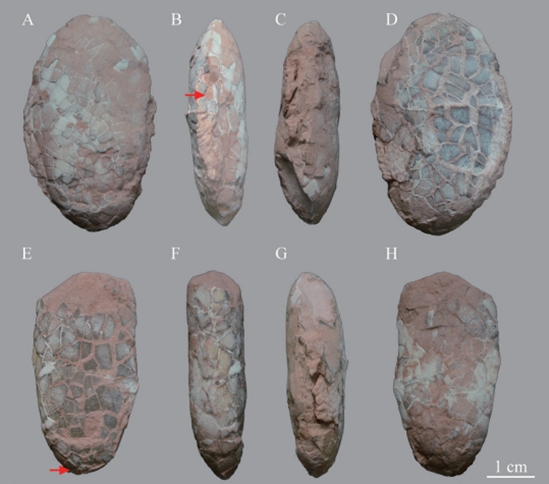
Photo: Courtesy of Anhui Geological Museum
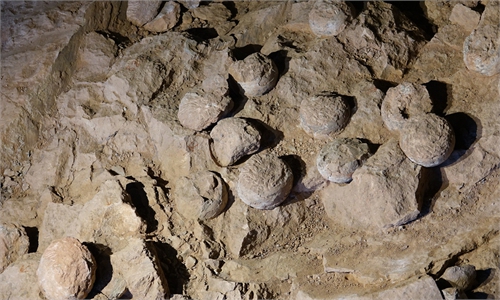
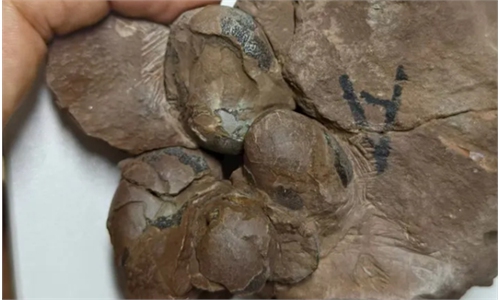
Accidentally unearthed during a water diversion project, two dinosaur egg fossils and a small section of dinosaur rib bone have been discovered in Hefei, East China's Anhui Province. Prior to this discovery, no dinosaur eggs or skeletal fossils had ever been discovered in the Hefei Basin.The Hefei Basin is located in the central part of Anhui. It is a large, nearly rectangular-shaped Meso-Cenozoic continental basin. The dinosaur discoveries made at the basin were recently made public via a report published in the academic journal Vertebrata PalAsiatica.
As a key writer to the report, also the discoverer of the fossils, Mao Lei revealed to the Global Times that the dinosaur eggs "most likely belonged to a small type of theropod dinosaur."
Mao is a researcher with the Anhui Geological Museum, where these fossils are currently housed for further analysis.
Around 18 and 17 centimeters respectively, the two fossil eggs were preserved in relatively complete shape. However, they show severe compression and significant erosion on both their inner and outer surfaces. The appearance of the eggshells displays a unique linearituberculate pattern, looking like tiny bumps lined up in rows.
"This ornamentation is so distinctive in appearance. We were surprised when we first saw them," Mao noted while also adding that the eggshell is less than one millimeter thick.
These egg fossils were discovered in a Late Cretaceous stratum dating back 65 to 100 million years ago. They belonged to the family known as "Elongatoolithidae," a specific group of elongated dinosaur eggs.
This type of egg shape has previously been found in areas such as the Hunan and Jiangxi provinces south of the Yangtze River. But the dinosaur eggs found in Hefei Basin mark the first such discovery made in the central Anhui area north of the Yangtze River.
"The discovery expanded the paleogeographic range of elongated dinosaur eggs. It also provides clues for studying the evolution and dispersal of this dinosaur egg group during the Late Cretaceous," Mao noted.
Along with the egg fossils, a segment of dinosaur bone approximately 10 centimeter long was also discovered. Slightly curved and flattened, this bone fragment narrows at the dorsal end and widens ventrally. It most likely represents the mid-to-proximal portion of a rib.
Although the research findings were announced recently, these dinosaur remains were discovered back in July 2020. At the time, a local water diversion project was under way, aiming to alleviate water shortages in northern Anhui Province and eastern Henan Province by implementing a dual-route scheme to divert water from the Yangtze River. These fossils were unearthed at a depth of 43 meters during the excavation of a water diversion channel. Researchers immediately rescued the specimens.
"These fossils reveal that the Anhui has not yet fully discovered its dinosaur heritage resources. It also laid a foundation for comparative studies on fossils in the future," said Mao.
Compared to provinces rich in dinosaur remains such as Sichuan and Jiangxi, the dinosaur resources in Anhui may be less renowned but are equally precious and distinctive. The southern Anhui region is one of China's key areas for dinosaur fossils.
Among these, the fossil of the dinosaur Wannanosaurus yansiensis is recognized as one of the smallest known ornithischian dinosaurs, with adult individuals measuring around than one meter in length. The fossil also represents the earliest and only uncontested pachycephalosaur fossil discovered in China.
"The research and discovery of dinosaurs is not just a job for professionals. We also hope that the public can provide more clues about fossils," Mao said. "We will enthusiastically dispatch experts to investigate and look forward to more exciting fossil discoveries in Anhui [Province]."
RELATED ARTICLES