Inbound tourism boom hits Chinese ports on first anniversary of 240-hour visa-free transit
By Published: Dec 17, 2025 10:14 PM


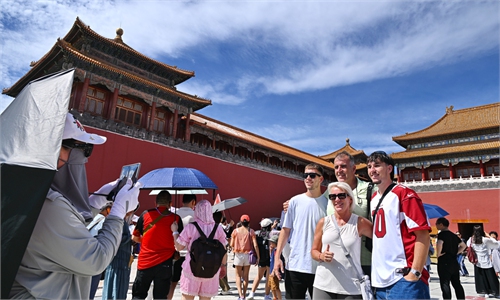
Foreign tourists pose for a group picture at the Temple of Heaven Park in Beijing on December 11, 2025. Photo: VCG
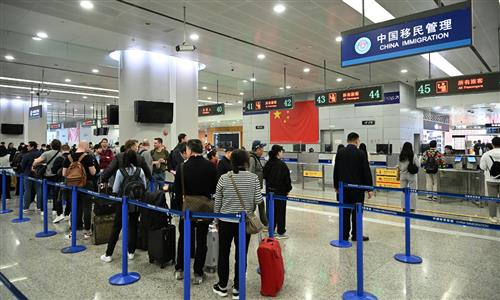
Wednesday was the first anniversary of China's 240-hour visa-free transit policy, which took effect on December 17, 2024. This landmark policy facilitates entry for foreign travelers from 55 eligible countries through 65 ports across 24 Chinese provinces.
From the picturesque landscapes of the southwest to the snowy winters of the northeast, and from the cultural heritage of southern Fujian to the vibrant charms of Hong Kong and Macao special administrative regions, diverse cultural and tourism products are precisely tailored to meet demand, driving sustained growth in inbound cultural and tourism consumption.
A Chinese expert said that this policy demonstrates China's firm commitment to advancing high-level opening-up.
According to data that Qunar sent to the Global Times on Wednesday, the number of domestic flight bookings made on the platform using non-Chinese passports has increased 20 percent year-on-year this year, covering 175 destination cities. The five most popular domestic destinations among foreign travelers are Shanghai, Beijing, Guangzhou, Chengdu, and Shenzhen.
National Immigration Administration data showed that in the year since the policy's implementation, 40.6 million foreign nationals have entered China through various ports, a year-on-year increase of 27.2 percent, CCTV News reported on Wednesday.
Among them, the number of travelers utilizing the 240-hour visa-free transit option has increased by 60.8 percent compared with the period before the policy was optimized.
As major national entry hubs, the airports in Beijing, Shanghai, and Guangzhou have fully leveraged the benefits of the policy, with the scale and growth rate of inbound foreign passenger flows showing remarkable performance.
Ports in Beijing recorded more than 3.4 million inbound foreign nationals, among whom 55 percent benefited from visa exemptions. Shanghai received 5.346 million inbound foreign nationals, with 56 percent enjoying visa exemptions.
Guangzhou airport processed more than 3.2 million inbound foreign nationals, and more than 57 percent of them took advantage of the visa exemption policy, according to CCTV News.
China's 240-hour visa-free transit policy enables foreign travelers to enjoy seamless interprovincial mobility, extended durations of stay, and engagement with diverse local contexts, Wang Peng, an associate researcher at the Beijing Academy of Social Sciences, told the Global Times on Wednesday.
In his view, by sharing authentic narratives of their journeys, these travelers could become ambassadors of contemporary China, offering the world a vivid, relatable perspective that deepens cross-cultural understanding and helps dispel longstanding misconceptions.
Compared with hub ports in Beijing, Shanghai, and Guangzhou, the effect in various regional ports driven by policies has been more pronounced, demonstrating an explosive growth trend.
The entry-exit border inspection station in Central China's Henan Province said that so far this year, the number of visa-exempt foreign nationals entering has exceeded 80,000, up 118 percent year-on-year, accounting for 76 percent of all inbound foreign nationals.
The total number of inbound foreign nationals at Liaoning airport this year has exceeded 355,000, a year-on-year increase of 54 percent, and the number of foreign travelers entering Liaoning via the visa exemption policy has grown by 5.7 times year-on-year, according to the Liaoning Daily on Wednesday.
As of Wednesday, more than 22,000 eligible foreigners had benefited from the 240-hour transit visa-free policy at Guangzhou Baiyun International Airport during the year since its implementation.
This was up about 125 percent compared with the number of travelers who enjoyed the 72/144-hour transit visa-free policies during the same period last year.
Wang added that China's continuous efforts to optimize visa exemption policies and facilitate the cross-border movement of people reflect its solid commitment to opening-up.
As China opens its doors even wider, it is advancing broader and deeper cooperation with countries around the world to foster shared prosperity, he said.
Various regions have seized opportunities by leveraging the 240-hour transit visa exemption policy, and cultural and tourism consumption in cities such as Beijing and Guangzhou has seen simultaneous growth.
From January to October, the tourism expenditure of inbound visitors in Beijing reached 41.7 billion yuan ($5.92 billion), up 48 percent year-on-year.
Xiamen hosted 1.5462 million inbound overnight tourists during the first three quarters, generating tourism revenue of $1.33 billion, up more than 49 percent year-on-year in both cases, reported CCTV News.
RELATED ARTICLES