Indian media address advice from spokesperson for Chinese Embassy in India on pollution control as smog chokes New Delhi
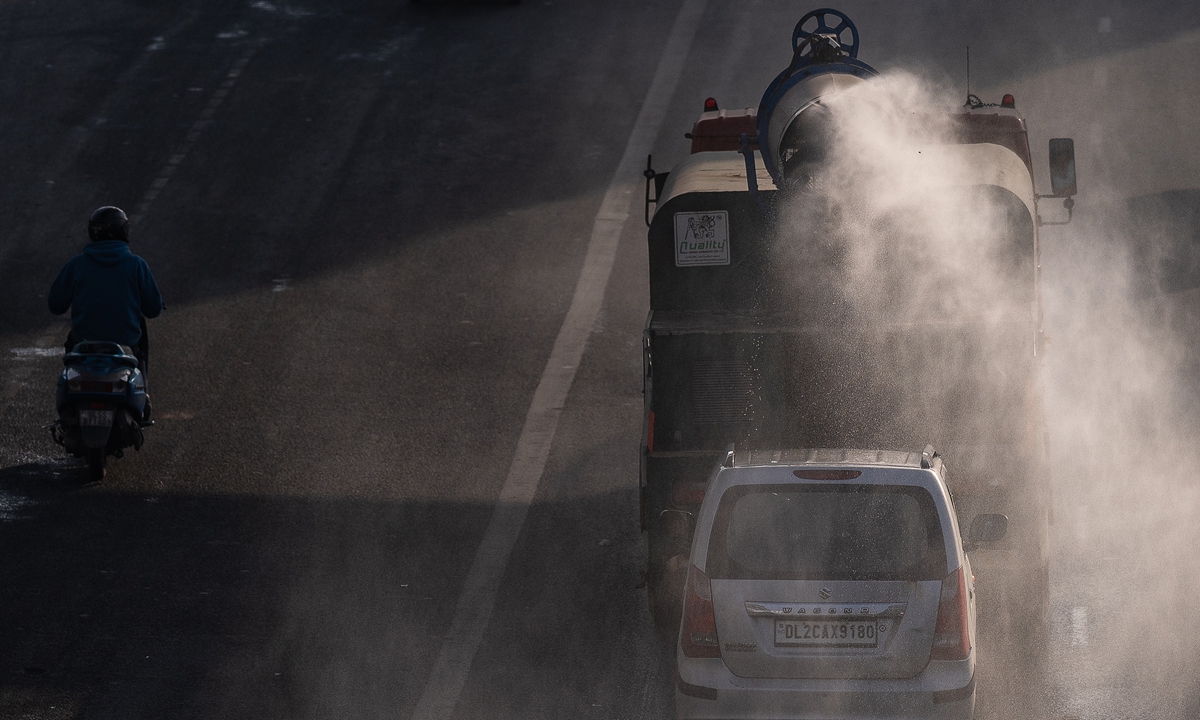
A municipal tanker spraying mist to curb air pollution passes along a road on December 3, 2025 in New Delhi, India. Photo: VCG
As New Delhi continues to choke under a blanket of toxic smog and takes measures to curb pollution, some Indian media outlets have turned their attention to remarks by the spokesperson for the Chinese Embassy in India on China's pollution-control experience. "China has lessons for India," The Times of India (TOI) reported on Thursday.According to NDTV, Delhi's Air Quality Index or AQI has been hovering between "Severe" and "Very Poor" since November. At 4 pm on Wednesday, the city's 24-hour average AQI stood at 334, placing it in the "very poor" category, though slightly better than Tuesday's reading of 354.
To tackle the air pollution, vehicles that do not have BS-VI engines will not be allowed to enter the national capital from Thursday as part of rigorous anti-pollution measures adopted by the Delhi government. Fuel stations will not serve vehicles without a Pollution Under Control (PUC) certificate, according to local NDTV News.
While reporting on the pollution, some Indian media outlets noticed a series of posts made by Yu Jing, spokesperson for the Chinese Embassy in India, in which she laid out the path Beijing followed to drastically improve air quality.
In a series of posts on X on Wednesday, Yu said Beijing has improved air quality by tightening vehicle-emissions controls and accelerating industrial restructuring. Measures included phasing out high-emission vehicles, restricting car growth, expanding public transport, and promoting electric mobility, while coordinating emissions cuts across the Beijing-Tianjin-Hebei region. She also noted that Beijing has shut down or relocated more than 3,000 heavy-polluting industries, with the relocation of major steelmaker Shougang alone cutting inhalable particulate matter by about 20 percent.
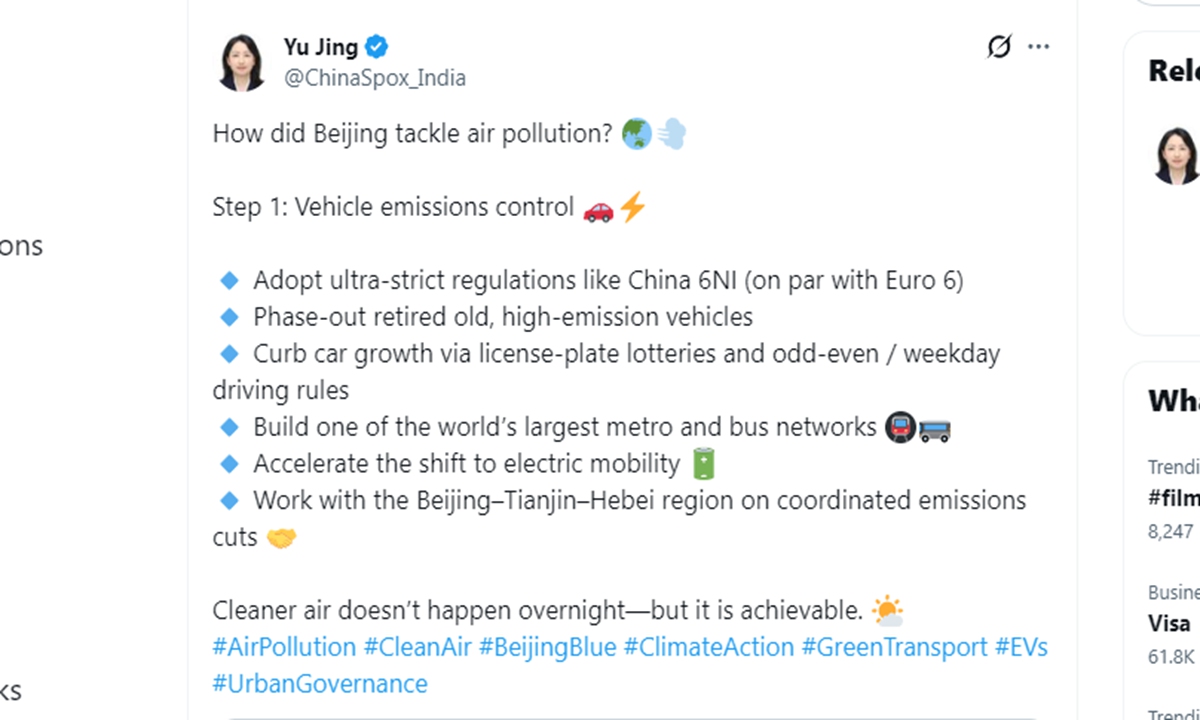
Screenshot of Yu Jing's posts on X
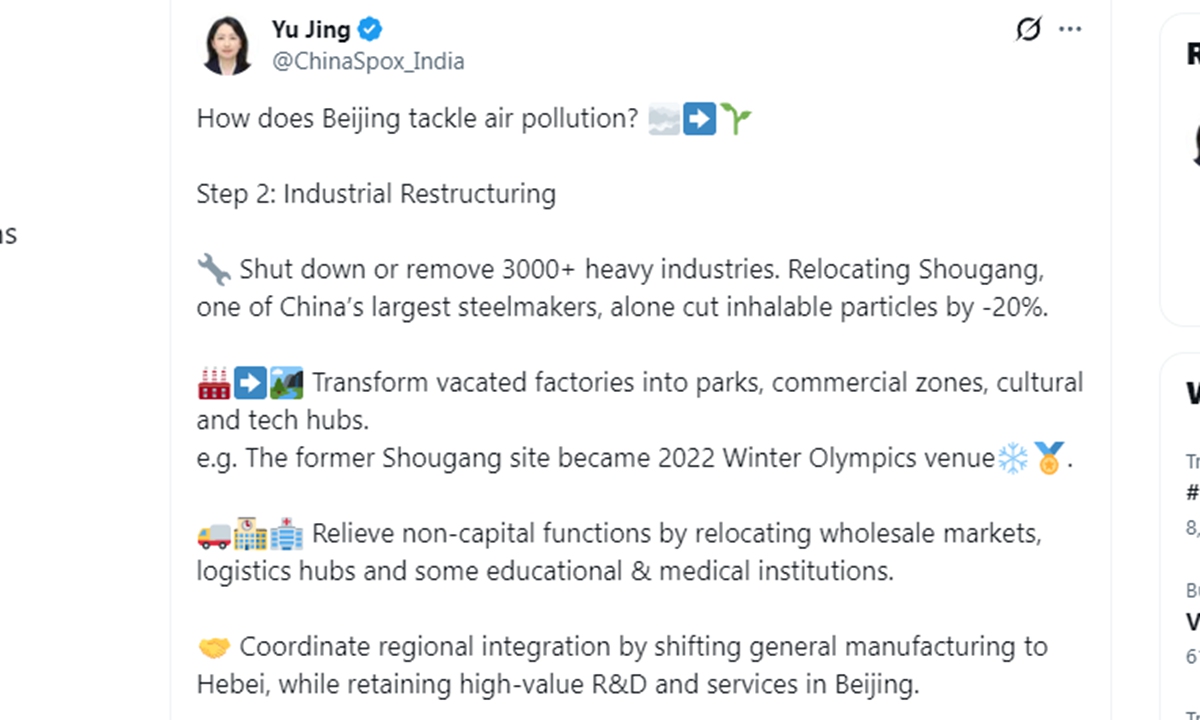
Screenshot of Yu Jing's posts on X
"Both China and India know the struggle with air pollution amid rapid urbanization. While the challenge remains complex, China's sustained efforts over the past decade have delivered noticeable improvements." Yu posted on Monday.

Screenshot of Yu Jing's posts on X
The diplomat also shared screenshots of AQI readings over Beijing and surrounding areas and over the Delhi and the National Capital Region.
According to the State Council Information Office, Beijing's average concentration of PM2.5 reached 30.5 micrograms per cubic meter in 2024, meeting the national standards for four consecutive years.
In TOI's report entitled "'This is how we did it': China embassy has advice for Delhi pollution; ultra-strict vehicle norms, public transport push key" published on Thursday, it said that these measures "are not unheard of in India." Quoting Anumita Roy Chaudhur, the Executive Director of Research and Advocacy of Centre For Science and Environment, the media said that: "In China, action was not taken just in Beijing but in 26 cities and towns to tackle the problem, which is regional. The first lesson is that the actions they took were urgent, stringent, and at a large scale. They took deep to enable massive energy transition, like getting rid of coal not only in industry but also in household use."
Echoing TOI, NDTV also said in its report entitled "'China, India Know The Struggle': Offer Of Help As Delhi Battles AQI Crisis" that "AQI in Beijing and surrounding areas has improved over the past decade after China announced a 'war on pollution' and launched a national, clean-air, action plan in 2013 that set regional targets to reduce PM2.5 levels. Concurrently, the Chinese government expanded and improved monitoring of AQI levels; a critical step in this regard was ensuring data collected was not tampered with in any form."
"[In] China, over the next five years, i.e., from 2013 to 2018, these measures were strictly enforced, and added to in 2018 by revised policies focusing on long-term and more sustainable means of improving AQI, which included industrial restructuring and regional coordination,." the report cited detailed content of the action plan.
Yu's offer was also well-received by a number of X users who commented on the post, with many pointing out the dire state of affairs in the Indian national capital, especially during winters. "Thank you so much. Smog towers built by your country may be gifted to tackle air pollution in Delhi. It may strengthen relations in a way…" one netizen said, to which Yu responded with a handshake emojis, Indian media the Economic Times reported.
A second user said, "Please share your expertise... It will be highly appreciated for South Asia. I love China in terms of transformation of life. Thanks," per Economic Times.
"Thank you for the thoughtful insights on how Beijing tackled air pollution," a third netizen with an IP in India's Maharashtra "Pranay" commented. "From strict vehicle emission rules to strong public transport and the push for electric mobility, this step-by-step approach shows that cleaner air is possible with consistency and cooperation."
"Yes I have been in Beijing during the time pollution was peak and also just before the Olympics and also travelled 2 years ago! The difference is clearly noticeable! Amazing work done indeed," said another netizen.
"It would indeed be great if Delhi could benefit from Beijing lessons learnt. I lived in Beijing from 2007 to 2019 and have been a witness to the transformation from rare Blue sky days to rare Hazy days," a netizen noted.
Dense toxic smog blanketed India's capital on Monday, pushing air pollution levels to their worst levels in weeks, disrupting travel and causing authorities to impose the strictest containment measures, according to a report by the Associated Press.
More than 40 flights were cancelled, and several dozens delayed. Over 50 trains arriving and departing from New Delhi were delayed by several hours, authorities said.
Global Times
RELATED ARTICLES