ARTS / CULTURE & LEISURE
China’s new regulation weaves culture of reading into social fabric
Building through reading


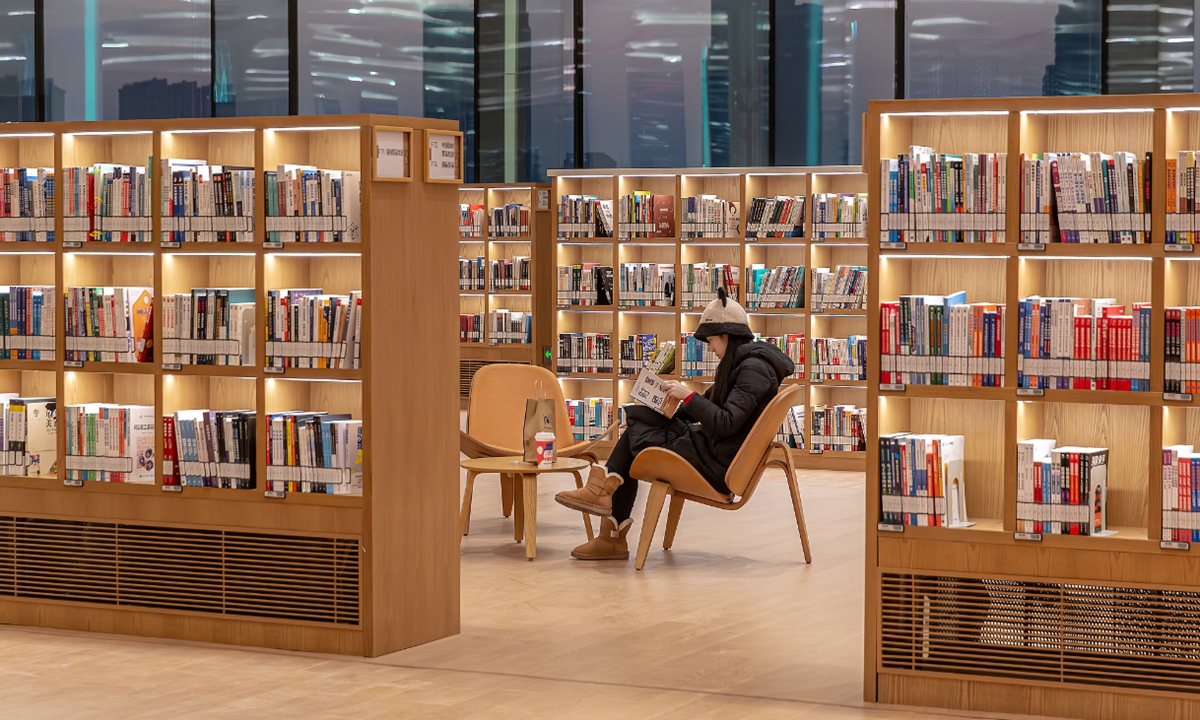
A woman reads a book in a library in Beijing. Photo: VCG
On Thursday, a weekday afternoon, the Chaoyang District Library in Beijing was nearly full. Most of the 20 or so tables in one reading room were occupied by young people buried in their books, with some desks already piled high with reading materials. Those who didn't manage to secure a desk simply found a bench in the lobby, where they were engrossed in their reading."Every time I come here, it is pretty much like this, and it gets even more crowded on weekends - seats are hard to find," a Beijing resident surnamed Cui told the Global Times. "The atmosphere for reading here is very strong. I can really settle down, put away my phone, and read."
This ambiance coincides with the state's stepped up efforts to promote reading in society. The State Council on Tuesday issued a regulation to promote reading among the public, which will take effect on February 1, 2026.
Comprising six chapters and 45 articles, the comprehensive regulation aims to boost nationwide reading, cultivate a reading-oriented society, raise the nation's ideological, moral, scientific, and cultural standards, elevate the overall level of social civility, and advance the development of a strong socialist culture, the Xinhua News Agency reported.
Picture a society where every airport lounge, subway station, and even the corner bank lobby features shelves lined with books - spaces where teenagers, seniors, and commuters pause to read, not just scroll through their phones. Imagine traveling on a high-speed train, and instead of defaulting to their mobile phones, travelers borrow a book for the journey, enjoying moments of quiet focus amid the digital noise. This is a future that the regulation aims to bring within reach.
"I believe this regulation will promote the entire reading industry, from publishing, to libraries, to bookstores. If every link can become more prosperous than before, then I am confident the overall reading atmosphere in society will become even stronger," renowned Chinese writer Shi Yifeng, winner of China's Lu Xun Literary Prize, told the Global Times on Thursday.

A citizen reads books in a library in Shenzhen, Guangdong Province. Photo: VCG
Not library, but urban living roomAmid the hustle and bustle of his daily car repair work, reading stands as Cui's favorite activity. Plunging into the works of his favorite writer Eric Berne, Cui has seamlessly woven his passion for reading into his daily routine, a habit made easy by a small yet freely accessible public library just a short walk from his home.
Nestled amid a residential neighborhood, the Chaoyang District Library has become an indispensable part of daily life for residents. Alongside senior visitors like Cui, the library space is mostly filled with young people. Some wore headphones and immersed themselves in books, while others flipped through paperbacks while taking notes. The silence made the sound of turning pages and reading particularly audible, creating a unique "ambiance" for reading.
"Libraries can create an ambiance that inspires my desire to read, which is very different from reading at home," Cui told the Global Times. He also added that he hopes there will be "more reading facilities near where I live."
Taking Cui's demand as an example, the public's call for more reading spaces has inspired cities across the country to increase their reading facilities.
The recently issued regulation to promote nationwide reading emphasizes that facilities for public reading should encompass a diverse range, not being limited to libraries but also including community reading rooms, cultural centers and more. By the end of 2024, in addition to 3,248 public libraries, there were also nearly 44,000 public cultural centers and over 40,000 new types of public cultural spaces nationwide that meet the public's demand for reading facilities.
"These diverse cultural spaces make it easier for the public to integrate reading into daily life. It is not a task, but rather an immersive cultural experience offered to citizens," Xiao Bo, a cultural sociologist based in Shanghai, told the Global Times.
To enhance the public's immersive reading experience, facilities across the country have begun developing more creative means to engage readers.
In Chongqing, the Jiangbei District Library integrates "reading" into intangible cultural heritage experiences, organizing activities such as stone rubbings and tie-dyeing at the library. Not far from it, the Beicang Library is nestled in an old renovated textile mill community. Art salons and small-scale concerts corresponding to different book themes are regularly held here.
"We aim to provide not just a library, but an urban living room centered around reading," Li Bo, the owner of the library, told the Global Times.
The new regulation highlights the use of "new technologies, new platforms, and new facilities" to promote nationwide reading. Echoing this, more and more facilities are starting to develop digital programs engaging readers.
Mao Yajun, the director of the Capital Library of China, told the Global Times that their digital development focuses on two key aspects. One is content development, such as transforming classic literary IPs like Chinese science classic Tiangong Kaiwu (The Exploitation of Nature's Works) into 3D visual products to "lower the barrier to reading." The book, compiled by Song Yingxing, a scientist in the late Ming Dynasty (1368-1644), offers a summary of ancient China's manufacturing and farming techniques, earning recognition as an encyclopedia of science and technology from that time.
On the other hand, the library's digital creativity also aims to provide reading convenience for specific groups. For example, it has developed a smart reading device specifically for elderly readers. It features a larger font size and a robot delivery service that brings requested books directly to elder readers after an order is placed through the device.
"Reading is a right for all. In the future, we must deliver more accessible and convenient services for special populations and individuals who face challenges in reading," Mao told the Global Times. Article 37 of the new regulation also encourages reading facilities to provide publications in accessible formats such as audio, large-print, Braille, and electronic versions for people with reading disabilities, thereby supporting the development of barrier-free reading infrastructure for all.
Whether through technology or the creation of more reading spaces, books in a variety of genres are increasingly making their way into the daily lives of the public.
Technological advances have made reading spaces increasingly modern. However, the public's demand for reading goes beyond physical spaces and extends to the quality and diversity of reading resources themselves. "I love reading at public facilities, but sometimes I find their books too old. I want more new books to be circulated here," Cui told the Global Times while browsing the bookshelves at the library.

A girl selects book from a bookshelf. Photo: VCG
From quantity to qualityPublishers are already taking action, strengthening cooperation with libraries and promoting the timely circulation of book resources. For example, in provinces such as Jiangsu, Sichuan, and Guangdong, regular book fairs or business seminars are being held between libraries, publishers and book distributors. Publishers bring their latest titles to the venue for display. Staff from libraries of all types and levels browse the exhibition, leaf through the books, and place orders on-site, purchasing suitable new books to replenish their collections.
This is just the tip of the iceberg for how content providers like publishers are fostering public reading. In addition to organizing basic book clubs and reader sharing sessions, the Yilin Press is also inviting notable authors to visit campuses, where they engage in face-to-face discussions with young students about in-depth reading and literary creation. For example, during a conversation with faculty and students at Nanjing Normal University, writer Liu Liangcheng began with "the sounds of insects," and, centering on the question "What are the insects singing?" explored his insights and reflections on nature and life, sparking a deep interest in reading among the students.
The Reader Publishing Group has built an extensive reading service network, including nearly 1,000 "Reader Stations," "Reader Study Rooms," and rural cultural hubs in cities like Shanghai and Suzhou, integrating reading into communities, Ma Yongqiang, former general manager of the Reader Publishing Group and chairman of the Gansu Provincial Literary Critics Association, told the Global Times on Thursday.
The transformation, however, extends far beyond bricks and mortar. The core of the strategy lies in reimagining what a reading service can be. The group is pioneering interactive, scenario-based experiences, such as immersive children's reading theaters and customized parent-child programs, often developed through cross-sector collaborations with partners. By tailoring its offerings for schools, communities, and families, the publisher is building a comprehensive ecosystem.
For Ma, the publisher's core obligation under the new regulation lies in its role as a "leader of national reading," anticipating reader needs, extending services to every corner of society, and nurturing a culture where reading becomes second nature.
The regulation, which asks publishers to deliver more high-quality content, will push the publishing sector from a focus on quantity to one on quality: First, by strengthening targeted publishing and developing graded reading materials for key groups such as youth, the elderly, and people with disabilities; second, by embracing technological integration and supporting digital and audio reading to complement the depth of traditional reading with the breadth of digital media; third, by promoting the transformation of physical bookstores from simple retail spaces into reading hubs, Zhang Peng, an associate professor at Nanjing Normal University and also the president of a publishing house, pointed out.
Writer Shi Yifeng envisioned a society where quality reading reaches the "capillaries" of a community - where even the smallest neighborhood boasts a well-equipped reading room. Everyone can immerse themselves in the world of books, whether it is a global literary classic like War and Peace or Dream of the Red Chamber, or a positive psychology book that answers a current personal question. Reading continually fosters people's observation and reflection on life and the times.
"China is a nation with a profound appreciation for learning," Shi said during the "Reading through the Seasons" literature salon held by the Global Times in Beijing in April.
"Our Chinese civilization, throughout its long development, has always been accompanied by reading and the fragrance of books. Books have subtly shaped our character and civilization. There's no doubt that we are a nation imbued with a love for books," Shi noted.
RELATED ARTICLES