China warns of vigilance against senior Japanese official’s claims that ‘Japan should possess nuclear weapons’
Claim sparks criticism at home, triggers high vigilance from international community
By and Li Yu Published: Dec 19, 2025 12:46 PM

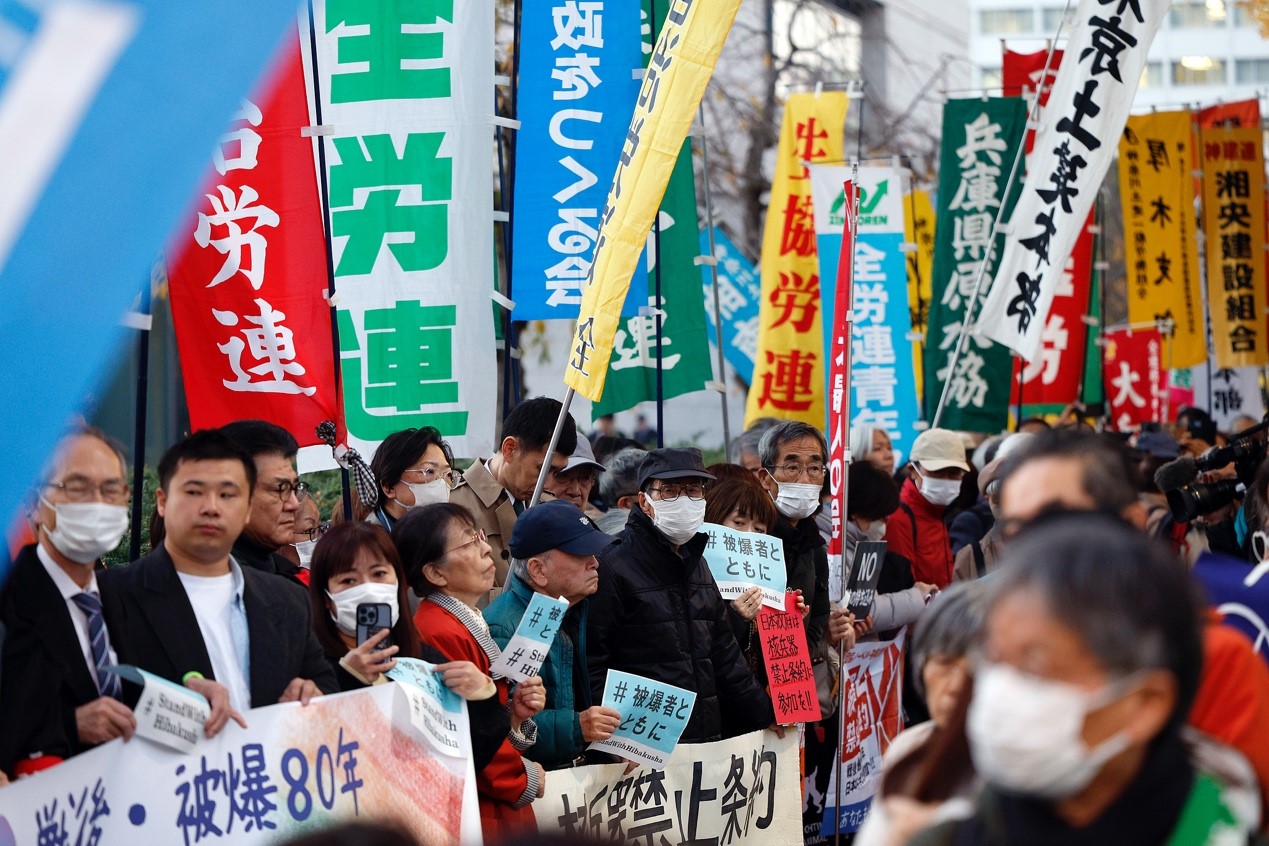
Demonstrators stage a rally before the Diet in Tokyo, Japan, 21 November 2025. Nihon Hidankyo, the Japan Confederation of A-and H-Bomb Sufferers Organizations, and others political organizations and unions, staged a protest in front of the Japanese Parliament after the new Japanese Prime Minister Sanae Takaichi criticized her country's traditional policy against nuclear weapons. Photo: VCG
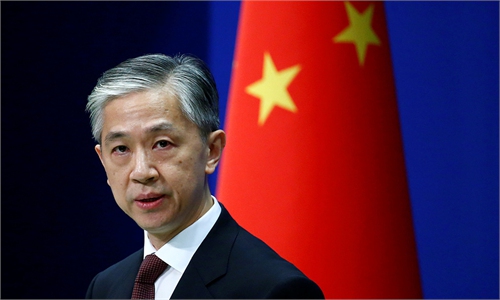
A Chinese Foreign Ministry spokesperson warned on Friday that the Japanese side must deeply reflect on its historical crimes, abide by international law and Japan's Constitution, stop finding excuses to expand military buildup, and stop testing the bottom line and red line of international justice on the issue of owning nuclear weapons following reports that a senior government official who advises Japanese Prime Minister Takaichi on security expressed a personal opinion that Japan should have nuclear weapons.China is closely following the report. If that's true, it will be a serious issue that exposes the dangerous attempts by some in Japan to breach international law and possess nuclear weapons. China and the rest of the international community must stay on high alert and express grave concern, Foreign Ministry spokesperson Guo Jiakun said at the regular press conference.
On Thursday, an unnamed official was quoted as saying in the Asahi Shimbun that he personally believes that "Japan should possess nuclear weapons." The official is responsible for advising Prime Minister Sanae Takaichi on security policies and related matters, according to the report.
He also claimed that this does not mean that the Japanese government is currently advancing discussions on the issue, and achieving this goal would be extremely difficult considering Japan's obligations under the Nuclear Non-Proliferation Treaty (NPT) framework, according to media report.
The official was only expressing his personal view, Mainichi reported, saying that when asked whether the prime minister would reconsider the "Three Non-Nuclear Principles," he replied, "I'm not sure, as it hasn't been discussed, but I don't think the prime minister holds such a view."
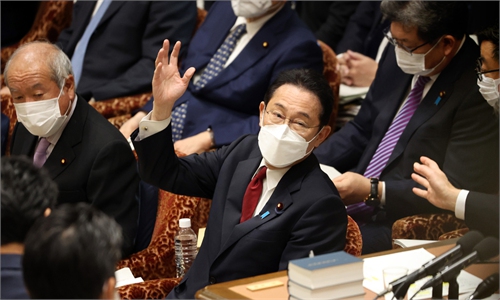
At a press conference on Friday, when Japanese Defense Minister Shinjirō Koizumi speaking about a possible review of the Three Non-Nuclear Principles, he claimed that in order to fully protect the lives of Japanese citizens and their peaceful way of life, it is necessary to discuss all options without excluding any, Jiji Press reported.
Also on Friday, Chief Cabinet Secretary Minoru Kihara claimed that Japan is committed to its non-nuclear principles, which the Kyodo News commented as "downplaying remarks" by an official a day earlier supporting possession of nuclear weapons in a deviation from long-standing policy.
Trying to picture itself as the advocate of a world free of nuclear weapons, Japan has claimed in its own narrative to be the "victim" of nuclear weapons in WWII. However, in fact the Japanese side has never completely reflected on the wars of aggression it has waged, and has become the source of instability that challenges the Treaty on the Non-Proliferation of Nuclear Weapons and undermines the international nuclear non-proliferation regime. The international community must be clear-eyed about Japan's hypocritical stance on nuclear non-proliferation and disarmament, Guo said.
High vigilance
In recent days, the Takaichi administration has signaled a push to revise the Three Non-Nuclear Principles, and this prime minister's office source who made the recent remarks reportedly participates in the cabinet's security policy formulation and is likely an insider or a figure of considerable influence, Da Zhigang, director of the Institute of Northeast Asian Studies at the Heilongjiang Provincial Academy of Social Sciences, told the Global Times on Friday.
"His statements align with Takaichi administration's stance on revising the Three Non-Nuclear Principles and, objectively, serve to shape public opinion and test reactions from various parties. Such comments warrant vigilance from the international community," Da said.
These remarks cannot simply be dismissed as "right-wing bravado." They represent a direct challenge to the international order established after WWII, Lü Chao, a professor at the Liaoning Academy of Social Sciences, told the Global Times on Friday.
As is well known, Japan has long been constrained by its postwar pacifist constitution and the Three Non-Nuclear Principles, having no right to wage war abroad and a deep understanding of the catastrophic impact of nuclear weapons. These principles have underpinned Japan's peaceful development for decades, Lü continued.
However, militarist elements in Japan have never abandoned their ambitions. Historically, calls for nuclear armament were confined to a few extreme right-wing individuals in the private sector. It was unthinkable for such rhetoric to appear at the level of senior officials, especially within the Prime Minister's Office. The fact that it now emerges in a senior official's rhetoric is an unprecedented provocation, the expert warned.
Russian Foreign Ministry spokesperson Maria Zakharova also warned on Thursday of "Japan's re-militarization," saying that such an irresponsible policy positions Japan as a catalyst for escalating tensions in Northeast Asia and the broader Asia-Pacific region, according to the Xinhua News Agency.
For some time, we've been witnessing erroneous remarks and moves from the Japanese side on military and security issues, who revamped security and defense policies, removed the ban on exercising the right to collective self-defense, and attempted to once again acquire nuclear weapons from allies through strengthening cooperation on "extended deterrence," seeking "nuclear sharing," revising the three non-nuclear principles and other means. Right-wing conservative forces in Japan are floating the idea of owning nuclear weapons—another case in point of their inflated ambition to revive militarism, break free from international order and speed up re-militarization, spokesperson Guo said.
Criticism at home
Such a claim of possessing nuclear weapons also sparked a wave of criticism in Japan.
Responding to the reports, former Defense Minister Gen Nakatani said on Friday that "this is not something to be discussed lightly. The government must respond appropriately,'' according to Japanese news outlet Kumanichi.
Calling the report "shocking," Japan's Social Democratic Party (SDP) said in a social media post late Thursday that "Precisely because Japan has experienced the devastation wrought by nuclear weapons, shouldn't we cherish and pursue peace even more?" the SDP said.
Reiterating its opposition to Japan possessing nuclear weapons, the party added, "Let us continue a peaceful postwar era in which no one kills and no one is killed."
Japanese Communist Party secretary general Akira Koike said the claim is an utterly irresponsible statement and absolutely unacceptable. The government should make the person retract the remarks and dismiss them, Koike said, according to Japanese media reports.
House of Councillors member Taku Yamazoe said on social media: "The theory of nuclear deterrence is nothing but an illusion; nuclear weapons, which bring hellish devastation, can only be abolished. Those who do not hold this stance have no right to wield Japan's political power."
"Impossible. It should never be," the Japanese Communist Party said on Friday on social media.
Japanese attorney Masaki Kito also said on social media on Thursday night that such "trial balloon" articles should stop, and the identity of this senior official in the PM's office should be made clear.
Komeito leader Tetsuo Saito told reporters at Diet that he was shocked and angered, calling the remarks a serious statement that warrants dismissal, Nikkei reported. He stressed that upholding the nuclear non-proliferation regime and adhering to Japan's Three Non-Nuclear Principles are the foundation of the country's security, and warned that such remarks would have a major negative impact on Japan's diplomatic standing, according to the Japanese media report.
RELATED ARTICLES