BRASIL 247 / MORE
Lula says lack of political will blocks Mercosur-EU deal after 26 years of talks
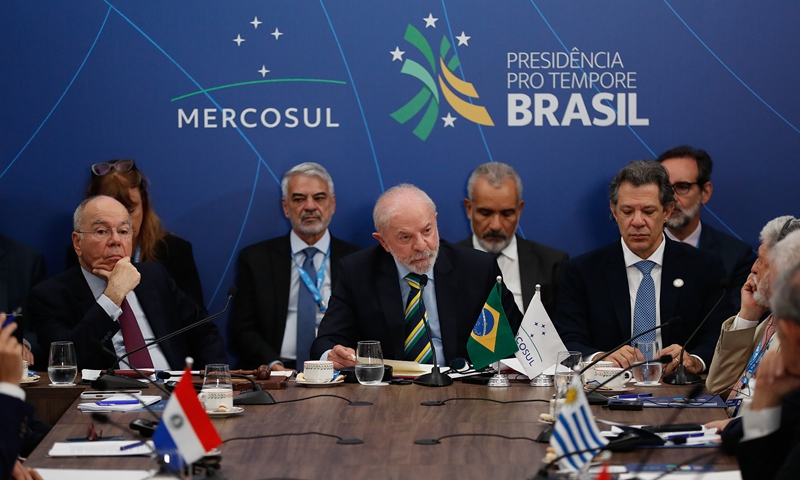
Brazilian President Luiz Inacio Lula da Silva (C) speaks at the plenary session of the Mercosur Summit in Foz do Iguacu, Brazil, on December 20, 2025. Photo: CFP
By Brasil 247 - Brazilian President Luiz Inácio Lula da Silva said on Saturday that the absence of political will in Europe is preventing the conclusion of the Mercosur-European Union agreement, a deal negotiated for 26 years. He made the remarks during the opening of the 67th Mercosur Summit of Heads of State and Associated States, held in Foz do Iguaçu, southern Brazil.
According to an official statement released by Brazil's Presidency, the date of the summit had been requested by the European Union itself, amid expectations that the long-awaited agreement would finally be signed. Those expectations, however, were not met.
"After twenty-six years of negotiations, we expected to finally sign the association agreement with the European Union. But unfortunately, Europe has not yet made a decision. European leaders asked for more time to discuss additional agricultural protection measures," Lula said.
The Brazilian president said he received a letter on Friday from European Commission President Ursula von der Leyen and European Council President António Costa expressing hope that the agreement would be approved in January. "Without political will and courage from leaders, it will not be possible to conclude a negotiation that has already dragged on for 26 years. Meanwhile, Mercosur will continue working with other partners," he stated.
Internal European resistance
Lula detailed the political obstacles that prevented the signing of the agreement on Saturday. He noted that France's opposition to the deal was long known, but said new difficulties emerged in recent days involving Italy.
"Everyone knew France's historical position. Last week, a problem arose with Prime Minister Giorgia Meloni of Italy. Not a problem with an agreement between Mercosur and the European Union, but with an agreement within the European Union itself," Lula explained.
Regional security and organized crime
During the summit, Lula highlighted advances made under Brazil's pro tempore presidency of Mercosur in the field of public security. Member states approved the Mercosur Strategy to Combat Transnational Organized Crime and created a regional commission to coordinate joint action.
"Weakening institutions means opening space for organized crime. Public security is a citizen's right and a duty of the state, regardless of ideology. Mercosur has shown its willingness to confront criminal networks jointly," the president said.
He also cited agreements against drug trafficking, human trafficking and money laundering, as well as the creation of a working group focused on asset recovery to cut off the financing of illicit activities.
Call for action against femicide
Lula also urged Mercosur countries to strengthen protections for women, proposing a regional pact to combat femicide and gender-based violence.
"Latin America holds the tragic record of being the most lethal region in the world for women. According to ECLAC, eleven Latin American women are murdered every day," he said.
"I would like to propose to Paraguay, which today assumes the bloc's presidency, that we work toward creating a major Mercosur pact to end femicide and violence against women," he added.
Venezuela, the US, and regional peace
Addressing rising tensions between the US and Venezuela, Lula warned that military intervention would have devastating consequences.
"Building a prosperous and peaceful South America is the only doctrine that suits us," he said. "An armed intervention in Venezuela would be a humanitarian catastrophe for the hemisphere and a dangerous precedent for the world," Lula warned.
Integration and Brazil's legacy
Lula also pointed to the inauguration of a new bridge linking Brazil and Paraguay as a symbol of regional integration.
"In a world where building walls seems easier than building bridges, this example deserves to be remembered," he said, referring to the new Integration Bridge between Foz do Iguaçu and Presidente Franco.
Brazilian Foreign Minister Mauro Vieira presented a balance of Brazil's six-month presidency of Mercosur, highlighting progress on regional trade, energy transition, technological development, public security and social policies.
"We are confident that the foundations built during this period will open the way to an even more promising future for Mercosur," Vieira said.
The summit officially marked the transfer of Mercosur's rotating presidency from Brazil to Paraguay, which is expected to prioritize the continuation of talks with the European Union and the deepening of regional integration.
(Reported by Brasil 247 on December 20, 2025)
