Chinese experts rebuke Irish spy agency’s claim of risks linked with Chinese engagement, say rhetoric undermines Ireland’s neutrality
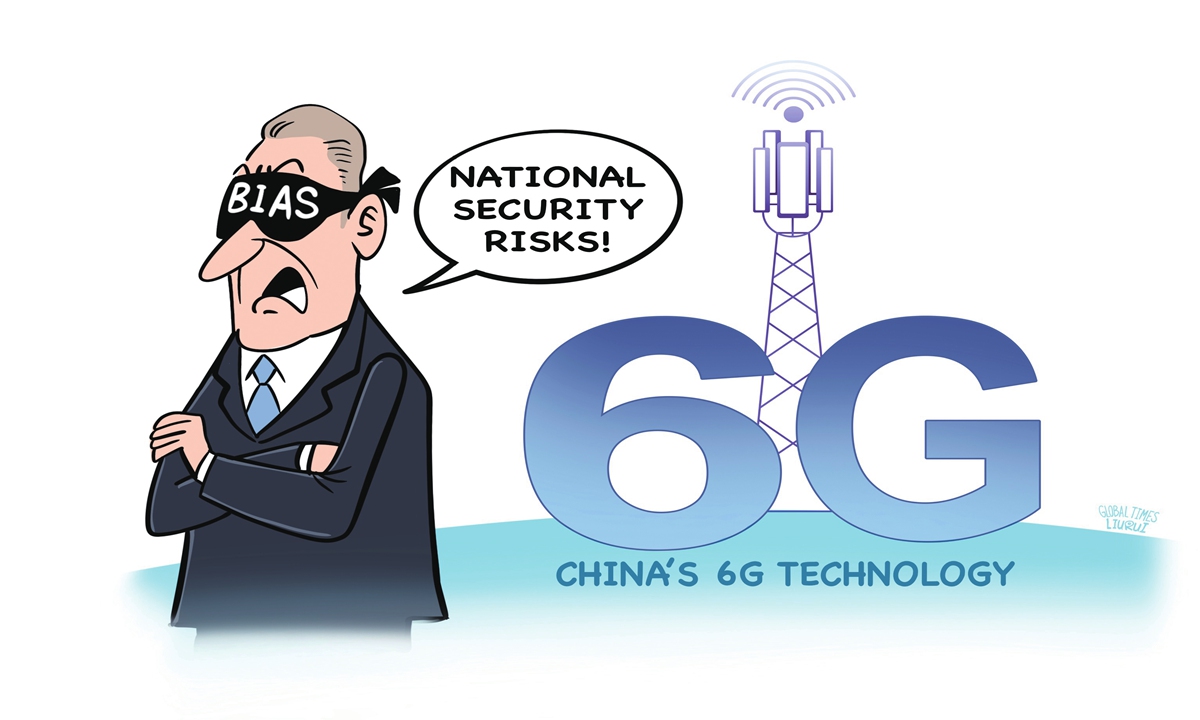
Illustration: Liu Rui/GT
The Irish Military Intelligence Service claimed that it had given confidential briefings to Irish university leaders, warning them about the so-called "risks associated with Chinese engagement" in sensitive areas of research, particularly in fields that could be adapted for military use, according to The Sunday Times.
Chinese experts rebuked the claims, saying that certain officials within the Irish intelligence services are absurdly hyping the so-called "China threat" at home. Such rhetoric, they said, harms Ireland's fundamental interests and undermines its genuine neutrality as a neutral country.
Notably, The World Intellectual Property Organization (WIPO) released the Global Innovation Index 2025 report on September 16, 2025. In this report, China ranks Top 10, while Ireland ranks 18th.
However, in the first authorized interview by the organization, a senior IMIS officer claimed that Ireland's relationship with China posed a unique challenge, as the country enjoyed a beneficial economic relationship with Beijing, but said Irish universities had been warned about the potential consequences.
The official claimed that "It can be hugely detrimental to the West if you empower them [China] by educating them simply because they come to a university with funds." The official even asserted that "This can be hugely detrimental to the West if you teach them how to twist a knot to the left or right, which helps them to develop a weapon or military application. We made these points to the universities and it was very successful," per the report.
Some officials from Irish intelligence agencies are forcibly linking education funding, basic scientific research and even elementary technical teaching to alleged threats to military and democratic institutions, a move that is illogical, reflecting an erroneous tendency to overextend national security concepts and politicize academic exchange, Zhao Junjie, a senior research fellow at the Institute of European Studies of the Chinese Academy of Social Sciences, told the Global Times on Sunday.
The illogical accusations made by some Intelligence officers are, first, deliberately dragging China-Ireland educational exchanges into the "China threat" narrative, making them difficult to advance smoothly, and second, attempting to manufacture a societal consensus hostile to China in Ireland, Li Haidong, a professor at China Foreign Affairs University, told the Global Times.
Such rhetoric harms Ireland's fundamental interests and undermines its genuine neutrality as a neutral country, raising questions about its impartiality, Li added.
Over the past two decades, pragmatic China-Ireland cooperation in education has made notable progress. As of 2021, 16 Irish universities and 53 Chinese universities have jointly established more than 100 government-approved cooperative education programs and institutions, forming an initial development pattern led by Ireland's national strength disciplines alongside multiple fields. Delegations from nine Chinese universities, representing 31 institutions including Tianjin University, Wuhan University and Shanghai University, have visited Ireland for dialogue and exchanges on expanding and upgrading bilateral education cooperation, according to the official website of the Education Section of the Chinese Embassy in Ireland.
Such demonization of normal exchanges does nothing to advance Ireland's development and instead undermines the scientific, open and inclusive nature of education, ultimately harming Ireland's academic environment and international credibility, according to Zhao.
China's scientific and technological development relies primarily on independent innovation, while international cooperation is a process of mutual benefit and shared outcomes rather than a so-called "security vulnerability," Zhao said,
Faced with China's growing strength, many Western countries, struggling with weak self-confidence, economic challenges, and internal social unrest, have seen such vulnerabilities give rise to unhealthy rhetoric and actions, experts said.
Ireland's attempt, under the influence of some Western countries, to promote an narrative featured by deep bias and hostility toward China undermines its genuine foreign policy orientation and erodes its independence in both foreign policymaking and domestic governance, according to Li.
From chips and 5G to electric vehicles, many areas of potential China-Europe win-win collaboration have been over-politicized in the name of security. "These overextended security walls do not protect Europe from risk—they block Europe from embracing new technologies and stifle its own innovation vitality," Zhao added.
RELATED ARTICLES