ASEAN urges restraint from Cambodia, Thailand as GBC to convene on December 24
By Published: Dec 22, 2025 11:02 PM

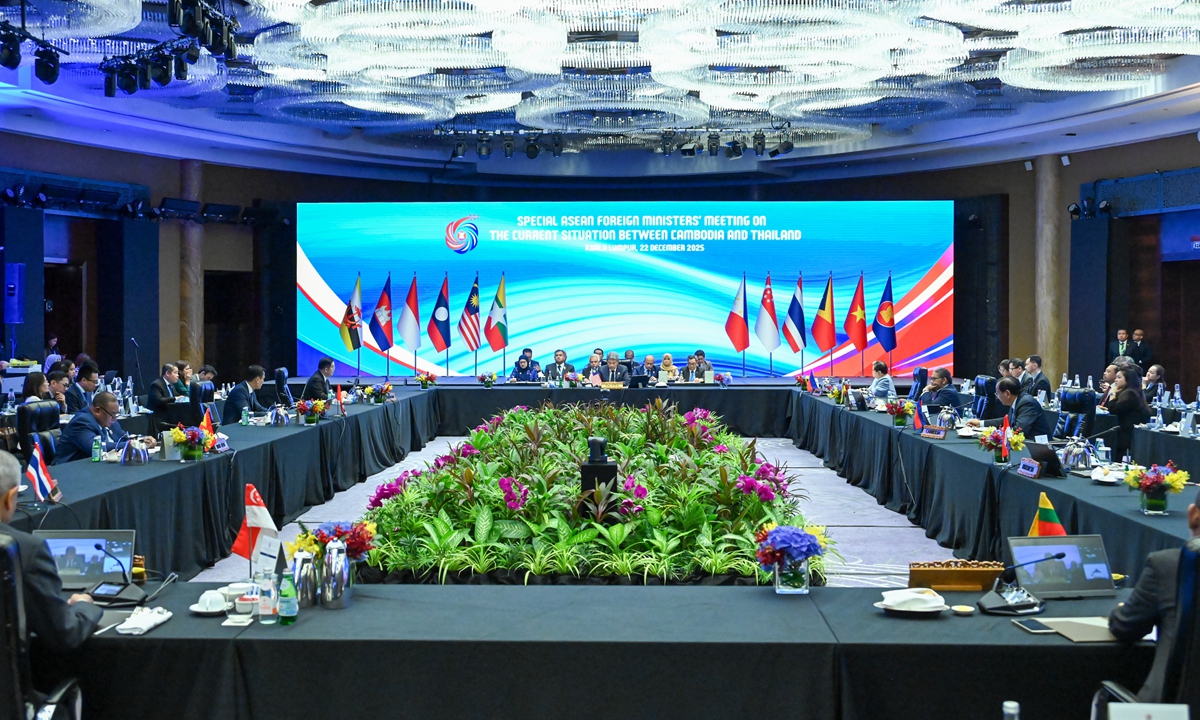
Special ASEAN Foreign Ministers' meeting convenes on December 22, 2025 in Kuala Lumpur, Malaysia to resume ceasefire talks after deadly border clashes between Cambodia and Thailand. Photo: VCG
Cambodia and Thailand are urged to exercise maximum restraint and take immediate steps towards the cessation of all forms of hostilities, according to a statement released on Monday following the Special ASEAN Foreign Ministers' Meeting convened to address the ongoing conflict.
"The ASEAN Foreign Ministers welcomed the discussions on resumption of the ceasefire and cessation of hostilities," it said, noting that the General Border Committee will convene on December 24 to discuss the implementation and verification of the ceasefire.
In response to the ASEAN's latest efforts to ease the tension, the Chinese Foreign Ministry spokesperson called on Monday on the two countries to quickly achieve a ceasefire and restore peace.
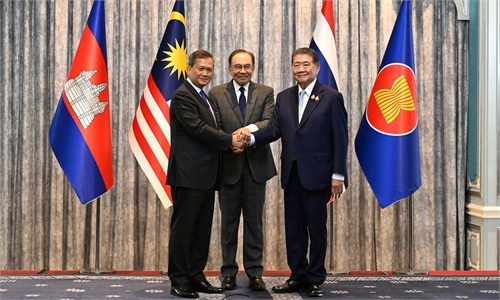
Cambodia and Thailand's top diplomats attended the gathering in Kuala Lumpur, the first face-to-face meeting involving the two governments since the fighting resumed on December 8, as Malaysia urged the bloc to play a more forceful role in halting the conflict, Reuters reported.
The two countries accused each other of aggression and moves that led to the breakdown of the truce and an enhanced ceasefire agreed in October in Malaysia, during which they committed to demining and withdrawal of troops and heavy weapons.
Heavy exchanges of fire have occurred in multiple locations along their land border, from forested inland areas near Laos to coastal provinces, per Reuters.
Both Cambodia and Thailand are important members of ASEAN. China commends and supports the effort of ASEAN, in particular Malaysia, to secure peace, Lin Jian, spokesperson from the Chinese Foreign Ministry, said at a press conference on Monday.
China, as the two countries' friend and close neighbor, sincerely hopes the fighting will stop and peace will be rebuilt at an early date, which is in the larger interest of peace and stability along their border and the fundamental interest of the people of both countries, Lin said.
The most fundamental reason lies in the long-standing lack of effective policy arrangements on the border dispute, as well as the failure to establish genuine mutual trust between the two sides, a Chinese expert said.
"Overall, this situation is not essentially different from the past; rather, it reflects unresolved 'old grievances' that have accumulated over a long period of time and have never been fundamentally addressed. This is why we repeatedly see a pattern in which ceasefires are followed by renewed outbreaks of conflict," Ge Hongliang, vice dean of the ASEAN College at the Guangxi Minzu University, told the Global Times on Monday.
Following the meeting on Monday, Thailand's Foreign Minister Sihasak Phuangketkeow said ceasefire declarations between Thailand and Cambodia should not be rushed, as any truce must be workable and sustainable, Malaysian media outlet New Straits Times (NST) reported.
Sihasak said discussions, which are set to resume on December 24, should not be conducted within a fixed time frame, according to NST.
Renewed conflict
More than half a million people in Cambodia have been displaced from their homes in two weeks of deadly border clashes with Thailand, Phnom Penh's interior ministry said Sunday, Channel News Asia (CNA) reported.
Around 400,000 people have been displaced in Thailand due to the reignited border conflict, Bangkok has said, per CNA.
Looking back at the conflicts since its beginning, the trust deficit between Cambodia and Thailand has fallen to a freezing point, Zhou Shixin, director of the Center of Southeast Asia Studies, Shanghai Institutes for International Studies, told the Global Times on Monday.
"Thailand has found some of Cambodia's actions difficult to understand and even disappointing, while Cambodia believes that Thailand has escalated the intensity of the conflict, which is not conducive to creating conditions for resolving the issue," Zhou said.
"In terms of easing tensions alone, the meeting can still play a certain role. However, to fundamentally resolve the disputes between Cambodia and Thailand - especially their border and territorial disagreements - it is essentially impossible to achieve this through a single foreign ministers' meeting," Zhou added.
China's efforts
Since the latest escalation between the two countries, China has been engaging the two sides for peace through its own way. Foreign Minister Wang Yi talked to Cambodian and Thai foreign ministers over the phone. MFA senior official has maintained communication with Cambodia, Thailand and relevant ASEAN countries. MFA Special Envoy for Asian Affairs Deng Xijun is on a shuttle-diplomacy trip to facilitate talks. On his shuttle-diplomacy trip, relevant information will be released in due course. China will continue working actively for peace and playing a constructive role for deescalation, Lin said.
In the earlier phone calls, both the Cambodian and Thai sides briefed Wang on the latest developments regarding the Cambodia-Thailand border clashes and expressed their willingness to de-escalate tensions and implement a ceasefire, according to Xinhua News Agency.
Both the Cambodian and Thai sides briefed Wang on the latest developments regarding the Cambodia-Thailand border clashes and expressed their willingness to de-escalate tensions and implement a ceasefire.
China's role is primarily to encourage peace and promote dialogue, with the aim of de-escalating the situation, while adhering to its own principles in terms of approach, Xu Liping, director of the Center for Southeast Asian Studies at the Chinese Academy of Social Sciences, told the Global Times on Monday.
"While China emphasizes respect for the territorial sovereignty and political will of both parties to the conflict, which is of fundamental importance, the two sides should be treated as equals, and we advocate addressing the conflict from a long-term perspective," Xu said.
RELATED ARTICLES