ARTS / CULTURE & LEISURE
Excavations reveal southern edge and construction process of Emperor Qin Shihuang’s Epang Palace platform
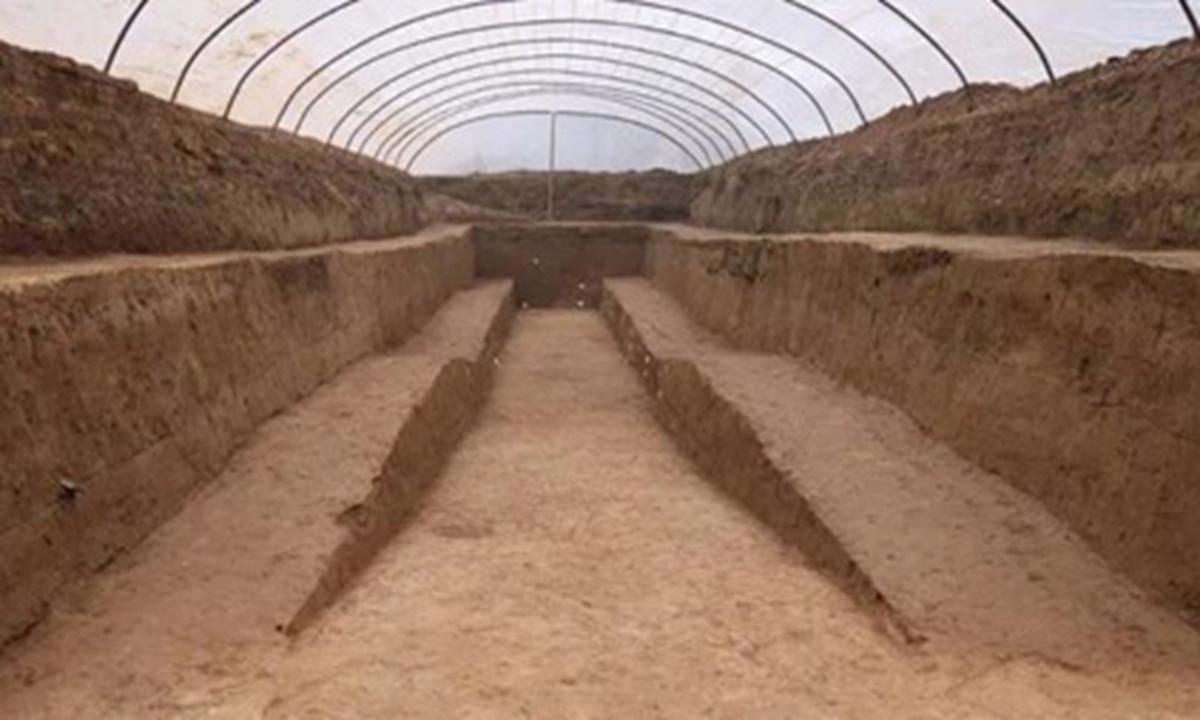
Panoramic view of the hardened surface in the southern section of the Epang Palace Photo: Courtesy of CASS
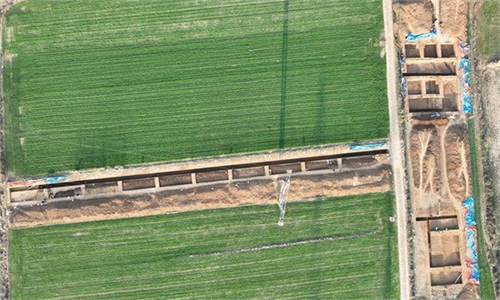
Archaeological excavations at the Epang Palace have newly pinpointed the precise location of the southern edge of the palace's rammed-earth platform within the excavation area, confirmed that construction began atop continuous silt deposits, and for the first time clearly revealed the basic workflow used to ram the platform.
The Epang Palace lies in Xi'an, Northwest China's Shaanxi Province, one of the best-known palaces of the Qin Dynasty (221BC-206BC). According to historical records, construction of the Qin imperial court palace began in the 35th year of Emperor Qin Shihuang's reign (212BC). With the fall of the Qin Dynasty after the reign of the Second Emperor, work on the Epang Palace was forced to cease.
"Through this excavation, we have determined the exact position of the southern edge of the Epang Palace platform within the excavation area," He Jiahuan, assistant research fellow at the Institute of Archaeology of the Chinese Academy of Social Sciences (CASS), told the Global Times, adding that the discovery is of great significance in researching construction techniques and processes of large-scale palace architecture.
During earlier archaeological survey initiatives, comprehensive investigation of the platform was impossible because it was overlain by a village. Indeed, the southern edge of the eastern section had been reconstructed largely on the basis of data from the western side.
This year's excavation shows that the actual southern edge lies about 32 meters north of the previously reconstructed line and roughly 407 meters south of the platform's northern edge.
"Taken together, the two phases of archaeological work indicate that the southern edge of the Epang Palace platform was not a straight line, but was adjusted and modified according to construction needs," He said.
He further noted that beneath the platform in the excavation area lies a continuous layer of black silt, underlain by yellow sterile soil. Only a few fragmentary Neolithic pottery sherds were recovered from the silt, indicating human activity at the site in prehistoric times prior to the construction of the Epang Palace.
Stratigraphically, the base of the silt slopes from higher in the south to lower in the north, with the silt beneath the rammed earth measuring about 0.5 to 0.6 meters in thickness. The excavation shows that rammed earth was compacted layer by layer above this silt.
Based on the findings, archaeologists have determined that before the construction of the Epang Palace, the area was a vast "pond" or "lake," and that the massive rammed-earth platform was built directly atop lakebed silt. The extensive distribution of silt beneath the platform thus points to a former wetland or lacustrine environment of varying depth.
The excavation also suggests that after the "pond water" was drained, the builders carried out a leveling process to achieve relatively uniform silt thickness. In deeper central areas where the silt was thicker, more material was removed; near the margins, where silt was thinner, less was cleared. This process produced a foundation trench that deepened gradually from the edges toward the center, remaining shallower at the periphery and deeper toward the center.
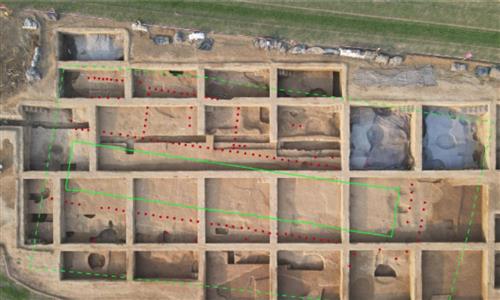
Moreover, this year's excavation revealed that within the same ramming layer, distinct differences in soil color and the distribution of ramming pits are present. This indicates the presence of two construction teams working simultaneously from the east and west toward a central line, providing rare physical evidence of the organization and management of large-scale state construction projects in the Qin Dynasty.
The basic sequence of the Epang Palace platform's construction was reconstructed for the first time: Builders first drained water from the site and cleared lakebed silt to form foundation trenches. The platform was then rammed in sections, beginning from the southern (outer) side and progressing northward. Once the foundation reached a certain height, earth was transported from south to north and compacted to form a hard-packed surface. Construction then continued upward in the northern part of the platform before gradually shifting back southward to complete the structure, with different teams operating in clearly delineated areas.
By confirming the construction sequence and technical details of the Epang Palace platform, this excavation significantly enriches our understanding of the technologies and procedures used in building monumental palatial structures, He said.
RELATED ARTICLES