SPORT / TENNIS
China expected to play a central role in BWF’s global development strategy: BWF President to GT
Tears, tributes and transition
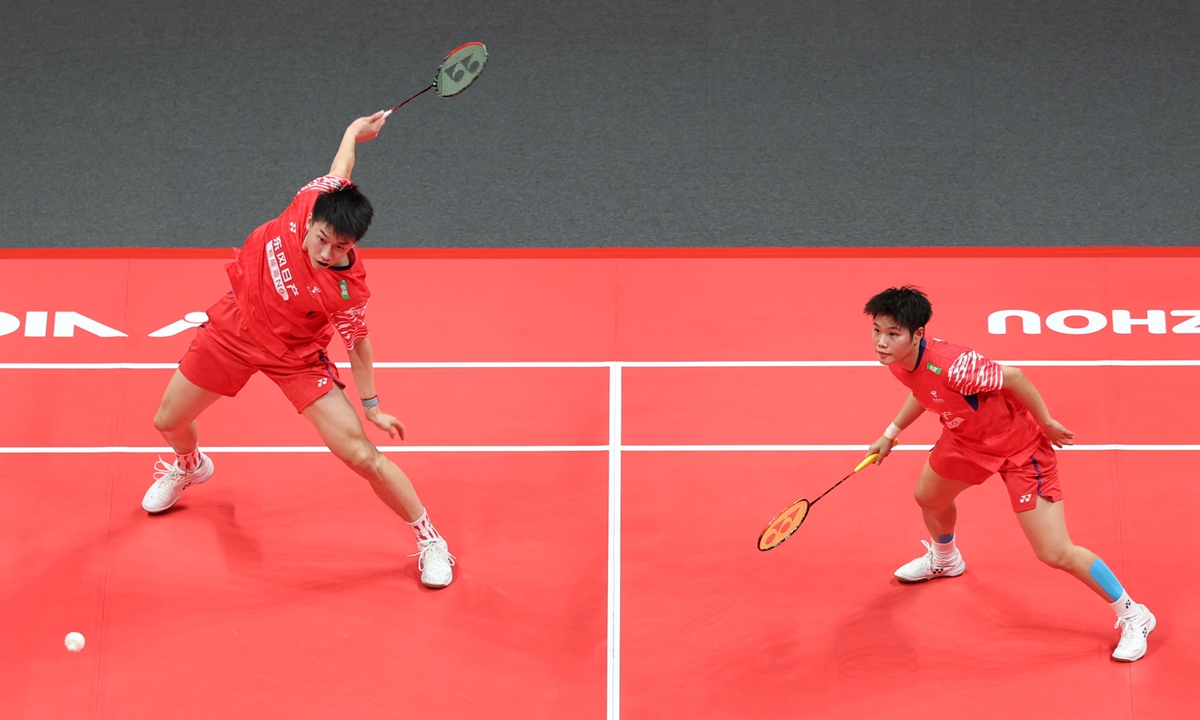
Feng Yanzhe (left) and Huang Dongping compete during the 2025 BWF World Tour Finals in Hangzhou, East China's Zhejiang Province on December 21, 2025. They secure the mixed doubles title. Photo: Cui Meng/GT
When Chinese badminton player Jia Yifan read a farewell message to her longtime women's doubles partner Chen Qingchen, whom she had paired with to win an Olympic gold medal in 2024, Jia's voice faltered as tears streamed down her face.
The scene, played out after the season-ending World Tour Finals, captured the weight of an era as Chen, along with Olympic mixed doubles winners Zheng Siwei and Huang
Yaqiong as well as men's doubles player Liu Yuchen, retired from the elite competition.
At a retirement ceremony on Sunday, when the four players walked through the tunnel, fans lit up the arena with phone flashlights, creating a sea of stars. "Your dedication and efforts have contributed to the brilliance of Chinese badminton," Zhang Jun, president of the Chinese Badminton Association, said at the ceremony.
On China's X-like platform Sina Weibo, countless users praised the athletes' past achievements and wished them well in the next chapter of their lives. One comment read: "There are always farewells in competitive sports. Here is the start of a beautiful new life together."
For the Badminton World Federation (BWF), the ceremony marked more than individual farewells. It symbolized the end of a golden generation that has shaped Chinese badminton and influenced the global stage, BWF President Khunying Patama Leeswadtrakul said.
"Chen Qingchen, Zheng Siwei, Huang Yaqiong and Liu Yuchen have defined a golden era of Chinese badminton through their excellence, resilience and sportsmanship," Leeswadtrakul told the Global Times in an email interview.
"All are multiple Olympic and World Championships medalists whose achievements have lifted global standards, inspired young athletes across continents, and strengthened badminton's international profile."
Their departure also marks a transitional moment for the Chinese team, as a new generation of players steps into the spotlight.
The Chinese badminton team finished the 2025 BWF World Tour Finals with one gold medal and four silver medals. Though the medal tally might not have been quite that satisfying for fans, it shows China's continuing prominence in the sport.
Unparalleled host
Beyond results on the court, China's influence in badminton is increasingly reflected in its role as a global organizer and facilitator of the sport.
The country has established itself as an unparalleled host for major tournaments, with a proven track record over the past few years.
Since 2023, China has hosted multiple major international tournaments, including the 2023 Sudirman Cup in Suzhou, 2024 Thomas Cup and Uber Cup in Chengdu and 2025 Sudirman Cup in Xiamen, on top of the year-ending BWF World Tour Finals in Hangzhou for the third consecutive year.
"China's success in hosting major badminton championships is built on a powerful combination of world-class infrastructure, experienced event delivery, and a deep national passion for the sport," the BWF president said.
Careful coordination among local federations, public authorities and fans ensures events are executed with precision, while maintaining an athlete- and fan-focused approach.
"Athlete- and fan-focused operations, rigorous planning, and strong community engagement are hallmarks of this success," she noted.
The BWF president said China's experience offers lessons for other regions. "These practices can be adapted and shared to help developing regions accelerate their event capabilities," she said, underscoring the potential for knowledge transfer in the global growth of badminton.
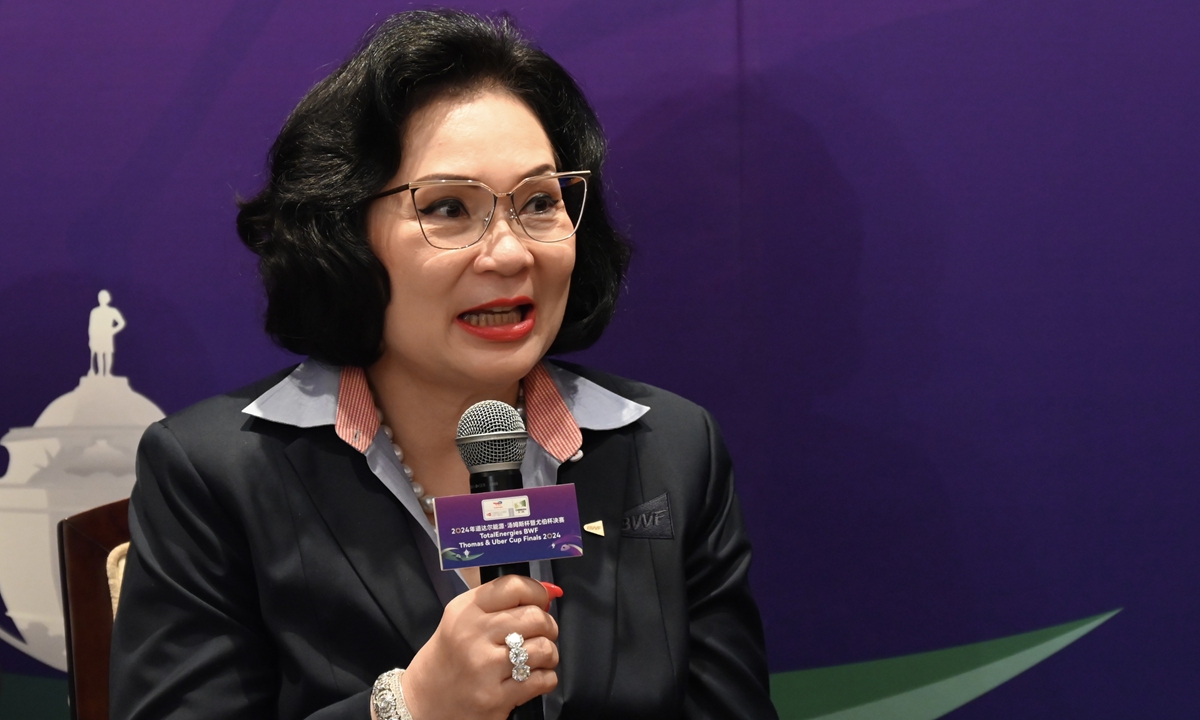
BWF President Khunying Patama Leeswadtrakul Photo: IC Photo
Evolving sportWhile strong hosting capacity underpins badminton's present, the federation is also looking ahead to how the sport can evolve globally.
As the sport looks to the future, innovation in rules and formats is also a priority, as the BWF has been trialing the best-of-three 15-point scoring system, a departure from the current 21-point system.
"The logic behind trialing the best-of-three 15-point format is to explore ways to modernize badminton in a manner that protects athlete well-being, while making the sport more dynamic, engaging, and suitable for contemporary audiences," the BWF president said.
The federation also sees significant growth opportunities outside Asia.
"Beyond Asia, badminton has significant growth potential across all continents," the president noted.
Leeswadtrakul told the Global Times that one important pathway is to explore the possible development of regional Training Centers for Excellence across different continents, alongside high-performance programs that bring together talented young athletes from diverse regions to train, learn, and compete together, informed by dialogue with stakeholders across the sport.
In addition to global expansion, badminton's inherent strengths make it uniquely positioned for long-term growth.
To connect with younger generations, the sport must continue diversifying formats and increasing its digital presence across social media and online platforms, ensuring that it fits contemporary lifestyles and remains engaging.
China is expected to play a central role in this global development strategy. "Within BWF's global development strategy, China can play a leading role together with other major badminton nations in supporting countries where badminton is still growing," Leeswadtrakul said.
In Leeswadtrakul's view, the retiring athletes themselves are also positioned to contribute meaningfully to badminton's global growth. "Retiring athletes such as Chen, Zheng, Huang and Liu can also contribute in meaningful and practical ways."
As Chen said at her retirement ceremony to her long-time partner Jia: "As long as you need me to prepare for Los Angeles, I will return to the national badminton team to train with you."
And for Olympic champion Zheng, retiring from competition is just a new beginning in contributing further into the sport. "Wherever we go and whatever we do in the future, we will never leave badminton. As long as we can contribute to the development of badminton from more dimensions, our new arena will be a broader and more meaningful one."
RELATED ARTICLES