ARTS / CULTURE & LEISURE
Jingling Mausoleum reopening brings history to life
Splendor of the Ming Dynasty
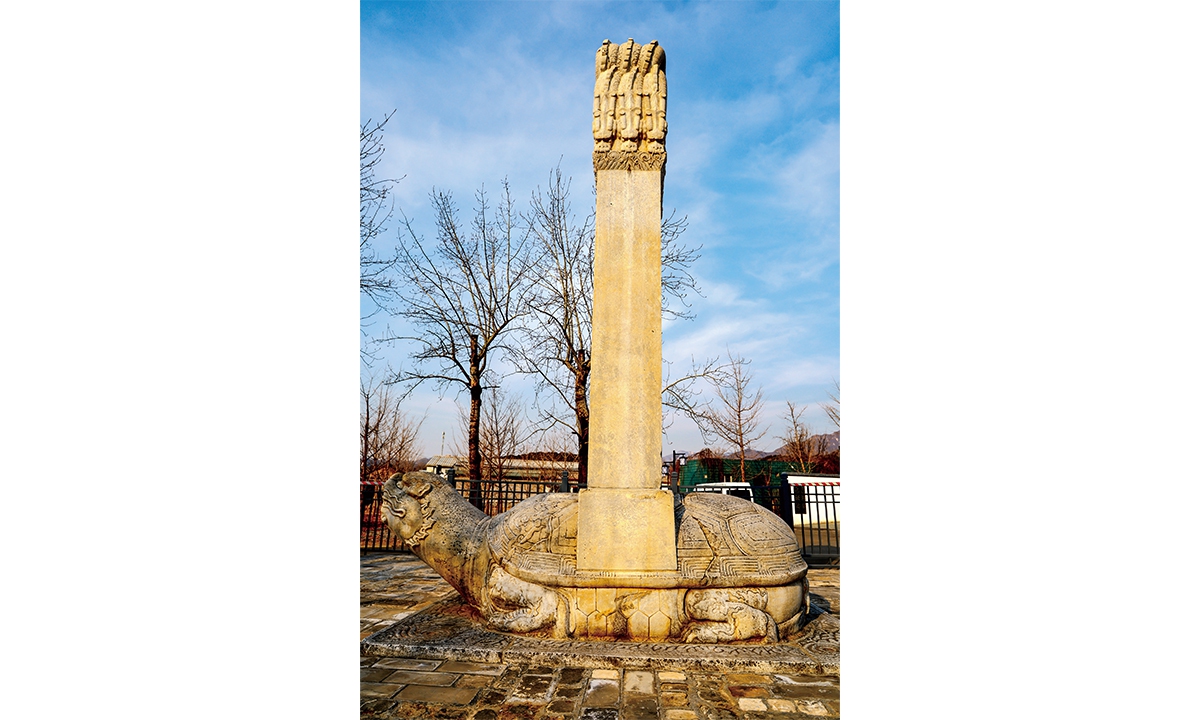
A stele at the Jingling Mausoleum in Beijing, which opens to the public through a reservation-only system on December 22, 2025. Photos: VCG
At the foot of the eastern peak of Tianshou Mountain, the Jingling Mausoleum has stood as a solemn guardian for nearly six centuries. On Monday, the mausoleum, the final resting place of the Xuande Emperor (Zhu Zhanji) and his Empress Sun, was reopened to the public as part of the Ming Tombs in Beijing.The reopening marked more than the lifting of a gate: It introduced a heritage-themed exhibition combining systematic historical interpretation with guided, on-site exploration, revealing both the symbolic order and the lived politics embedded in an imperial tomb.
The Jingling Mausoleum was built in 1435 during the Ming Dynasty (1368-1644). Though some of its structures survive only as ruins, the mausoleum's overall spatial integrity remains remarkably intact. Covering roughly 25,000 square meters, it preserves the canonical Ming imperial burial layout known as "front square, rear round," a spatial metaphor that marries Confucian ritual order with cosmological beliefs, per a local tour guide.
On reopening day, guides led visitors through the site, unpacking its architectural logic, historical background, and lesser-known anecdotes that rarely surface outside academic texts.
Walking slowly along the spirit path, visitors encounter the remains of the stele pavilion, the foundations of the Ling'en hall, and the imposing square city and Minglou tower at the rear.
Though weathered by time, the ceremonial sequence remains legible. The ritual hierarchy that once governed imperial death, its choreography of power, virtue, and memory, still lingers in stone and earth.
When TV meets history
For many visitors, the Jingling Mausoleum is not merely a historical site but a place already half-imagined. In 2019, the TV series Da ming feng hua, or Ming Dynasty, ignited popular interest in the era and elevated Zhu Zhanji from a footnote in dynastic history to a striking human figure. He stood apart from the stereotypical image of emperors bloated by indulgence or detached from reality.
Chen Tao, a guide at the site, told the Global Times that history offers a more restrained but no less compelling portrait. Zhu Zhanji ruled for only a decade, yet his reign, together with that of his father, came to be known as the "Reign of Ren and Xuan," a period remembered for political stability and relative prosperity.
The History of Ming records that "after 60 years of the dynasty, the public sentiment gradually eased, and signs of peace and good governance emerged." Chen noted that Chinese history is littered with rulers whose devotion to the arts undermined their rule. Zhu Zhanji, however, appeared to strike a rare balance. "He knew how far to go," Chen said. "His personal interests never eclipsed the responsibilities of governance."
That sense of moderation is written into Jingling itself. As the smallest mausoleum among the Ming Tombs, the reason behind its scale lies partly due to geomantic constraints: Hemmed in by narrow mountain terrain, the site offered limited space. But it was also a conscious political statement. Zhu Zhanji had left an edict calling for frugality in death, consistent with his lifelong emphasis on restraint. Like the tomb of his father, the Xianling Mausoleum, Jingling was deliberately modest in scale and labor, according to the Beijing Evening News.
Zhang Beiyu, one of the first group visitors, told the Global Times that the current admission ticket includes a guided tour lasting about an hour and a half. Guides weave in numerous historically verifiable details, complemented by elements of fengshui, adding layers of historical and geomantic insight to what might otherwise be a rather solemn visit.
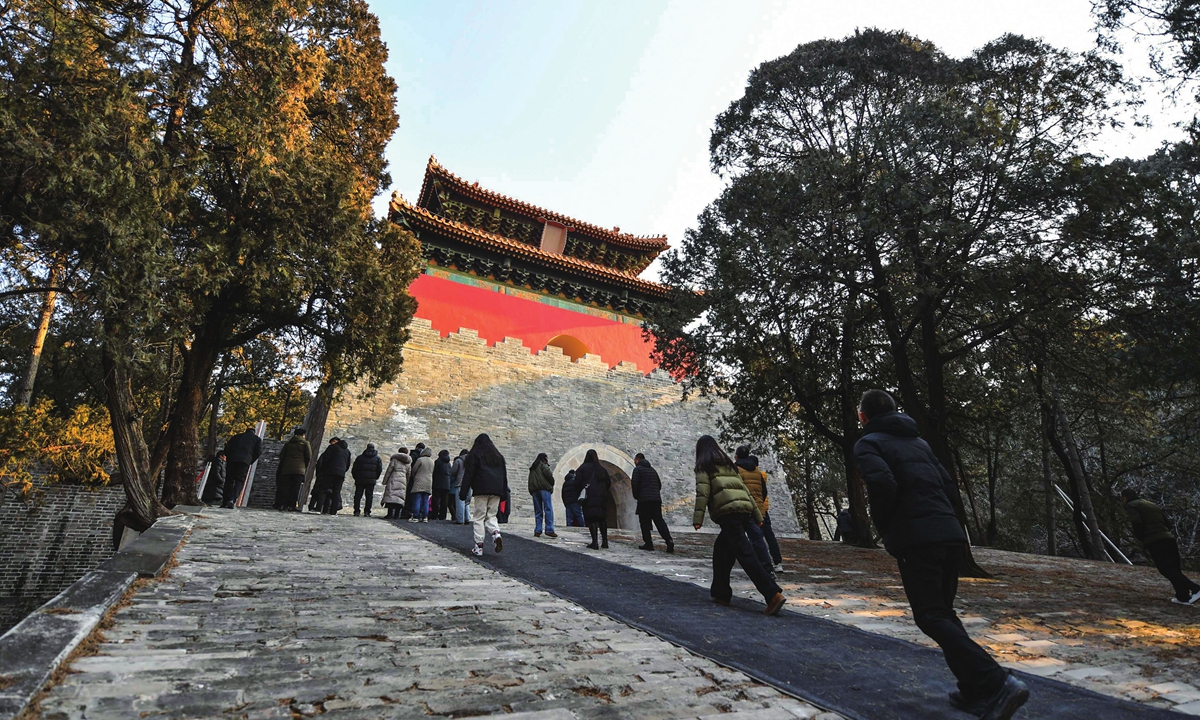
Tourists visit the Jingling Mausoleum in Beijing on December 22, 2025.
Quiet power of World HeritageJingling's reopening might feel like a return, but in fact marks a new chapter.
The mausoleum had been accessible to visitors until 1998, when it was closed to preserve its original state. In 2024, following the principle of minimal intervention, Beijing's Changping district undertook a year-long conservation project aimed at stabilizing structures, refining research, and rethinking exhibition design.
The site has now reopened in the form of a heritage-value presentation. The underground palace, however, remains closed, per the site's administration.
An official from the Ming Tombs administration office, speaking on condition of anonymity, told the Global Times that extensive preparatory work was required to ensure the exhibition's launch, from conservation and academic research to narrative planning.
In 2023, UNESCO formally included the Ming Tombs in Beijing and the Xiaoling Tomb of Ming Dynasty in Nanjing as an extension of the "Imperial Tombs of the Ming and Qing Dynasties" on the World Heritage List. While Changling's grandeur and Dingling's excavated underground palace often dominate public attention, experts emphasize that the collective planning of the necropolis is its true achievement.
Today, eight sections of the Ming Tombs are open to the public. Authorities expect that by 2030, the exhibition scope of the Ming Tombs will extend to all principal mausoleums.
According to the official, Jingling's reopening is not an endpoint but part of an ongoing process. Conservation work across the site continues, and officials see heritage interpretation as a bridge between preservation and public engagement.
"By reconnecting architecture, history, and lived experience, we hope to draw visitors not only into the past but into a deeper understanding of how power, restraint, and memory once shaped the empire, and how they continue to resonate in stone, silence, and time," the official said.
RELATED ARTICLES