ARTS / CULTURE & LEISURE
Young people seek visually immersive experiences
New Year’s Eve ‘light-chasing’
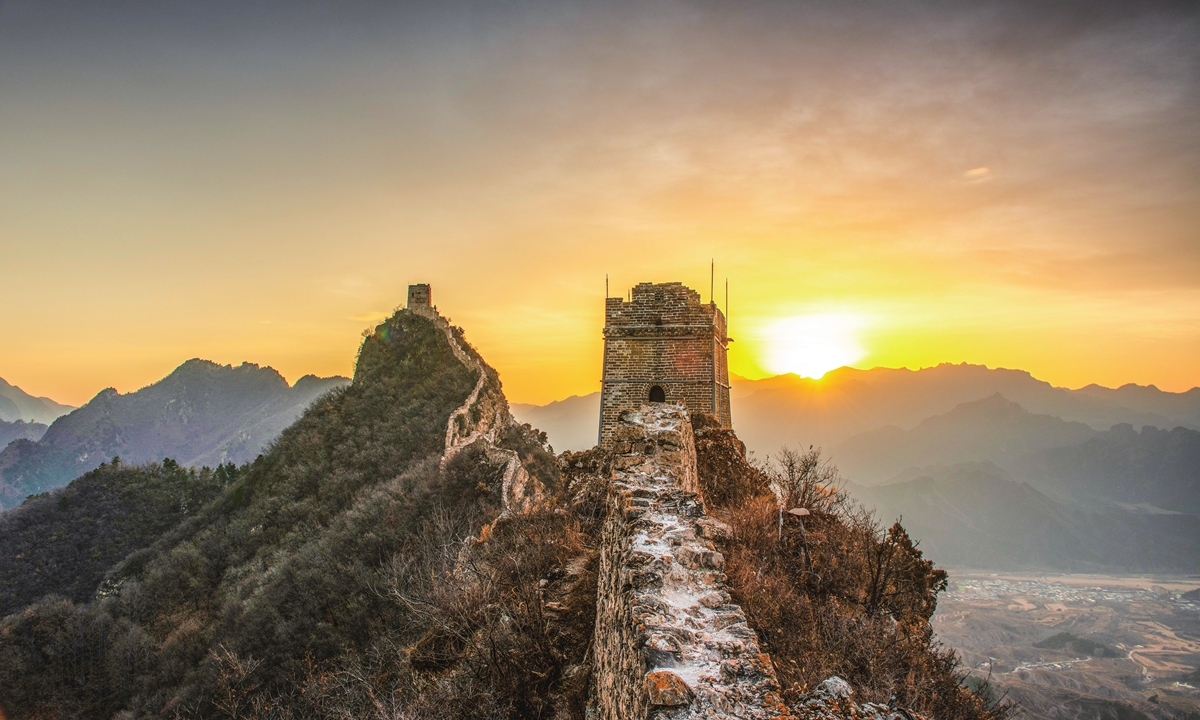
The sun rises over the Simatai section of the Great Wall in Beijing on November 26, 2025. Photos: VCG
Across cities in China, as night falls, lights begin to shine on riversides, city walls, and public squares. Music drifts through the air, and crowds gather to enjoy fireworks, drone shows, and light installations. This is the scene many young people have come to seek during the year-end celebrations.For them, following the light displays, moving from one show to another, has become a way to experience a city after dark, a new trend called "light-chasing."
Data from Chinese tech-driven retail company Meituan Travel shows that since mid-December, searches for "New Year's Eve fireworks shows," "New Year's Eve concerts," and "New Year's Eve bonfire camping" - all part of the "light-chasing" trend - have surged by over 500 percent. Meanwhile, tech-heavy "cyber New Year" experiences such as drone countdowns have seen even faster growth.
This shift is reshaping how people spend the New Year's Eve.
Enlighten darkness
Unlike traditional holiday consumption focused on sightseeing, shopping, and dining, the New Year's Eve emphasizes key moments and emotional intensity. For many young people, December 31 is no longer just about "waiting for midnight": It has become a continuous, immersive experience that lasts the entire night.
In Beijing, the "light-chasing" route stretches across the capital city: The Yongle Bell at the Big Bell Temple (Dazhongsi) will ring; a drum performance will take place at the Juyongguan section of the Great Wall in suburban Beijing; and the Gubei Water Town will simultaneously host a concert, a drone countdown, night tours, performances and accommodations.
More than 40 museums in Beijing are holding the New Year's Eve events and will extend business hours, with over 20 museums staying open until the wee hours of January 1 to welcome 2026.
The New Year's Eve has been broken into multiple consecutive consumption and experience nodes, according to Beijing Daily.
Zhu Yue, a 28-year-old employee at a state-owned enterprise in Beijing, told the Global Times that she had already planned her itinerary in advance: "On the December 31, I'll drive to the Gubei Water Town after work, enjoy the concert and drone countdown, return to my guesthouse after midnight, and head to the Simatai [section of the] Great Wall the next morning to catch the sunrise."
"If it were just about waiting for midnight, I could stay at home. But if I want to have the full 'light-chasing' ritual, I might as well fill the whole night," she said.
Zhu said the lights, the music, the fireworks, and the changes in scenery bring the entire city to life.
Liu Haoqiu, a cultural tourism event planner and tour guide based in Shanghai who also loves "light-chasing," told the Global Times on Wednesday that he usually plans night tour activities, so every New Year's Eve he goes to different light shows and drone performances to experience them firsthand.
"The most striking thing is the lights themselves: The colors, the patterns and the movements are immediately captivating," he said. "When combined with music and the flow of people through the city, the atmosphere forms naturally. It's not just about entertainment; it's about how these elements bring urban spaces to life and create shared moments."
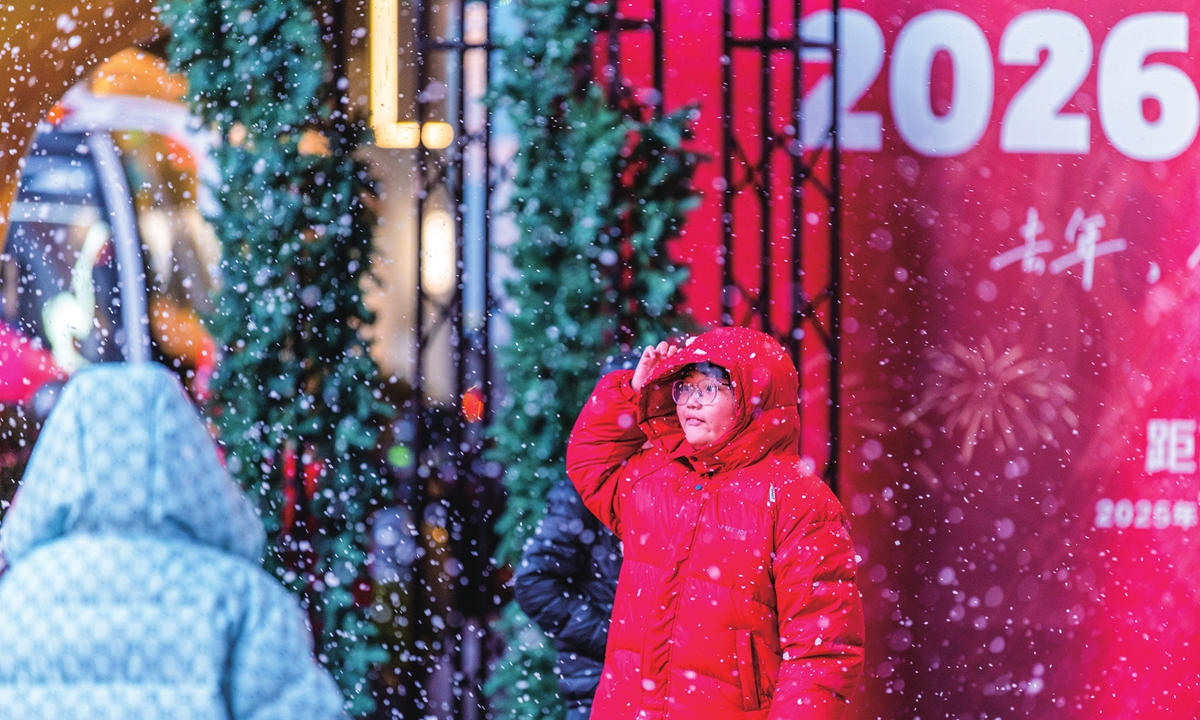
People enjoy the festive atmosphere created by artificial snow nearby the countdown clock for the 2026 New Year in Jinhua, East China's Zhejiang Province on December 21, 2025.
Lingering heatWhile the New Year's Eve events create a sense of ritual, they are also driving consumption across the full chain - from accommodations and dining to retail.
Many restaurants are incorporating festive moods into their offerings, from limited New Year's Eve set menus to brunches on the New Year's Day, attempting to link dining directly with the celebrations. Some cultural and tourism projects are combining night tours with sports and leisure, launching hybrid experiences such as "hot spring + night tour" or "skiing + countdown."
Guan Dongxu, a professional working for an online travel platform, told the Global Times that the key to this type of "light-chasing consumption" is not a single event but the extension of time. People are willing to pay for experiences that last the entire night, which naturally boosts accommodation and the next-day spending.
"New Year's Eve is one of the few 'all-night consumption windows.' When the night is activated, the entire consumption chain extends naturally," he noted.
According to Beijing News, visitors to Shanghai and Beijing often search for New Year's Eve fireworks. In contrast, tourists to Southwest China's Chongqing Municipality and Wuhan, capital of Central China's Hubei Province, tend to look for "New Year's Eve sky lanterns," while those to Shenzhen, South China's Guangdong Province and Xi'an, capital of Northwest China's Shaanxi Province prefer "New Year's Eve drone shows."
Guan said the differences in preferences across regions also reflect the unique characteristics of "light-chasing" New Year's activities and the cultural distinctions of each city.
"These differences show that 'light-chasing' New Year is not just an event format, but a reflection of local culture and lifestyles," he said. "It also means that local cultural and tourism planners can leverage the regional characteristics and visitor preferences to extend the consumption chain, making each city's New Year's Eve a unique experience of light and emotion."
As the night unfolds, the "light-chasing" phenomenon shows that New Year's Eve is no longer just a moment on the clock, but a living and moving experience that connects people, spaces, and cities. From fireworks and drone shows to illuminated streets and night tours, each display of light reflects both the city's energy and the collective mood of its visitors.
RELATED ARTICLES