ARTS / CULTURE & LEISURE
New starting point for cultural and tourism cooperation between China, Uzbekistan: Uzbek official
Friendly destinations

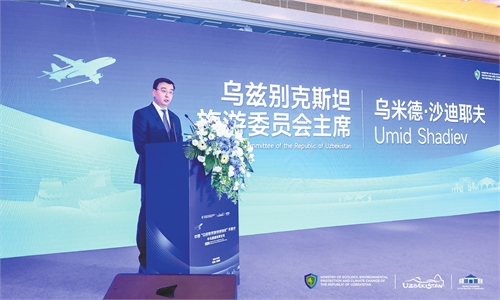
Feruz Dodiev, advisor to the chairman of the Tourism Committee of the Republic of Uzbekistan, addresses attendees at the closing ceremony of the "2025 Uzbekistan-China Tourism Year" in Beijing, on December 22, 2025. Photo: Dong Feng/GT
Editor's Note:Both China and Uzbekistan are ancient civilizations, and the great Silk Road has borne witness to the friendly exchanges between the two peoples over the past 2,000 years and beyond. Today, both sides are working together to deepen cultural and people-to-people exchanges and promote friendly relations. As the visa-free policy took effect on June 1, 2025, the number of tourists traveling between the two countries continues to increase. Global Times (GT) reporter Dong Feng interviewed Feruz Dodiev, advisor to the chairman of the Tourism Committee of the Republic of Uzbekistan, who summarized the cooperative achievements of the "2025 Uzbekistan-China Tourism Year" and expressed optimism for the prospect of bilateral cooperation.

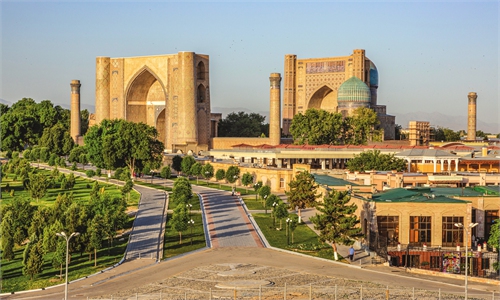
Tourists visit downtown Samarkand, Uzbekistan in April 2025 Photo: VCG
GT: In June 2025, the visa-free agreement between China and Uzbekistan came into effect. How do you evaluate the overall situation of personnel exchanges between the two countries, and what are the typical characteristics of current personnel exchanges?Dodiev: After the introduction of the visa-free scheme, we have seen the volume of travel increase in different directions, not just in tourism - business travel to Uzbekistan is also becoming quite popular.
We have even seen the increase of transit visitors because it has become more convenient and easier to travel to some other destinations [through Uzbekistan] to Russia, and Europe. For example, we have made a good connection with cities like Istanbul, Dubai, and others.
Generally, in terms of tourism and tourist flow, we are very happy that we have this visa-free scheme now because we [have] not just doubled, but more than tripled tourist numbers compared to the same period [the first 11 months] in 2024.
Another important reason why we have such a good result is that we increased flight numbers and the number of cities connected to Uzbekistan.
GT: How does Uzbekistan view its increasingly close people-to-people exchanges with China?
Dodiev: The massive increase in inbound travelers from China has also occasioned an increased demand for different travel programs, for example, tours to various sites. In terms of service delivery, when you have two to three times more travelers coming from China, of course there will be a gap that should eventually be filled. There will also be some new requirements for local suppliers in the hospitality industry or restaurants.
We have put up Chinese signs and directions in major cities. We are now recommending to most of our restaurants to have menus printed in Chinese.
We have also published a special phrases and expressions book, listing the 100 most important sentences and phrases used in the country. All these important sentences are translated into Uzbek so that tourists can more easily ask how much some souvenirs cost, order something, or buy something. So, we are trying to make their travel experience easier and more comfortable.
GT: What are the positive effects that the increase in Chinese tourists has brought on Uzbekistan?
Dodiev: I think it's more about new, interesting projects, because we have a lot of business people who are now coming to Uzbekistan as tourists. But while visiting the country as a tourist destination, they have a chance to meet up with some local business people or with some local government agencies to see what is still needed in the business market.
We see a lot of such successful cases, from small ones to the big projects. This year, we saw at least 20 new Chinese restaurants open in Tashkent. For instance, bubble tea shops have become quite popular and are opening up, and people like them.
There are big projects such as big housing projects being invested into and constructed by Chinese partners. There are also infrastructure projects, manufacturing, and other different kind of projects in various sectors.
GT: How will the increased people-to-people exchanges help both countries achieve the shared goal of sustainable socioeconomic development?
Dodiev: I think people-to-people dialogue is the most essential part of any development. If the people of Uzbekistan build a friendship with the people of China, cities in both countries are also likely to see increased exchanges.
That's why I wholeheartedly agree that the most important attention should be given to people-to-people communication. Introduce the two peoples to make them familiar with each other, not just on a general level like country to country, but in going to the grassroots; going between the provinces, cities, and communities for better effectiveness and efficiency.
GT: How would you analyze any challenges that Chinese might face when traveling to Uzbekistan? What improvement measures does Uzbekistan plan to implement to address these issues?
Dodiev: The main challenge of this speedy increase was that we, at the beginning, lacked tourist guides proficient in the Chinese language. When we had this sudden increase [in tourist numbers], it was very difficult to catch up, because finding or training such skilled tour guides requires some time. We engaged all universities that have Chinese speaking specialists, giving them subsidies, and assisting them in organizing additional courses. This problem was already solved.
We are catching up now and even trying to develop more specialists for tour groups in Uzbekistan. We decided to create an online travel platform of Uzbekistan, which will offer about 10 to 15 different languages, including Chinese.
There will be some online AI assistance offered within the system, so they can place orders as they would in China. I know that Chinese people use AI to book flights, trains, and navigate. We are creating something similar, so it will be very easy for them to organize their travel itineraries.
RELATED ARTICLES