ARTS / CULTURE & LEISURE
Qing Dynasty’s imperial office in Palace Museum reopens after 10 years of restoration
Restored to former glory
By Published: Dec 26, 2025 10:07 AM

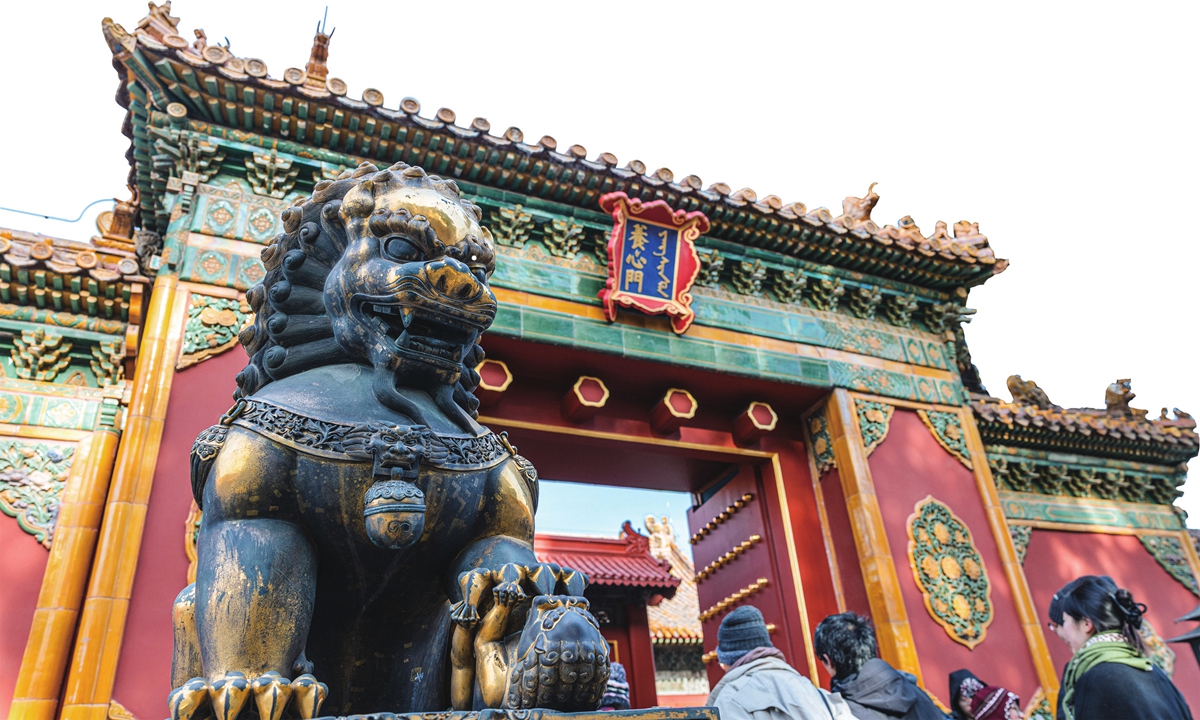
Tourists walk through the Gate of Mental Cultivation (Yangxinmen), which is the entrance to the Hall of Mental Cultivation (Yangxindian), an important building in the inner courtyard of the Palace Museum on December 26, 2025. Photos: Li Hao/GT
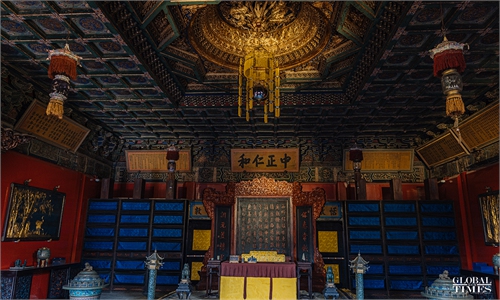
After nearly one decade of research-based conservation and systematic restoration, the Hall of Mental Cultivation, or Yangxindian, at the Palace Museum reopened to the public on Friday.Visitors rushed to the Hall of Mental Cultivation in flocks on Friday morning when this section of the Palace Museum was announced reopened. At noon time, the hall "was so crowded that we could barely move," as some visitors told the Global Times.
"It was deeply impressive to see the real Hall of Mental Cultivation with our own eyes," one of them said.
The Hall of Mental Cultivation was built in 1537 during Ming Dynasty (1368-1644) and rebuilt during the reign of the Qing Dynasty's Yongzheng Emperor (1722-35). The Yongzheng had the entire area repurposed from the former imperial workshop to the imperial office where he lived and handled state affairs.
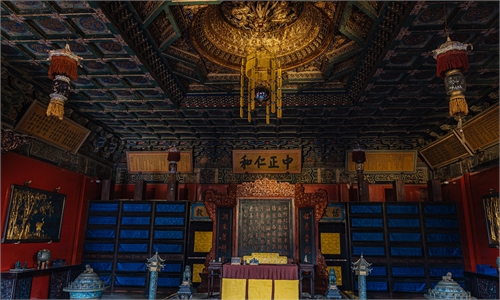
The main hall, where Yongzheng often handled state affairs and was often filmed in movies and TV series, was the most crowded as many people expected to "see the history."
"It is my first time visiting the Hall of Mental Cultivation. Every corner has left a deep impression on me," a visitor surnamed Cai from Guangdong Province told the Global Times. "Through the glass panes, I could vividly sense the weight of history."
A 25-year-old visitor surnamed Zhou from Central China's Henan Province is a fan of Qing Dynasty TV series. "The Hall of Mental Cultivation appears in so many TV dramas that I love and it is kind of a dream coming true to see the real one," she said.
Since 2015, the project has effectively addressed the structural issues in the building itself, restored and sustained the health of the hall area, and improved the conservation environment for the interior artifacts.
According to the Palace Museum, numerous long-hidden historical details and the ingenuity of ancient craftsmanship came to light during the restoration.
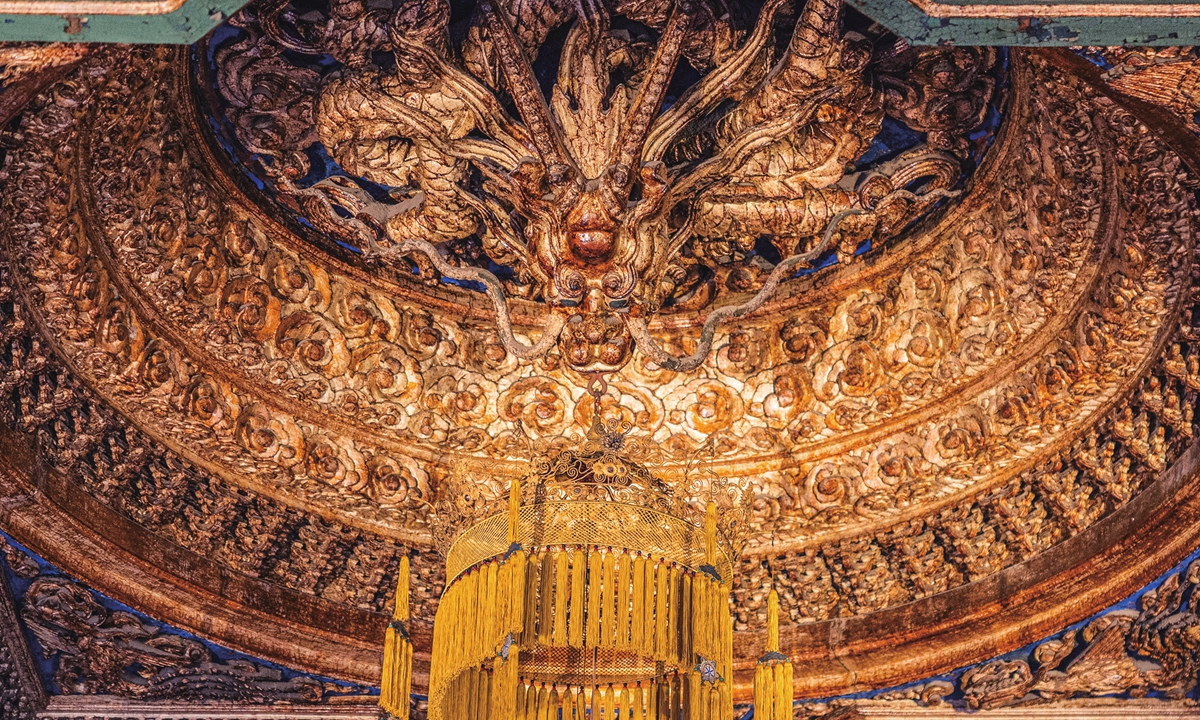
A caisson ceiling of the Hall of Mental Cultivation (Yangxindian) at the Palace Museum
The large plaque from the main hall of the Hall of Mental Cultivation was removed for conservation during the project, said Wang Hui, director of the Engineering Management Department of the Palace Museum. The wooden carvings on the plaque were restored. It required the combined efforts of five or six workers to reinstall the plaque, weighing over 200 kilograms, in its original position on September 22."The plaque has two dragon heads at its center. The upper one is missing, while the lower one has a damaged nose," said Li Jingyuan, head of wooden artifact restoration at the museum.
The missing areas left irregular curved surfaces following the wood grain. Conventionally, restorers would first flatten the damaged area, then attach a carved replacement part using fish bladder glue. However, this approach inevitably damages the historical traces on the original surface. With 3D scanning technology, the interface of the replacement carving can now be fabricated to match the damaged area precisely, achieving truly "lossless" restoration.
With each stroke of the knife and every carve and fill, relic restorers strive to recover historical details.
"The dragons on this plaque have a youthful posture. By the reign of Qianlong Empror, dragons have come to appear more composed, with a tenser expression," explained a restorer, citing the dragon heads as an example. The upper dragon on the plaque has a small, round face, as it is fully visible to viewers, while the lower dragon, with only its chin showing, has a broader face. "When making replacement carvings, we deliberate carefully and adjust repeatedly to finally achieve visual harmony."
During the "dissection" of a drainage column in the auxiliary structure of the main hall, workers discovered that the internal metal pipe was made of a tin-lead alloy, a material offering properties such as water resistance and atmospheric corrosion resistance, making it well suited for drainage purposes.
The transparent skylight on the north wall of the Eastern Warm Chamber, used for admitting light, was carefully examined and analyzed. It was confirmed to be a "shell-made window tile" crafted from thousands of polished oyster shells sourced from the ocean. This material is both translucent and flexible, shimmering and shining brilliantly in sunlight.
Furthermore, within a brick-carved ventilation opening, two sheets of opera performance programs from the Qing Dynasty for Spring Festival celebrations were discovered, providing precious physical documentation for the study of imperial entertainment culture.
The infusion of modern technology empowered the restoration work with greater precision. The restoration team utilized 3D scanning technology to create digital archives for all artifacts, clearly documenting traces of structural deterioration and weathering.
To address the challenge of lighting in ancient building halls, they researched and implemented fiber optic lighting adjustment systems, optimizing the visitor experience while ensuring the safety of the artifacts.
The conservation and restoration of movable cultural relics in the Hall of Mental Cultivation were carried out in strict accordance with the principles of cultural heritage conservation. Leveraging technological advancements, digital technologies were introduced as auxiliary tools in the restoration processes, achieving excellent results.
The display of the Hall of Mental Cultivation preserves the authentic arrangements from the reigns of the Yongzheng (reigning 1723-35), Qianlong (reigning 1736-95), Tongzhi (reigning 1862-74), and Guangxu (reigning 1875-1908) emperors, featuring a total of 1,020 displayed artifacts, said Wen Ming, the Palace Museum's Deputy Director of the Court History Department, the Xinhua News Agency reported on Friday.
The main chamber of the hall is arranged according to its appearance during the informal imperial audiences held since the Yongzheng reign. His son the Qianlong Emperor kept three cherished calligraphic masterpieces in the westernmost chamber of the hall and named the chamber the Hall of Three Rarities, or Sanxitang.
The Eastern Warm Chamber, which has undergone the most significant changes in interior layout within the hall, follows the scene where the practice of "ruling behind a curtain" by the Empress Dowager Cixi (1835-1908) took place in the late Qing Dynasty.
All 184 paper- and silk-based cultural relics, including calligraphy works, paintings, inscribed boards, and couplets, along with 255 textile artifacts, have been uniformly replaced with high-quality replicas for the display. This measure allows the originals, which are highly sensitive to light, to be preserved more effectively in the controlled environment of the storerooms, while maintaining the authentic visual effect of the Hall of Mental Cultivation's historical restoration display.
RELATED ARTICLES