National grain output hits new high in 2025 despite successive severe natural disasters
Achievements will safeguard food security, bolster economic devt: expert
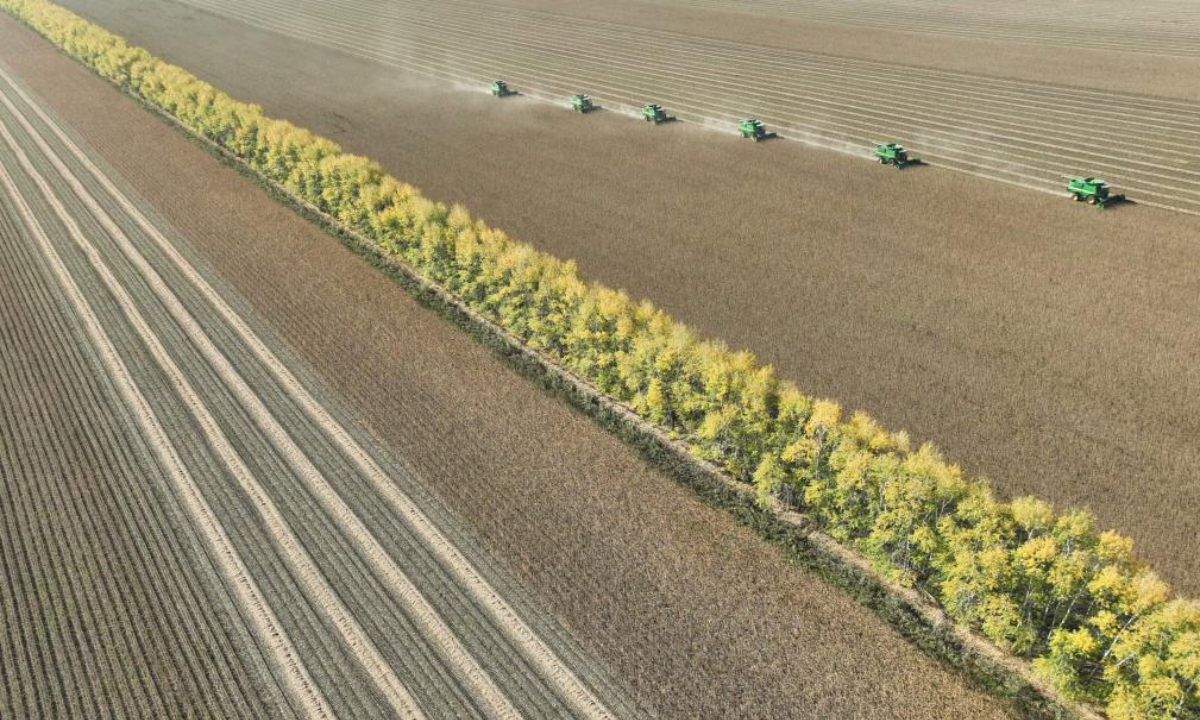
An aerial drone photo shows harvesters working at a soybean field of a farming company under Beidahuang Group in ortheast China's Heilongjiang Province, Sept. 30, 2025. Heilongjiang Province, a major grain producer in northeast China, saw its 22nd bumper harvest with a record-breaking grain output reaching 82 million tonnes this year, data from the National Bureau of Statistics (NBS) showed on Friday. Photo: Xinhua
In 2025, China's national grain output reached a new high of 715 billion kilograms, up 1.2 percent year-on-year, building on the high base of surpassing the 700 billion-kilogram milestone for the first time last year, China Media Group reported on Sunday.
Despite a string of severe natural disasters this year, including spring drought, summer high temperatures and seasonal drought, and continuous autumn rainy weather, the achievement of a bountiful harvest has been hard-won, the report noted.
A Chinese expert attributed the achievement to effective measures taken in response to natural disasters, as well as continuous improvements in grain production capacity, noting that the stable grain output has played a positive role in addressing potential international risks, safeguarding food security and supporting economic and social development.
In 2025, the Northeast and Northwest regions of China became the main drivers of increased grain production. At the same time, in the Huang-Huai-Hai major producing area - comprising seven provinces including North China's Hebei, East China's Shandong, Central China's Henan and East China's Jiangsu provinces - which features flat terrain and abundant water resources, yields have continued to rise through concerted efforts despite frequent natural disasters, according to the report.
Henan Province in Central China has dredged more than 100,000 kilometers of ditches and canals in recent years. This year, it has achieved full connectivity of existing rural ditches and canals, enhancing the capacity for irrigation during droughts and drainage during waterlogging.
Additionally, 286 agricultural emergency service centers and 716 agricultural machinery emergency response teams in the province are on standby around the clock, ready to promptly address disasters and safeguard grain production during key periods, the report added.
In addition to the Huang-Huai-Hai region, grain-producing areas across China have been continuously strengthening themselves, as farmland infrastructure has been steadily upgraded, large-scale efforts to increase yields per unit of area have continued to expand, and the foundation of the nation's grain reserves has been consistently reinforced, said the report.
"China's grain output has remained stable above 700 billion kilograms for a second year, demonstrating that, through years of development, the country's grain production capacity has continuously improved and reached a new level," Li Guoxiang, a research fellow at the Rural Development Institute of the Chinese Academy of Social Sciences, told the Global Times on Sunday.
Li noted that in the current environment where international uncertainties are prominent, the stable-yet-progressing grain output has played a positive role in addressing potential international risks, stabilizing domestic prices, and supporting economic and social development.
The expert noted timely and effective responses by localities to frequent natural disasters in certain regions, as well as continuous efforts to enhance grain production capacity.
According to the report, China's main grain crops include corn, rice, soybeans and potatoes. This year's increase in grain output was primarily driven by corn, a high-yielding crop, which is the country's largest grain crop, accounting for 42.1 percent of total grain output in 2025.
This year, the sown area for corn increased by 3.3 million mu (220,000 hectares), equivalent to the grain planting area of a major grain-producing county. In terms of yields, the corn yield per mu rose by four kilograms in 2024, and by more than seven kilograms in 2025, said the report.
The dense planting precision regulated model, which serves as the core of the national corn yield improvement project, has been promoted and applied in major producing regions including the Northwest, Northeast, Huang-Huai-Hai and Southwest, with a nationwide promotion area of nearly 100 million mu in 2025, the report said.
"Under support policies, the country has focused on stabilizing sown areas, promoting large-scale improvements in per-unit-area yields, and relying on technology and equipment to develop grain production capacity," Li noted.
On December 24, China's National Development and Reform Commission said that it would intensify efforts to implement a new round of initiatives to raise grain production capacity by 100 billion jin, with a focus on boosting corn and soybean output while consolidating and enhancing staple grain production.
Li noted that the expansion of grain production capacity is primarily aimed at meeting domestic demand and strengthening supply resilience. The core objective is to enhance strategic autonomy and safety buffers, creating greater room to safeguard food security amid rising uncertainty in the global trade environment, he said.
RELATED ARTICLES