ARTS / CULTURE & LEISURE
Ending medicine chase -- a rural family's relief amid China's livelihood initiative
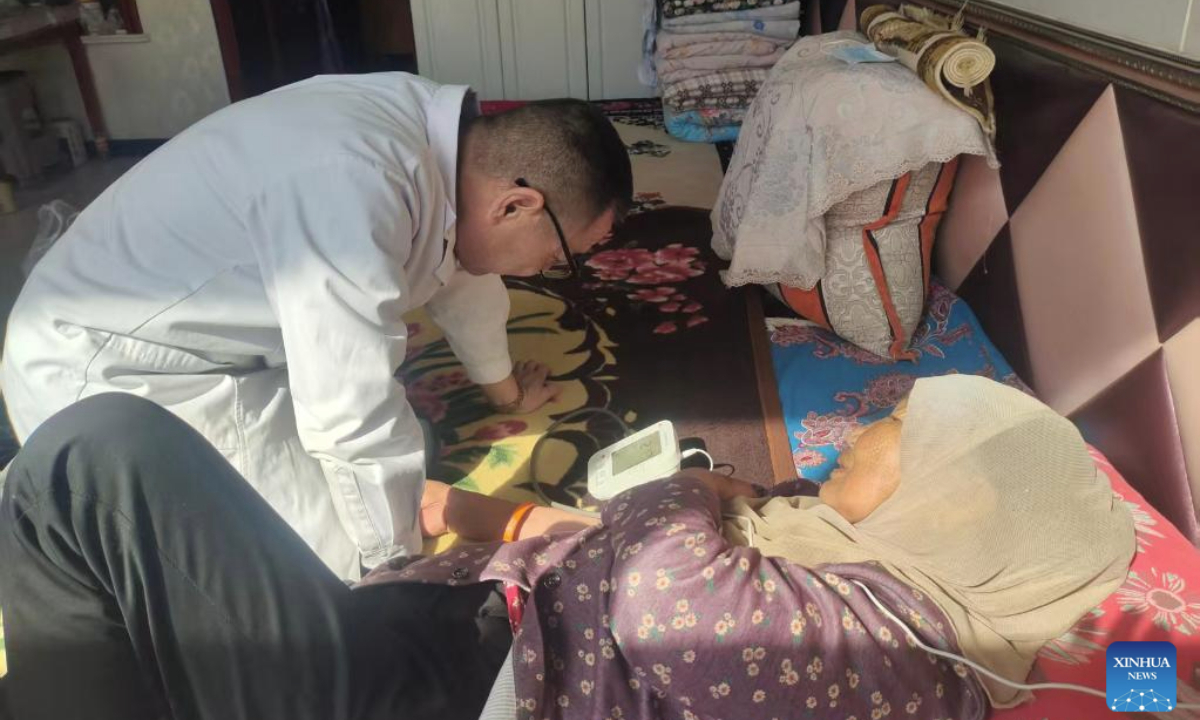
This undated photo shows Ma Junling (L), a doctor from the health center of Hexi Township, measuring blood pressure for Yang Meilan, in Tongxin County, northwest China's Ningxia Hui Autonomous Region. (Xinhua)
After Yang Meilan, 70, finally reached a point in her life where she no longer had to worry about food, clothing, her children's tuition, or the roof over her head, she still faced one lingering hassle: getting the medicine she needed for her chronic condition -- medicine that wasn't available in her town.Yang hails from Hexi Township, Tongxin County in northwest China's Ningxia Hui Autonomous Region. This area is part of the Xihaigu region, which used to be called the least suitable place for human settlement by UN experts because of its harsh droughts and delicate ecosystem.
Thanks to continuous poverty-reduction efforts over the years, all 1,100 impoverished villages in Xihaigu had been lifted out of poverty by 2020, with 803,000 people shaking off poverty over the decade since 2011. Yang is one of them.
Today, Yang's family farms land, grazes five cattle and 30 sheep, and lives on an annual per capita income of approximately 26,000 yuan (about 3,695 U.S. dollars).
But there's still one frustration hanging over her. Ever since Yang was diagnosed with a chronic kidney condition at 53, she's poured considerable time and money into trips just to get the medication she needs -- Roxadustat. Sometimes she would travel to Yinchuan, the capital city of Ningxia, and sometimes to Xi'an or Lanzhou, nearby provincial capitals.
The travel fare and accommodation could easily add up to nearly a thousand yuan just for one trip, Yang recalled, saying, "You have no idea how hard it used to be to get medicine." Aside from the travel expenses, medicines prescribed in another provincial region used to mean a lower coverage of reimbursement.
Yang's struggle with access to special medication tests the local government's commitment to addressing even the minute but pressing concerns of residents, particularly rural residents who have just shaken off poverty.
Such efforts by local governments have been underway in recent years, with many focusing on addressing a specific concern that affects people in need.
The recommendations for formulating China's 15th Five-Year Plan (2026-2030) for national economic and social development identify the goal of "strengthening inclusive, fundamental, and essential livelihood initiatives to address the pressing concerns and difficulties of the people."
Tongxin County is taking this to heart. The county has a permanent population of over 300,000, but only a few hundred individuals need special medications. "There aren't many people in our village with my condition. I used to think that no one would care about such a minor issue. It surprised me that it would one day get addressed," Yang said.
In 2025, the county implemented a unified procurement system. The special medication needs of residents were gathered at the village level through door-to-door visits and then reported to the county pharmacy for centralized purchasing and distribution.
"Your medicine has arrived. Please come and pick it up," Yang is informed by her village doctor over the phone each month -- the call that she is always happy to receive.
"Our county has largely resolved the issue of medical access for the public. At present, 214 individuals benefit from the 'door-to-door medicine delivery' service, which would save a total of nearly 560,000 yuan annually in extra costs previously incurred from purchasing medications outside the county," noted Jin Zicai, director of the Tongxin County health bureau.
The county has set up a "green channel" to speed things up. For life-saving drugs like Clonazepam, when the county's central pharmacy receives urgent requests from township clinics, it immediately activates the "green channel" to complete procurement, approval, and delivery as quickly as possible.
"For any family, life truly feels hopeful when the sick member does not have to worry," said Ma Chengxiao, Yang's husband. He noted that the Roxadustat his wife is currently taking costs only 232 yuan per month after reimbursement, saving them over 2,000 yuan compared to the previous combined costs of medication and travel.
He added that this convenience not only eased the family's financial burden but also allowed them to focus more on working toward prosperity. "The money saved over the year could be spent on buying some nice food and drinks, and the rest is still enough to raise a few more calves," Ma said.
