BRASIL 247 / MORE
Brazil is heading toward the lowest poverty and inequality levels in its history
Minister links projected 2026 social gains to Lula's integrated policies, highlighting hunger reduction and Bolsa Família redesign
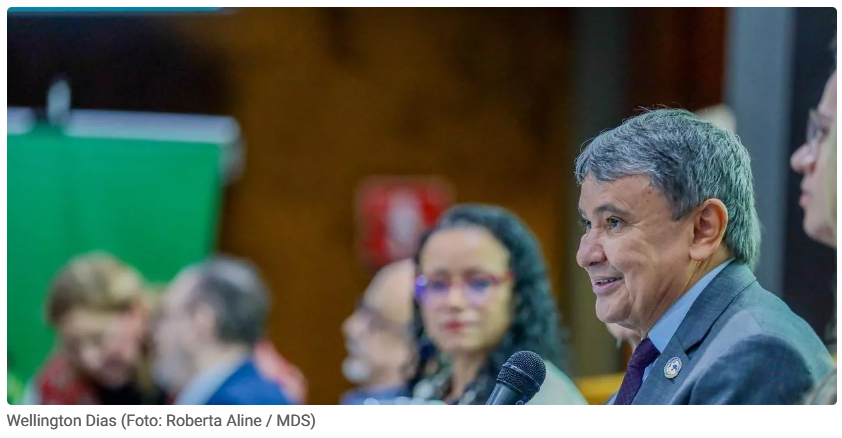
Photo: screengrab from the official website of Brasil 247
By Brazil 247 - Brazil's social development minister Wellington Dias said the country is on track to reach the lowest levels of extreme poverty, poverty, and inequality ever recorded, projecting 2026 as a year of major social advances tied to policy coordination across government.
Speaking in an interview on Voz do Brasil, in content published by Agência Gov, Dias said Brazil is moving toward "the lowest level of extreme poverty and poverty in all of history" and "the lowest inequality index," arguing that 2026 could become "a year of great victories for the social area."
Dias said Lula's return to office in 2023 allowed the country to resume and strengthen anti-hunger policies with faster results. "I say this to underscore: back then we celebrated an achievement that took us 11 years to reach. Now, in just two years, under President Lula's leadership, we took more than 30 million people off the hunger map, according to FAO surveys. It was the largest contribution to reducing hunger in the world," he said.
Discussing Brazil's official removal from the UN Hunger Map, Dias stressed that the milestone shows the impact of government choices and cited undernourishment figures and the methodology based on a three-year average. "Why? Because we closed that year with 2.5% of the population in so-called undernourishment or malnutrition in hunger, that is, insufficient food. And we closed 2024 at 1.7%. It is measured over a three-year period; the three-year average is what counts," he said.
The minister attributed part of the progress to upgrades in the Cadastro Único (CadÚnico) registry and closer integration with health and education services through what he called "active outreach." He described a state approach that identifies malnutrition in basic health units and then mobilizes social assistance, health, and education networks as needed.
On Bolsa Família, Dias argued the program goes beyond cash transfers and emphasized changes designed to prevent families from falling back into hunger as they move in and out of employment. "It is a model called active outreach; the Bolsa Família model itself is a new Bolsa Família, it guarantees a volume of resources capable of buying food, because it has a value around R$ 230.00 per person in the family, that is what we pay," he said. He also highlighted a rule meant to ensure benefits end only after a durable escape from poverty. "And it is still a model in which, once you enter, you only leave upward," he said, adding: "And now, when there is a job, when there is a small business, you do not leave the benefit, you do not leave Bolsa Família because of the job, because of the business; you only leave when you leave poverty."
Dias also pointed to youth mobility indicators, citing a study that, over 10 years, 70% of adolescents left Bolsa Família, linking the result to integration with education and nutrition policies. "Look, Bolsa Família is not just an income transfer. It is integrated with food supplements, school meals, and now, with full-time school, lunch and snacks," he said. He added: "Approximately three million young people who were between 15 and 17 years old in 2014—since then, of those young people, for every 10, 7 left. So, three million young people overcame poverty. Most completed technical education or higher education."
On international coordination, Dias recalled that he co-chairs the Global Alliance Against Hunger and Poverty alongside Spain, an initiative launched under Brazil's G20 presidency, and argued that global action is needed to meet Sustainable Development Goals by 2030. "That is how President Lula, during Brazil's presidency of the G20, proposed—and it was approved—the Global Alliance Against Hunger and Poverty, of which today I am the co-chair, together with Spain," he said. He noted that conflicts and climate crises have worsened hunger worldwide and said Brazil's approach has drawn attention from other countries.
Looking ahead to 2026, Dias said Brazil should enter a new cycle that combines economic growth with inequality reduction and stronger public services, including public security and social protection. "And let 2026 come, and a Brazil even more prepared to grow the economy, to improve health and education, to improve security," he said. He also mentioned Lula's guidance on tackling multiple forms of violence. "The president focuses; he wants to fight, for example, violence against women, assault, robbery, theft. But also to go after the big ones," he said, concluding: "With this strength, integrated work, all of Brazil, 2026 will be a year of great victories for the social area."
(Reported by Brasil 247 on December 30, 2025)
