ARTS / ART
Victory sign gesture on Tang Dynasty mural draws visitors into Taiyuan’s past
Layers of Time
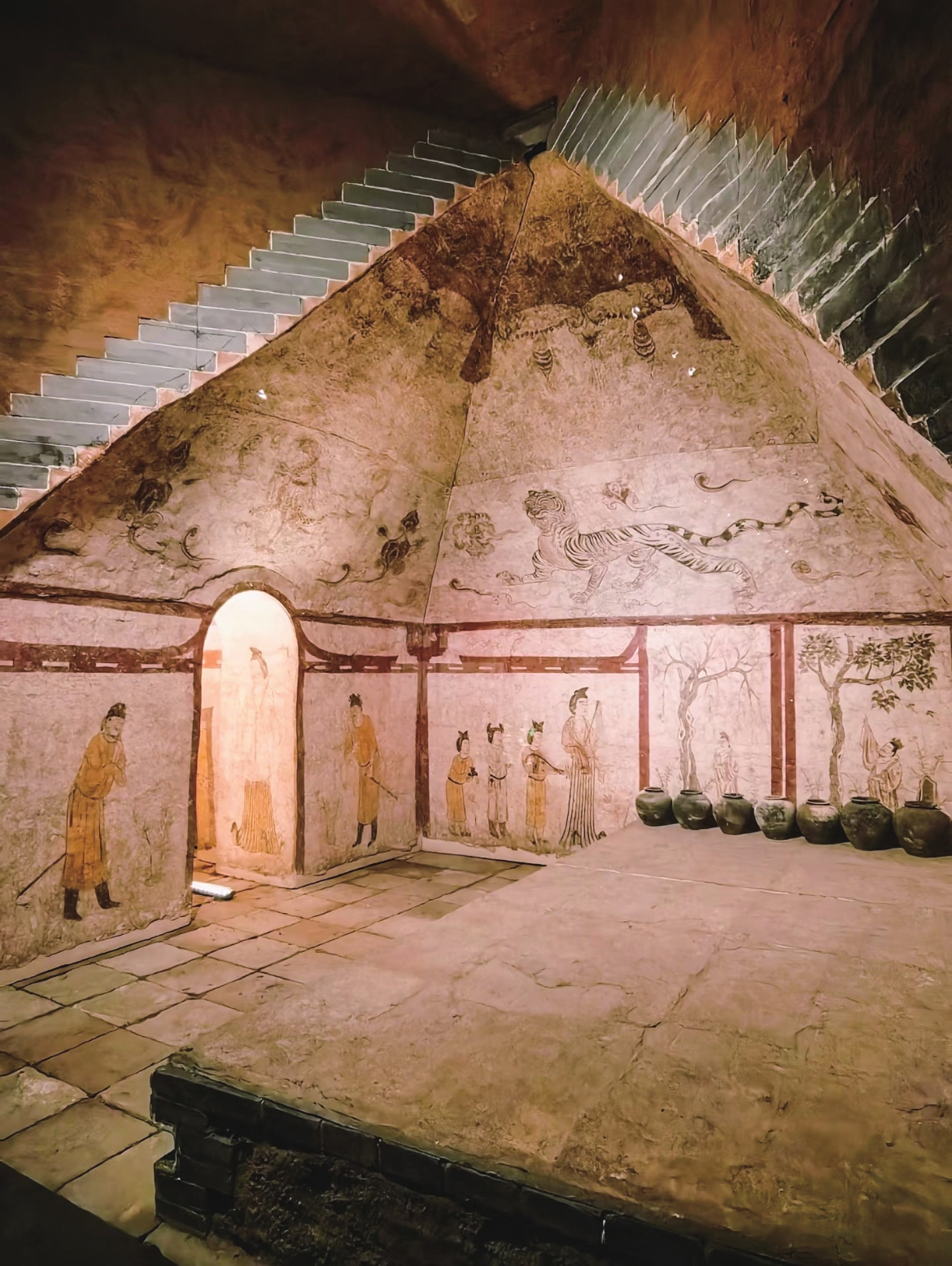
A mural inside the Tang Dynasty tomb of Guo Xing at the Archaeological Museum of Jinyang Ancient City in Taiyuan, North China's Shanxi Province Photos: Courtesy of the museum
As the New Year holidays draw near, many visitors arriving in Taiyuan, capital of North China's Shanxi Province, are adding an unexpected stop to their first cultural itinerary of the year: an archaeological museum built into the walls of an ancient city.At the Archaeological Museum of Jinyang Ancient City in North China's Shanxi Province, the mural inside the Tang Dynasty (618-907) tomb of Guo Xing has become an unlikely symbol of this renewed interest. Painted more than 1,000 years ago, one of the figures in the mural raises two fingers in a gesture strikingly similar to today's "victory sign," prompting visitors to pause, smile, and ask questions that bridge past and present.
"People often walk in and ask us right away, 'Where is that mural with the hand gesture?'" Zhao Tao, director of the museum, told the Global Times. "For many, it becomes their first impression of Jinyang, and of archaeology itself."
Opened to the public in 2024, the museum has quickly garnered attention as a key cultural landmark in Taiyuan. Visitor numbers have continued to rise since its opening, with daily attendance reaching nearly 4,000 during peak periods such as the summer holidays. As the New Year approaches, the museum expects another wave of visitors seeking meaningful cultural experiences to begin the year.
"Many people come here specifically because of the word 'archaeology' in our name," Zhao said. "They are not only interested in seeing relics, but in understanding how history is discovered."
Situated on the southern edge of the Jinyang Ancient City site in Taiyuan's Jinyuan district, the museum is a core part of the Jinyang National Archaeological Site Park.
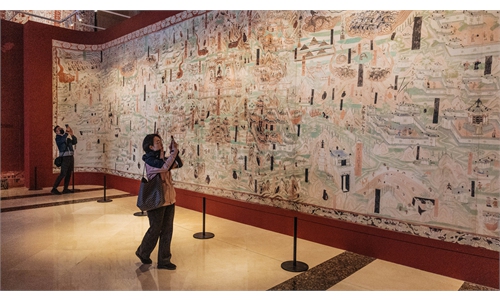
Its main exhibition presents nearly 1,000 artifacts, including murals, bronzes, ceramics and epitaphs excavated from tombs and ruins surrounding the ancient city across different historical periods.
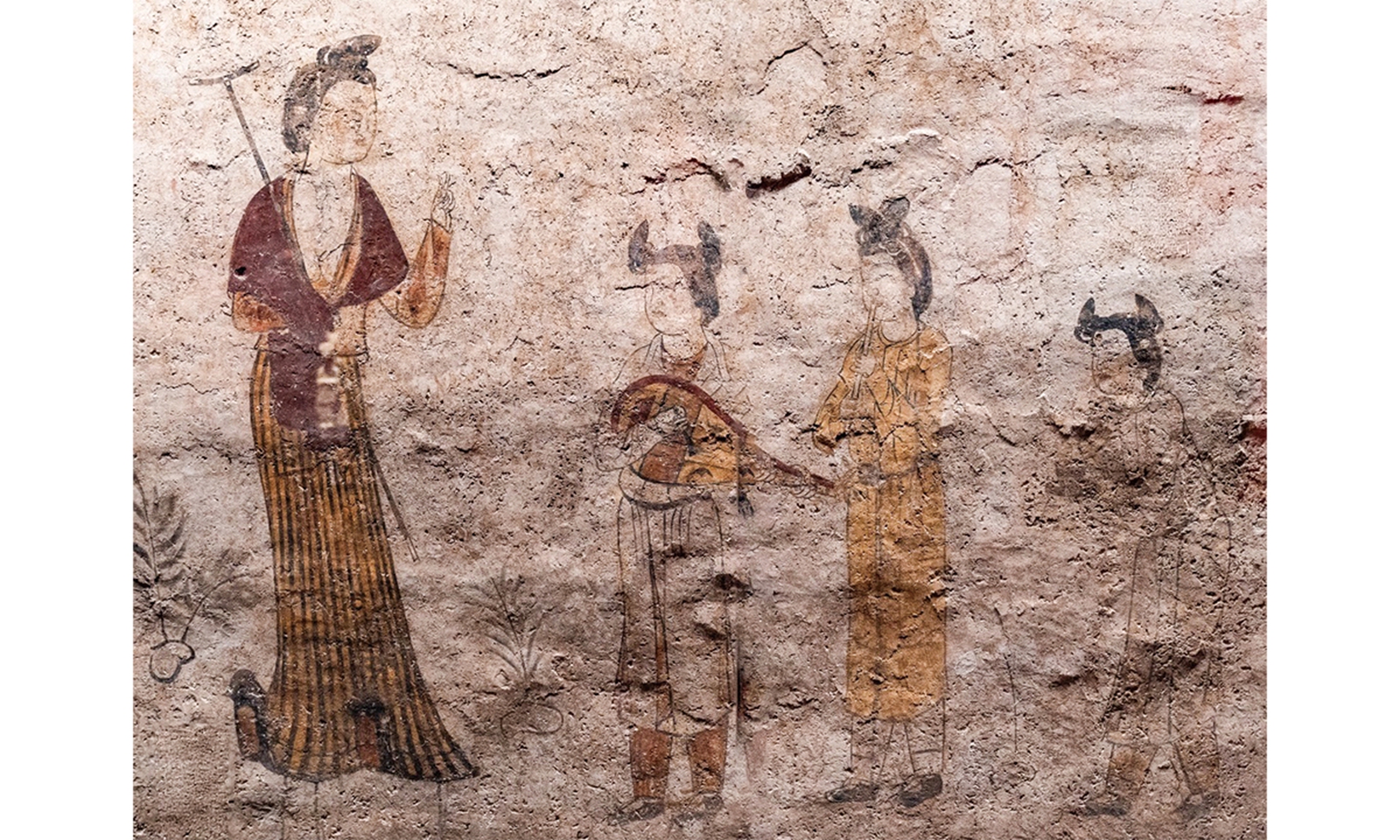
A mysterious "victory sign" in one of the murals at the Archaeological Museum of Jinyang Ancient City
When a mural goes viralAmong these artifacts, the Tang Dynasty mural tomb of Guo Xing has emerged as the museum's most recognizable exhibit. According to Zhao, its popularity reflects a rare convergence of academic value and public curiosity.
"Guo Xing's tomb holds exceptional archaeological significance," Zhao explained. "It is the largest Tang Dynasty mural tomb discovered in the Taiyuan area to date. The mural themes, especially the 'figures under trees,' are representative of Tang tomb art in this region, while the murals in the passageway and the architectural patterns imitating gate towers are first-time discoveries locally."
Yet it is the difficulty of interpretation that has drawn the public closer. "The hand gesture looks modern, and that surprises people," Liu Yiming, a visitor from Kunming, Southwest China's Yunnan Province, who visited the museum in October 2025, told the Global Times.
Rather than distancing itself from this attention, the museum has chosen to engage directly with it. "A 'viral' artifact brings responsibility," Zhao noted. "We need to respond to public curiosity with serious research and clear explanations."
The museum has therefore strengthened its academic interpretation of the Guo Xing tomb, offering explanations on mural symbolism, tomb layout, and burial customs, while deliberately adopting what Zhao describes as a "down-to-earth" approach. But unfortunately, the meaning of the "victory sign" still remains unsolved.
Curiosity underground
Public interest at the museum, however, goes beyond any single artifact. "People are deeply curious about archaeology itself," Zhao observed. "They ask why archaeologists stop digging at certain layers, how excavation tools are used, and why exploration grids are shaped the way they are. These questions come up every day."
To meet this curiosity, the museum has integrated archaeological dig sites directly into its exhibition design. Built within the ancient city wall, the museum follows a long, narrow, linear layout that guides visitors through five thematic sections, from the founding of Jinyang to its prosperity during the Tang Dynasty, without repetition or backtracking.
One of the most striking spaces lies between two exhibition halls. There, visitors pass between exposed rammed-earth walls: on one side, ancient laborers carry earth and bricks as they build the city; on the other, modern archaeologists crouch within square trenches, carefully uncovering relics. Beneath the corridor floor, a simulated section of the Jinyang No.2 architectural complex unfolds. "This passage is designed as a dialogue between ancient construction and modern archaeology," Zhao said. "It shows that archaeology is the bridge that allows us to move between past and present."
Beyond exhibitions, the museum has positioned itself as an educational platform for all age groups.
Since opening, it has hosted numerous archaeology-themed study programs, allowing children to experience simulated excavations, artifact restoration, mural conservation, and tile-rubbing techniques. "We also organize visits to real excavation sites," Zhao added.
"Archaeologists lead enthusiasts and volunteers into the field, explaining the remains from a professional perspective. This hands-on experience helps people understand that archaeology is a process, not just a result."
A city shaped by museums
Jinyang Ancient City served as Taiyuan's urban center from the Spring and Autumn Period (770BC-476BC) through the Northern Song Dynasty (960-1127), remaining in continuous use for nearly 1,500 years. Often described as a place where "half of China's history can be traced through one city," it stands as a cornerstone of Taiyuan's historical identity.
The rise of the museum coincides with Taiyuan's broader push to integrate cultural heritage into urban life.
Taiyuan now has 106 museums of various types, averaging one museum for every 51,000 residents.
Flagship institutions, including the Jin Temple Museum, the Northern Qi Mural Tomb Museum, and the Jinyang Archaeological Museum, have gained national attention, contributing to Taiyuan's growing reputation as a "museum city."
Looking ahead to upcoming holidays such as the Spring Festival, Zhao believes the key challenge is sustaining engagement beyond peak moments. "We want exhibitions to feel approachable and related. When people understand how history is uncovered," he added, "they don't just look at relics, they start to feel connected to them. That is how a museum becomes part of a city's living future."
RELATED ARTICLES