Industrial output value of China’s low-altitude equipment sector grows at 10% during 14th Five-Year Plan
By Published: Jan 04, 2026 11:01 PM

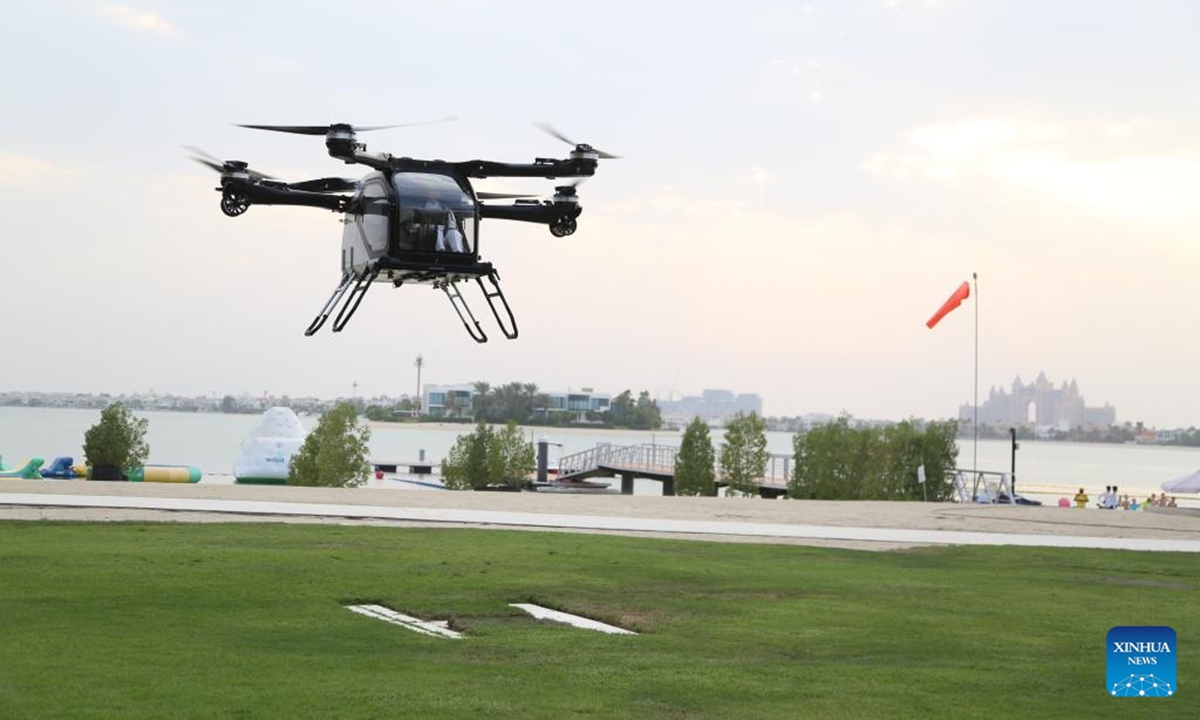
A flying car developed by Chinese company XPENG AEROHT is seen during a demo flight in Dubai, the United Arab Emirates, Oct. 12, 2025. A flying car developed by Chinese company XPENG AEROHT on Sunday took to the skies over Dubai, the United Arab Emirates (UAE), marking a significant step in the global reach of China's low-altitude aircraft technology. (Photo: Xinhua)
China's low-altitude equipment industry continued to expand in scale during the 14th Five-Year Plan period (2021-25), with industrial output value maintaining an average annual growth rate of more than 10 percent, according to data from the Ministry of Industry and Information Technology (MIIT), China Central Television (CCTV) reported on Sunday.
During that period, the number and variety of low-altitude equipment products in China became increasingly diverse. To date, more than 70 domestically produced models have completed airworthiness certification, showing that the development and application of traditional general aviation equipment have progressed steadily, according to the report.
Meanwhile, 18 civil unmanned aerial vehicles obtained airworthiness approval, while nearly 30 ton-class drones and close to 70 types of electric vertical takeoff and landing aircraft are currently under development, the report noted.
Liu Fawang, an MIIT official, noted that low-altitude applications in China have been expanding from traditional sectors such as general aviation operations and flight training to a wider range of fields, including agricultural and forestry plant protection, logistics and delivery, and emergency rescue, the CCTV report noted.
Liu stressed that drones are being rapidly adopted and applied in regions such as Northwest China's Xinjiang Uygur Autonomous Region and Northeast China. China's agricultural drone fleet exceeds 200,000 units, with an annual operational area surpassing 400 million mu, Liu noted.
Zhao Deli, founder of XPENG's flying car affiliate Huitian, a leading player in the low-altitude industry, told the Global Times on Sunday that China's low-altitude economy is now embarking a period of "taking off" after just a few years of development. Fast-track growth in low-altitude travel not only transforms transportation, but also brings more convenience to ordinary people's lives.
Zhao said that the company will continue to focus on the research and development of manned flying cars, while exploring more application scenarios.
As of December 30, 2025, a total of 1,081 enterprises had completed the registration of low-altitude equipment products, with 3,623 types of products filed and more than 5.29 million units registered, MIIT data showed.
China's 15th Five-Year Plan (2026-30) has identified the low-altitude economy as one among a number of "strategic emerging fields" that should accelerate development in the period. Many localities across China have launched accompanying policies to boost its development, according to another CCTV report.
During the 15th Five-Year Plan period, China's low-altitude equipment industry will further accelerate technological innovation, strengthen safety foundations, continuously improve the industrial standards system, and promote innovative applications of low-altitude equipment in a manner tailored to local conditions, the MIIT official noted.
Industry observers said that the five-year period will be a critical window for the low-altitude economy to see wide-scale commercial deployment in China. It is expected that an overarching low-altitude operational network will take shape in the country, tapping into more diverse potential application areas ranging from logistics delivery and low-altitude tourism, to urban governance and emergency rescue.
This will in turn fuel upgrading in industrial chains, foster the development of new quality productive forces and inject new impetus into China's high-quality growth track, observers said.
RELATED ARTICLES