ARTS / CULTURE & LEISURE
Silent national heroes Wu Shi, Zhu Feng, Chen Baocang honored in Shanghai exhibition for the first time
By Published: Jan 06, 2026 01:40 PM
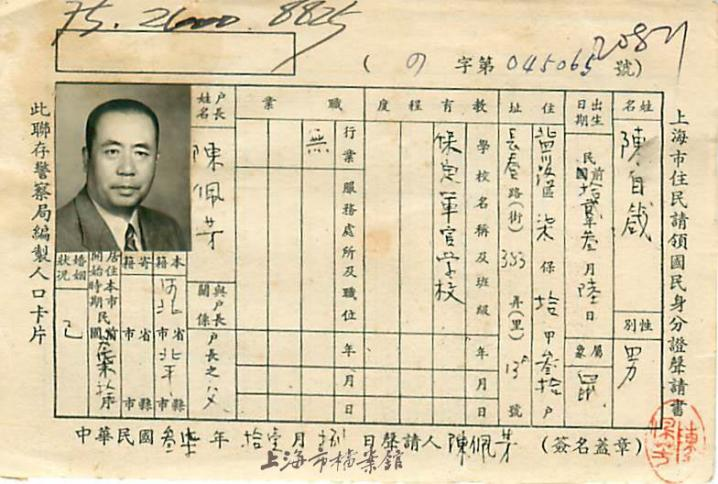
The "Shanghai Resident Application for National Identity Card" filled out in Shanghai by Chen Baocang under an alias. Photo: Courtesy of the Shanghai Municipal Archives
A new exhibition at the Shanghai Municipal Archives, which opened on Monday, has displayed archival records related to Communist Party of China covert-frontline heroes Wu Shi, Zhu Feng, and Chen Baocang for the first time.Twenty-five original archival documents showcase Wu Shi's core secret intelligence network in Shanghai, Zhu Feng's efforts to raise funds for the revolution and establish a clandestine liaison platform, as well as Chen Baocang's preparations in 1949 for his undercover mission on the island of Taiwan.
"These documents clearly mapped out their life and work in Shanghai before heading to Taiwan for the undercover mission," Fang Hua, Deputy Director of the Utilization Service Department at the Shanghai Municipal Archives, told the Global Times on Tuesday.
The heroic deeds of Wu Shi, Zhu Feng, Chen Baocang and others have been widely revered since their stories were declassified. In August 1949, Wu was appointed by then Kuomingtang (KMT) authorities as the "deputy chief of staff of the defense ministry." In order to obtain more intelligence, Wu traveled to the island of Taiwan with the KMT. Together with other Communist Party of China agents, Wu provided the mainland with critical intelligence, including KMT troop movements on Kinmen island. However, a betrayal exposed Wu's identity, leading to his arrest and execution in 1950.
The recent hit TV series, Silent Honor, which chronicles the story of Wu and other Communist Party of China (CPC) undercover agents on the island of Taiwan, has reignited public interest in this period of history, prompting many viewers to delve into historical archives to uncover more details about Wu and other covert agents in the time period.
As their work in Shanghai during that time involved highly perilous underground activities, searches conducted directly under their real names yielded no results in the archival records. However, through a thorough analysis of their aliases and related contacts, 25 archival documents relating to the three martyrs were ultimately uncovered, according to the Shanghai Municipal Archives. These documents are now being publicly displayed for the first time in the exhibition.
Among the exhibits, several archival documents relate to Wu Shi's secret contacts in Shanghai, He Kang and Wu Changzhi, clearly outlining Wu Shi's core intelligence network in the city.
According to archival experts from the Shanghai Municipal Archives, Wu Shi and He Kang's father, He Sui, were not only fellow townsmen but also modern professional soldiers deeply influenced by traditional culture, and had been close friends for decades. With the help of He Kang, Wu repeatedly transmitted confidential military intelligence.
Among this batch of precious first-hand historical materials is a "Shanghai Resident Application for National Identity Card" filled out in Shanghai by Chen Baocang under the alias Chen Zizhen. According to Fang, the application form reveals that Shanghai marked a critical phase in Chen Baocang's transformation from a Kuomintang general to an undercover operative on the covert-frontline in Taiwan.
Additionally, the exhibition includes Zhu Feng's applications for national identity cards, filed under the aliases Zhu Jing and Chen Zhumiming, as well as her employment in Shanghai. She used to work for Dingyuan Qianzhuang or Dingyuan Bank.
And for the first time, the exhibition also features identity card applications of its personnel, including the manager Xu Zhendong, assistant managers Xie Jiafu, Lu Jianya, and Chen Xiuchuan, as well as Xie Jiafu's memoirs.
"These precious first-hand historical materials shed light on the dedication of a group of underground Party members working on the front," said Fang, who hoped the exhibition can bring these long-shelved heroic archives out of the vaults and into the public view.
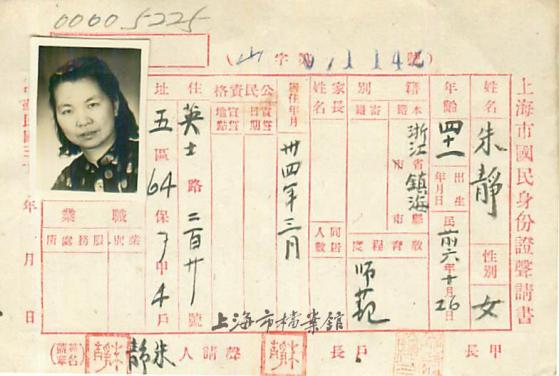
Zhu Feng's applications for national identity card, filed under the aliases Zhu Jing. Photo: Courtesy of the Shanghai Municipal Archives
RELATED ARTICLES