Cross-Straits trade reaches over $285 bn in Jan-Nov 2025, up 7.3 percent year-on-year: spokesperson
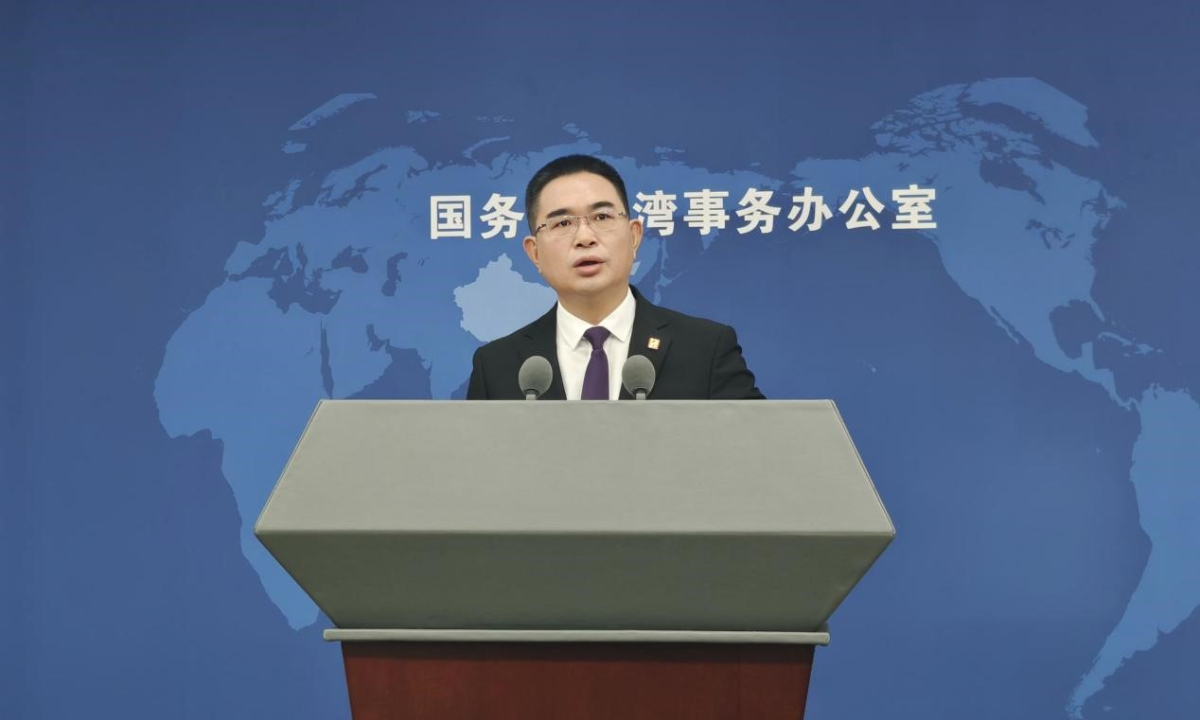
Chen Binhua, the spokesperson from the Taiwan Affairs Office of the State Council.
New registrations of Taiwan-invested enterprises in the Chinese mainland reached 6,423 from January to October 2025, and actual use of Taiwan capital reached $1.75 billion, up 53 percent year‑on‑year. Cross-Straits trade remained on an upward trajectory: from January to November 2025, cross‑Straits trade totaled $285.395 billion, up 7.3 percent year-on-year, a spokesperson with the Taiwan Affairs Office of the State Council said on Wednesday.
The remarks were made in response to a request for information about the progress in cross‑Straits economic exchanges and cooperation during 2025 and expectations for 2026.
Chen Binhua, a spokesperson for the Taiwan Affairs Office of the State Council, said at a regular press conference on Wednesday that in 2025, Taiwan businesses on the Chinese mainland continued to grow in a sound manner. Local governments rolled out measures to support them, keeping production and operations stable and maintaining growth in both Taiwan investment and overall cross-Straits trade.
According to Chen, cross-Straits integrated development took new steps in 2025. Authorities strengthened policy supply and improved supporting measures to advance the pilot zone for integrated development.
More than 30 government bodies issued supporting documents and policy measures, boosting cross-Straits integration. From January to October, trade between East China's Fujian Province and Taiwan island reached 72.82 billion yuan ($10.43 billion), with 2,043 new Taiwan-invested enterprises established and actual utilized Taiwan investment reaching $670 million, Chen said.
Personnel exchanges and cooperation also entered a new phase. "Thanks to a series of policies and events to facilitate cross-Straits personnel exchanges and promote cross-Straits economic exchanges and cooperation, business groups and important business figures from Taiwan island visited the mainland in 2025," Chen said, adding that more and more Taiwan compatriots are coming to the mainland to experience its beautiful landscape and rapid development.
Cross-Straits airlines operated more than 610 passenger flights per week in 2025. From January to November, the "Mini Three Links," which refers to the direct trade, postal and transport services between Kinmen and Matsu, two islands attached to Taiwan, and Fujian Province in the mainland, operated 10,997 flights, a year-on-year increase of 38.69 percent. They carried 1.7543 million passenger trips, a year-on-year increase of 45.77 percent.
Last but not least, new progress has been made in the construction of cross-Straits cooperation platforms.
"We have steadily promoted the construction of demonstration zones for the integrated development across the Taiwan Straits, and cross-Straits cooperation platforms such as Pingtan in Fujian Province, Kunshan in East China's Jiangsu Province, and Dongguan in South China's Guangdong Province."
"Meanwhile, emerging industrial chains on the mainland have been further opened to Taiwan-based firms, and regions were encouraged to carry out targeted industrial matchmaking. A number of key Taiwan-invested projects have come on stream, continuously raising the level, scope and resilience of cross-Straits supply-chain cooperation," said the spokesperson.
Chen noted that this year is the opening year of the 15th Five-Year Plan period (2026-30). He said that systems and policies that promote cross-Straits economic and cultural exchanges and cooperation will be continuously improved, the construction of cross-Straits integrated development demonstration zones will be advanced with high quality, industrial cooperation will be strengthened, and cross-Straits economic cooperation promoted.
The policy of equal treatment for Taiwan compatriots and enterprises will be implemented to provide them with more opportunities, a better environment and a broader stage to take root and develop on the mainland, Chen said. Efforts will be made to help Taiwan businesses and enterprises integrate into the new development pattern and achieve high‑quality development, to enhance the well‑being of people on both sides of the Taiwan Straits, and to jointly strengthen the economy.
RELATED ARTICLES