ARTS / CULTURE & LEISURE
Reality checks are inescapable as new coach Shao Jiayi faces a tough road ahead

Illustration: Liu Xiangya/GT
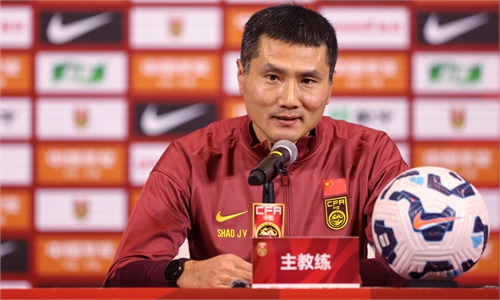
Shao Jiayi officially began his on-site coaching this week as the head coach of the Chinese men's national football team. The emotional reaction among fans and pundits was immediate and palpable.For many, his appointment represented a rare moment of optimism regarding a homegrown football figure who has begun to establish himself as a coach, rather than the national team bringing in another foreign marquee name to fix longstanding structural issues. Yet beneath the optimism lies a stark set of realities that could test Shao's vision and resolve as he pursues the team's ultimate goal: securing a spot at the 2030 FIFA World Cup.
Now over 45, Shao is part of a generation of Chinese players who ventured abroad and gained experience in competitive environments. His playing career in Germany, with clubs like 1860 Munich, Energie Cottbus and Duisburg, established him as one of China's most successful overseas professionals.
After retiring, he returned to domestic football, working in youth development before most recently managing Qingdao West Coast in the Chinese Super League. In that role, he impressed fans by consolidating a team with limited resources and leading it to one of its best-ever finishes in the top flight.
That trajectory suggests a coach capable of maximizing what he has, an essential skill in a national program where elite talent is scarce. In Qingdao, East China's Shandong Province, Shao didn't rely on high-profile foreign stars; instead, he instilled structure, tactical awareness and a collective identity.
Such qualities are precisely what Chinese football has lacked in recent years, as national team campaigns have repeatedly stumbled amid coach turnover and inconsistent strategies. The men's team has cycled through more than 10 coaching changes in the last decade.
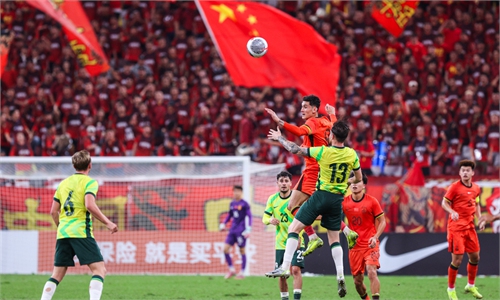
However, club success does not always translate directly to the international stage. The challenges of international management are distinct: Players assembled from diverse club philosophies must cohere quickly; pressure from fans and media is relentless; and tactical nuance must often compensate for talent gaps relative to continental and global rivals. The Chinese national team qualified for the FIFA World Cup only once, in 2002, but did not score a goal in three group matches.
Perhaps the most striking aspect of Shao's approach is his merit-based selection philosophy, particularly his refusal to prioritize age automatically. At his first national team training camp in Zhaoqing, South China's Guangdong Province, he underscored that selection would hinge on club performance and tactical fit rather than seniority. This aligns with his track record at Qingdao, where he gave meaningful minutes to young players, a bold move in a sport as some individuals often equate youth with risk.
This philosophy resonates with China's long-term goals. If qualification for the 2030 World Cup remains the benchmark, integrating young talent now is not just a preference but a necessity.
Younger players bring energy and adaptability, and more crucially, the time to develop together into a cohesive unit. Yet, such youth integration carries risks: Inexperienced squads can struggle to manage the ebb and flow of high-stakes matches, and early defeats can erode confidence rather than build it. The balancing act between youth and experience will be one of Shao's defining managerial tests.
Another encouraging development is Shao's data-driven coaching ethos. He has openly embraced analytics, support staff roles like data analysts, and rigorous performance testing, such as using sprint testing to assess players' physical readiness early in the training camps. Moreover, he has brought in seasoned assistants, including the former head coach from his playing days in Germany, to broaden tactical perspective and training methodologies. These signs point to a coach who is not merely preaching modernity but practicing it.
Yet, even the best coach cannot overcome structural weaknesses that lie beyond his immediate control. Shao has acknowledged that the broader foundations of Chinese football, especially at the youth levels, remain fragile. Unlike the era leading up to China's lone World Cup appearance in 2002, when youth teams consistently posted strong results in Asia and produced a generation of players tested in high-pressure environments, today's youth programs have struggled to achieve similar continental impact. Without a steady pipeline of players accustomed to intense international competition, national team coaches are left trying to craft competitiveness from an uneven player pool.
Recent youth performances illustrate this point. China's under-23 national team, which serves as a bridge to the senior squad and a key developmental platform, has qualified for the AFC U-23 Asian Cup but has never advanced far in the finals. Even when they make the tournament, results have tended toward early exits, highlighting inconsistency at this critical stage of growth.
The success of the national team ultimately depends on the strength of the entire football ecosystem. No matter how innovative or committed Shao is, the structural deficits in youth competition, domestic league development, and international experience cannot easily be coached away.
Optimism must be tempered with realism. The underlying developmental challenges in Chinese football remain profound. For Shao, success may not come as a sudden breakthrough but as a gradual building of identity and confidence. If he can cultivate these elements, and if the broader football ecosystem commits to long-term cultivation of talent, then the dream of returning to the world stage may yet be possible for China.
The author is a reporter with the Global Times. life@globaltimes.com.cn
RELATED ARTICLES