US, Colombian presidents reportedly hold phone call amid heightened tension; Bogota likely adopts ‘flexible strategy’: expert
By Published: Jan 08, 2026 12:19 PM

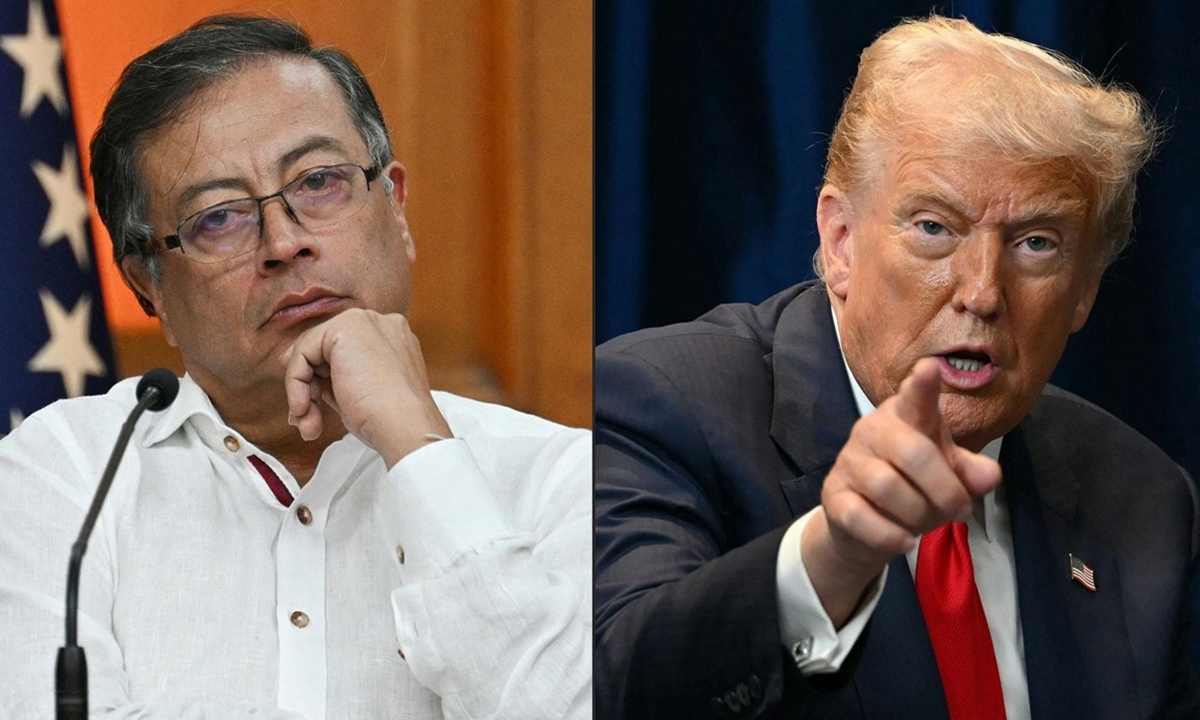
Colombian President Gustavo Petro and US President Donald Trump Photo: VCG
US President Donald Trump and Colombian President Gustavo Petro spoke by phone on Wednesday, discussing bilateral relations amid heightened tensions between Washington and Bogotá, according to Reuters. This is the first phone call between the two presidents since Trump said on Sunday that a US military operation focused on Colombia's government "sounds good" to him, per Reuters.
The phone call came after the US suddenly forcibly seized the Venezuela President Nicolas Maduro, sending shockwaves across the Latin American region. Amid the current situation, Bogota appears to be adopting a "flexible strategy" by seeking dialogue while remain firm on core positions, a Chinese expert said on Thursday.
"It was a Great Honor to speak with the President of Colombia, Gustavo Petro, who called to explain the situation of drugs and other disagreements that we have had. I appreciated his call and tone, and look forward to meeting him in the near future," Trump claimed in a post on Truth Social on Thursday.
The US President further claimed that arrangements are being made between US Secretary of State Marco Rubio and the Foreign Minister of Colombia, and a meeting will take place in the White House in Washington, D.C. He did not offer a date for the meeting.
Petro posted a picture of him on the phone on his X account on Thursday with the Spanish caption: "here talking with President Trump."
The official account of the Presidency of the Republic of Colombia on X also said that President Petro confirmed that he spoke for the first time by phone with the US president. The Colombian leader requested the restoration of direct communications between foreign ministries and presidents, in order to engage in dialogue. Additionally, they discussed Venezuela and drug trafficking in Colombia, according to a translation of the post.
The two leaders spoke for about an hour late Wednesday afternoon in a call facilitated by the US Embassy in Colombia, the New York Times (NYT) reported. A US official also said that the call lasted about an hour, which is unusually long for a call between Trump and another leader, and the Colombian Foreign Ministry described it as a "good meeting," per the NYT.
El Tiempo, a major Colombia newspaper, also reported that the phone call covered drug trafficking and Venezuela, among other topics. After months of diplomatic efforts, the presidents of Colombia and the US held a conversation that opens the possibility of a meeting, it said.
For now, the specific details of the phone call between Trump and Petro remain unknown to the public, and the information disclosed by both sides has been relatively limited.
In a latest X post on Thursday, Petro said "among the issues Trump and I discussed was the disagreement we have over his view of the relationship between the US and Latin America." The Colombian President referred to a letter he wrote to Trump focusing on Latin America's capacity to supply the 100 percent of the US energy mix, which would represent the greatest step forward in the climate change fight.
"Using Latin America solely as a source of oil would only lead to the destruction of international law and, consequently, to barbarism and a third world war," Petro said.
"What is clear, however, is that against the backdrop of an increasingly complex dynamic in US-Latin American relations, more Latin American countries are adopting more flexible and pragmatic diplomatic strategies in an effort to secure greater strategic room for maneuver," Pan Deng, director of the Latin America and Caribbean Region Law Center of China University of Political Science and Law, told the Global Times on Thursday.
The phone call was also held amid crows of protest in Colombia following the US' military threats, the Guardian said, as demonstrations aiming to defend national sovereignty in response to Petro's call for a "day of national mobilization."
Following Saturday's strikes on Venezuela, Petro called on Colombians to defend "national sovereignty" and warned against US intervention, the Hill reported. Petro also deployed 30,000 Colombian soldiers along the country's border with Venezuela on Sunday.
Trump and Petro have had an increasingly sour relationship over the last year, according to US media reports. In September, the US canceled Petro's visa after he called on troops to disobey Trump's orders, and Washington also sanctioned Petro and members of his inner circle personally, for allegedly enabling drug trafficking, Bloomberg said.
Some observers analyzed that whether Petro has been changing his tough tone against the US following the aftermath of forcibly seizing of Maduro. Eric Daugherty, a chief content officer for @RightLineNews and @FLVoiceNews wrote on X that Petro "just called Trump, dropped the 'tough guy' act and a meeting is being arranged with Marco Rubio."
"Watching Maduro get dragged out of Caracas in handcuffs apparently changed the calculus," Mario Nawfal, an influencer on X with 2 million followers, said in a post.
Especially in the case of Venezuela, US actions have not only affected regional security dynamics but have also posed new, practical challenges for Latin American countries in managing their relations with Washington, Pan said, noting that whether this impact will intensify confrontation and deepen bloc divisions, or instead prompt both sides to recalibrate communication mechanisms and explore new models of cooperation, remains to be seen.
RELATED ARTICLES