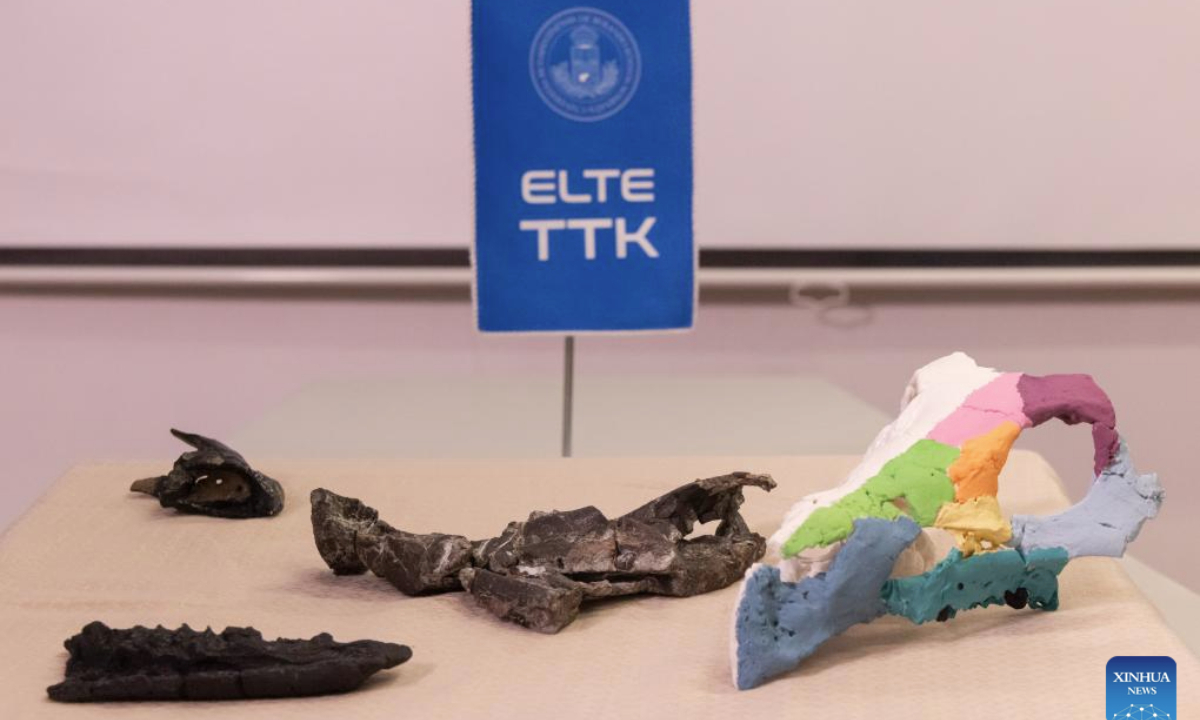
The skull fossils and a 3D replica of the Ajkaceratops Kozmai are displayed during a press conference in Budapest, Hungary, Jan. 7, 2026. Hungarian researchers have identified a new ceratopsian dinosaur skull fossil from western Hungary, providing the strongest evidence to date that horned dinosaurs lived in Europe during the Late Cretaceous period, scientists said on Wednesday. The fossil, attributed to Ajkaceratops Kozmai, was unearthed at the Iharkut (central Hungary) fossil site in the Bakony Mountains and studied by an international research team led by paleontologist Attila Osi of Eotvos Lorand University (ELTE). The research findings were published in the scientific journal Nature. (Photo by Attila Volgyi/Xinhua)
Hungarian researchers have identified a new ceratopsian dinosaur skull fossil from western Hungary, providing the strongest evidence to date that horned dinosaurs lived in Europe during the Late Cretaceous period, scientists said on Wednesday.The fossil, attributed to Ajkaceratops Kozmai, was unearthed at the Iharkut (central Hungary) fossil site in the Bakony Mountains and studied by an international research team led by paleontologist Attila Osi of Eotvos Lorand University (ELTE). The research findings were published in the scientific journal Nature.
The discovery suggests that ceratopsian dinosaurs, a group that includes the well-known triceratops, were not limited to Asia and North America, as previously believed, but were also present and more diverse in Europe. Scientists said the fossils date back around 85 million years, when much of present-day Europe consisted of island chains along the margins of the ancient Tethys Sea.
The findings were presented at a press conference held at ELTE's Faculty of Science in Budapest on Wednesday, where university officials and researchers said the newly analyzed skull fossil helps rewrite the evolutionary history of European dinosaurs and highlights the scientific importance of the long-running Iharkut excavation program.
The Iharkut fossil site has been under continuous excavation for more than 25 years. Formed during the Late Cretaceous period, the site has yielded a rich assemblage of terrestrial and freshwater vertebrates, including fish, amphibians, turtles, lizards, crocodiles, and several dinosaur species.
University officials said the discovery was the result of long-term fieldwork supported by institutional continuity and international cooperation. The research involved scientists from Hungary, Britain, the United States, Germany and Romania, and drew on both newly excavated materials and specimens preserved in museum collections.
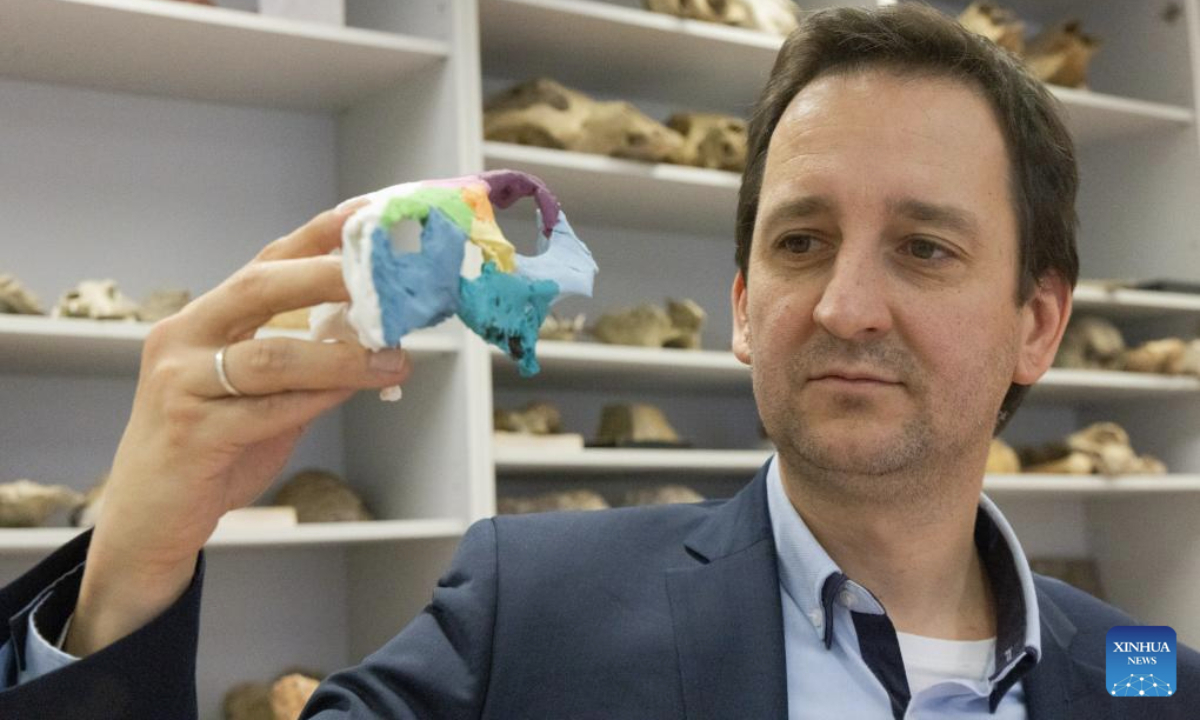
Attila Osi, a paleontologist of Eotvos Lorand University (ELTE), introduces the research findings of the Ajkaceratops Kozmai skull fossils during a press conference in Budapest, Hungary, Jan. 7, 2026. Hungarian researchers have identified a new ceratopsian dinosaur skull fossil from western Hungary, providing the strongest evidence to date that horned dinosaurs lived in Europe during the Late Cretaceous period, scientists said on Wednesday. The fossil, attributed to Ajkaceratops Kozmai, was unearthed at the Iharkut (central Hungary) fossil site in the Bakony Mountains and studied by an international research team led by Attila Osi. The research findings were published in the scientific journal Nature. (Photo by Attila Volgyi/Xinhua)
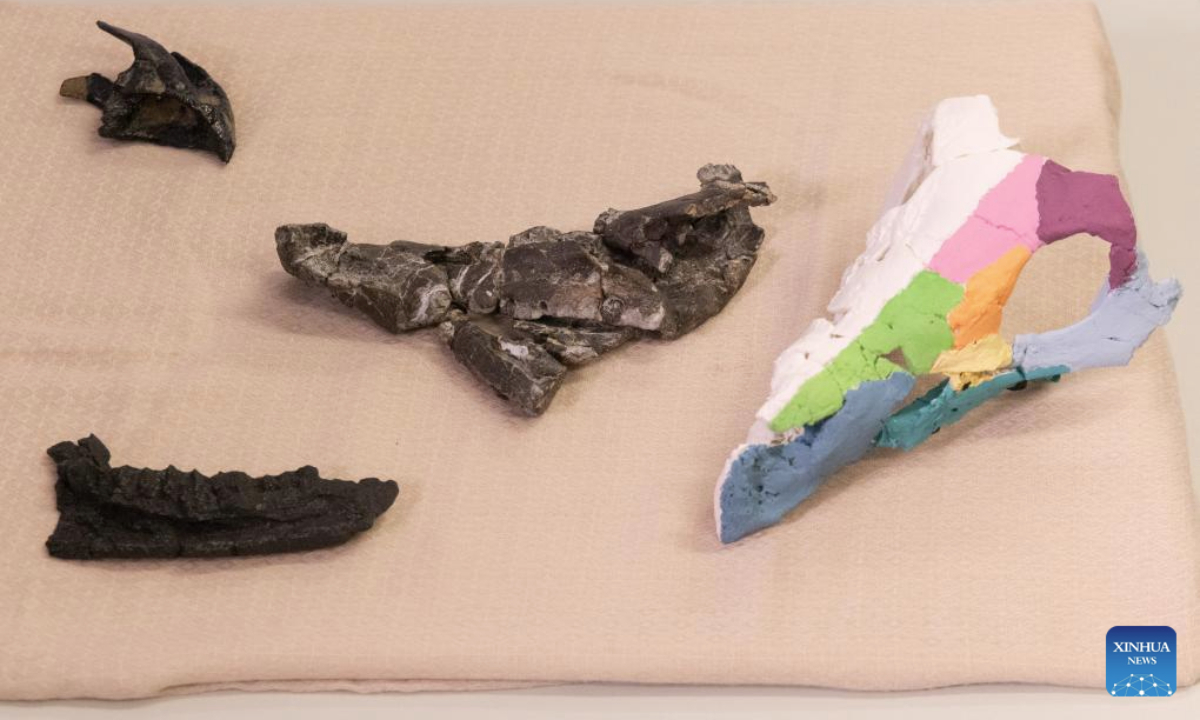
The skull fossils and a 3D replica of the Ajkaceratops Kozmai are displayed during a press conference in Budapest, Hungary, Jan. 7, 2026. Hungarian researchers have identified a new ceratopsian dinosaur skull fossil from western Hungary, providing the strongest evidence to date that horned dinosaurs lived in Europe during the Late Cretaceous period, scientists said on Wednesday. The fossil, attributed to Ajkaceratops Kozmai, was unearthed at the Iharkut (central Hungary) fossil site in the Bakony Mountains and studied by an international research team led by paleontologist Attila Osi of Eotvos Lorand University (ELTE). The research findings were published in the scientific journal Nature. (Photo by Attila Volgyi/Xinhua)
