US seizes oil tankers as official vows ‘indefinite’ Venezuelan oil sales; Russian politician calls it ‘outright piracy on the high seas’
This photo released on January 7, 2026, by the US European Command's X account shows what US European Command says is the seizure of the Marinera, previously known as Bella 1, oil tanker in the northern Atlantic Ocean. Photo: VCG
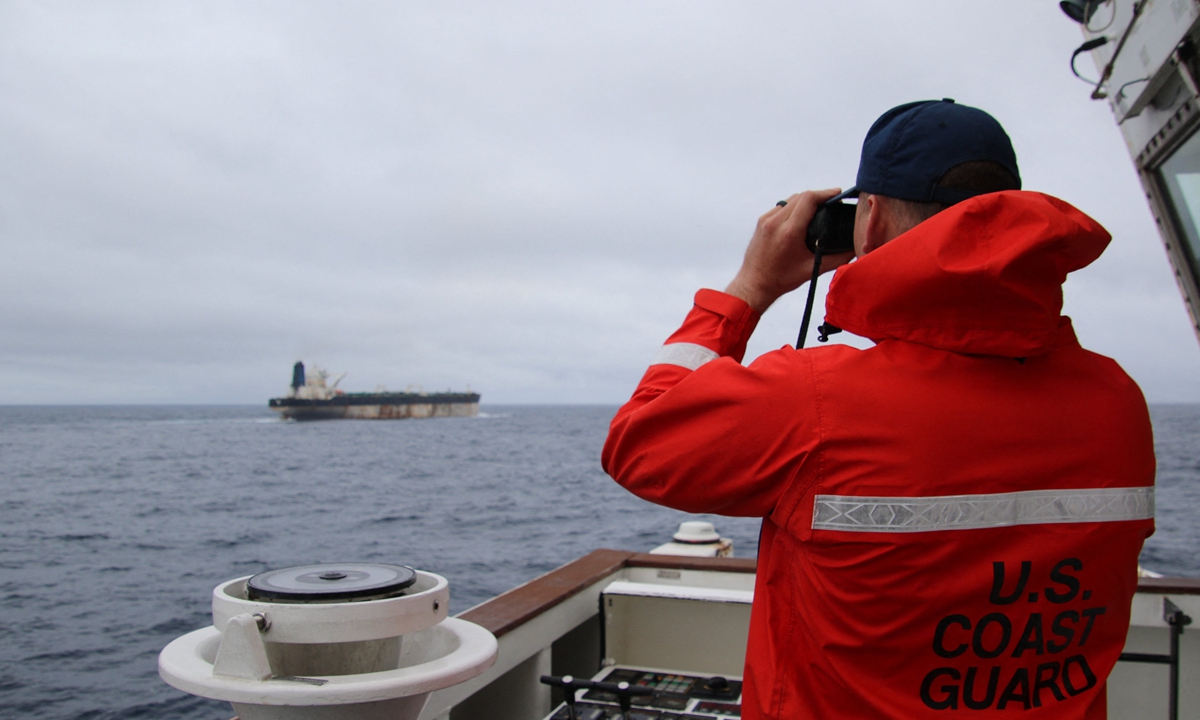
The US military seized two Venezuela-linked oil tankers in the Atlantic and the Caribbean, one of them Russian-flagged, on Wednesday, the same day when a senior US official claimed that the US will sell Venezuelan oil "indefinitely" after completing sales of the crude currently accumulating in storage there, according to media reports.
With a Russian politician calling the US action "outright piracy on the high seas," Chinese experts told the Global Times that Russia's anger could be seen as understandable, and added that the US is also to force Venezuela, as a sovereign state, to fully accept and comply with a US-designed roadmap.
On Wednesday, US European Command confirmed on X platform the seizure of the Marinera for alleged violating US sanctions, and US Defense Secretary Pete Hegseth said in reply to the X post that "The blockade of sanctioned and illicit Venezuelan oil remains in FULL EFFECT — anywhere in the world."
White House Press Secretary Karoline Leavitt said later at a news briefing that the Russia-flagged Marinera vessel, previously known as the Bella 1, which was seized first on Wednesday morning by US forces in the North Atlantic, is being part of a "Venezuelan shadow fleet" that transported sanctioned oil, according to the Xinhua News Agency.
Leavitt said that the Marinera was "deemed stateless" after "flying a false flag." She said the crew would be subject to prosecution under US law and "will be brought to the United States for such prosecution if necessary," per NBC News.
Russian authorities said the US seizure was a violation of maritime law and urged the US to treat Russian nationals on board humanely. The Russian Transport Ministry, in its statement, wrote "In accordance with the 1982 UN Convention on the Law of the Sea, freedom of navigation applies in the high seas, and no state has the right to use force against vessels duly registered in the jurisdictions of other states."
The Russian Foreign Ministry issued a statement on its website regarding the tanker on Thursday, expressing grave concern and firmly opposing the US authorities' threat to prosecute the crew under absurd pretexts. It called for an immediate halt to illegal actions against the tanker and other vessels lawfully operating on the high seas, and demanded that the crew's prompt return to their homeland not be obstructed.
Lü Xiang, a research fellow at the Chinese Academy of Social Sciences, told the Global Times that the so-called sanctions imposed by the US on Venezuela are unilateral measures with no basis in international law and therefore cannot justify law-enforcement actions against third-party countries.
"Using domestic law to arbitrarily seize vessels belonging to third parties on the high seas constitutes a blatant violation of their legitimate rights and interests," Lü told the Global Times on Thursday.
In response to a question regarding US' seizure of a Venezuela-linked and Russian-flagged oil tanker, Chinese Foreign Ministry spokesperson Mao Ning said on Thursday that the US arbitrarily seizing other countries' vessels in high seas seriously violates international law.
China has consistently opposed illegal unilateral sanctions that lack a basis in international law and are not authorized by the UN Security Council, and opposes any actions that violate the purposes and principles of the UN Charter and infringe on the sovereignty and security of other countries, the spokesperson added.
At the briefing, Leavitt also said that the Trump administration will continue to enforce an embargo against all "shadow fleet" vessels alleged by the US to illegally transport oil, per Xinhua.
The Marinera, originally known as the Bella-1, had previously slipped through a US maritime blockade of sanctioned tankers in the Caribbean and rebuffed US Coast Guard efforts to board it, Reuters reported.
US Navy SEALs were among the US forces that boarded and the tanker, CNN quoted two people briefed on the operation as saying.
The SEALs were transported to the tanker by the US Army's 160th Special Operations Aviation Regiment, also known as the "night stalkers," the people said.
The Pentagon declined to comment to the CNN, saying it does not confirm or comment on Special Operations Forces assets.
Lü observed that as US pressure on Venezuela increasingly spills over to harm third-party interests, the impact of its actions will continue to expand, forcing more stakeholders to have to consider countermeasures.
Chairman of the State Duma Committee on International Affairs Leonid Slutsky told Tass the seizure was "unquestionably a violation of maritime law and UN conventions," while Senator Andrei Klishas said on Telegram that the US had "turned to outright piracy on the high seas," according to NBC News.
Pressed about whether the seizure would inflame tensions with Russia, Leavitt claimed that Trump had an "open, honest and good" relationship with Vladimir Putin but that he would "enforce our policy that's best for the US of America, and with respect to these ship seizures, that means enforcing the embargo against all dark fleet vessels."
Given the highly sensitive strategic balance between Russia and the US, the expert said that both sides realize the danger that an escalation of tensions could move beyond conventional confrontation, plunging the world into a far more dangerous situation, the Chinese expert warned.
Trump ordered a "total and complete blockade" of all sanctioned tankers entering or leaving Venezuela last month. As of Wednesday, US forces have seized four oil tankers linked with Venezuela, according to Xinhua.
Questions surround US' plan
Also on Wednesday, US Energy Secretary Chris Wright said that the US will sell Venezuelan oil "indefinitely" after completing sales of the crude currently accumulating in storage there, the Politico reported.
Wright claimed the proceeds from those sales would be "deposited into accounts controlled by the US government" and then "flow back into Venezuela to benefit the Venezuelan people," the report said.
In an interview on Fox News, US Vice President JD Vance claimed Venezuela would only be able to sell its oil if it serves the interests of the US, The Guardian reported on the same day. "We control the energy resources, and we tell the regime, you're allowed to sell the oil so long as you serve America's national interest, you're not allowed to sell it if you can't serve America's national interest," Vance claimed.
Vance's remark has sparked netizens blasts, with some commenting under the video "That's absurd," and "the US has colonized Venezuela."
Another netizen @gymbell2058 wrote that "I never realized this is the kind of world my family is living in."
However, a report by CNN pointed out that the vision laid out by senior Trump officials, led by Energy Secretary Chris Wright and Secretary of State Marco Rubio, would represent an unprecedented exertion of control over a foreign country's oil resources with no clear timetable or guarantee of success.
The report continued that it raises immediate logistical challenges as well as a range of thorny legal and national security dilemmas, according to interviews with a range of industry sources and lawmakers as well as current administration officials, threatening to entangle the US in a messy foreign policy project.
Lü said the US' repeated seizure of oil tankers and its blockade of Venezuelan oil are aimed primarily at forcing Venezuela's government, including the acting one, to fully accept and cooperate with a US-designed "road map," and it thereby creates a so-called "legitimacy" for Washington to control Venezuela's oil resources, Lü said.
The report by Reuters noted that Trump is scheduled to meet with the heads of major oil companies at the White House on Friday to discuss ways of raising Venezuela's oil production.
The US' moves on Venezuelan oil could also be seen as an intimidating propaganda posture, exposing the Trump administration's strong desire to dominate the country's resources, Li Haidong, a professor at the China Foreign Affairs University, told the Global Times on Thursday.
However, this intent to control may encounter resistance from both the government and opposition in Venezuela, Li said.
The oil contracts that Venezuela has signed and is executing with other countries possess full legality. If Washington forcibly intervenes, it could also face dual resistance from Venezuela and the other signatory countries, Li added. The expert noted that these potential factors could lead to an outcome that does not necessarily follow the path envisioned by the US.
RELATED ARTICLES