ARTS / CULTURE & LEISURE
‘World Hot Spring Capital’ Chongqing meets micro-vacation demand
Warm winter trend
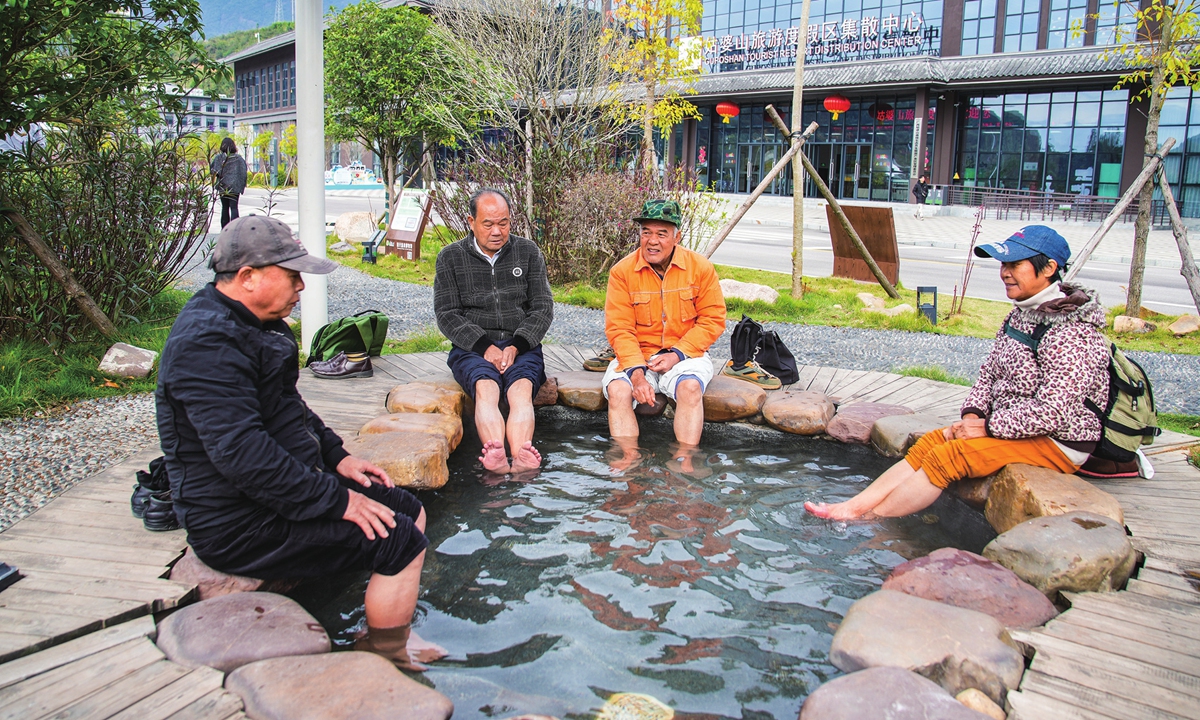
People enjoy hot springs at the open-air hot spring museum in the Guposhan Tourist Resort in Hezhou, South China's Guangxi Zhuang Autonomous Region, on November 19, 2025. Photo: VCG
Heading north along the Jialing River into Southwest China's Chongqing Municipality, the mountains gradually narrow, and steam rises from hot springs tucked among the forests and valleys.On winter afternoons, visitors slowly enter the hot spring area, change clothes, and soak in the pools, while white steam rises into the cold air. Some lean against the poolside chatting, others soak quietly, leaving their phones aside.
Time here seems to slow down. Most people don't rush; they stay only in the pool area, and after soaking, rest for a while, sip tea, enjoy the mountain views, or hang out with friends.
This "short-stay" style of hot spring visit has become the norm for winter leisure travel this season.
Leisure day relaxation
Hot spring resources are distributed across all districts and counties of Chongqing except Yuzhong district. According to Xinhua News Agency, the main urban area accounts for 139 hot spring sites, representing 62.05 percent of the city's total.
Awarded the title of "World Hot Spring Capital" by the World Federation of Hydrotherapy & Climatotherapy, Chongqing is one of the cities in China with the densest concentration of hot spring resources.
Wang Yuanhao, a staff member of a hot spring resort in Bishan, Chongqing, told the Global Times that visitor numbers have risen sharply since the start of winter, particularly on holidays and weekends.
"Compared with the same period in previous years, visitor numbers have increased by at least 30 percent, especially among young people and small families. They don't plan to stay all day, but even two or three hours is enough to fill the pools," he said.
Wang noted a new phenomenon emerging from this change: "In the past, winter pools were often empty. Now, by mid-afternoon, almost every pool has someone bathing. The contrast between the indoor and outdoor temperatures has even become part of the experience. The warmth of the hot springs draws people out for short leisure breaks despite the cold air."
"Winter hot spring popularity isn't just about more people soaking, it also drives demand for dining, relaxation, and short activities," Wang added.
"Many visitors snack while soaking, or join small-scale family or child-friendly activities. Overall, hot spring areas are being used more intensively than ever during winter."
At Bishan Hot Spring, resident Yang Gen arranged his wedding at a hot spring resort. After the ceremony, friends and relatives dispersed across different pools and rest areas.
"This way, you don't have to stick to a tight timeline, and older family members don't have to sit and wait the whole time," Yang said.
Before and after the ceremony, both families enjoyed soaking in the pools and chatting, seamlessly blending the wedding with leisure time.
Wang emphasized that, in addition to regular visitors, winter now brings more weddings and small family gatherings to hot spring hotels.
These guests typically stay for only one night, prioritizing convenience and experiences. Compared with traditional banquet halls or longer vacations, this combination better fits the rhythm of weekends and short holidays.
The trend is also evident among ordinary visitors. Many families depart after work on Friday and return Saturday morning; others spend only half a day over the weekend at the pools.
"You soak and then leave, you don't necessarily need to stay overnight," said Zhang, who came with his parents.
"Hot springs have become a regular part of weekend plans, rather than a formal, extended vacation."
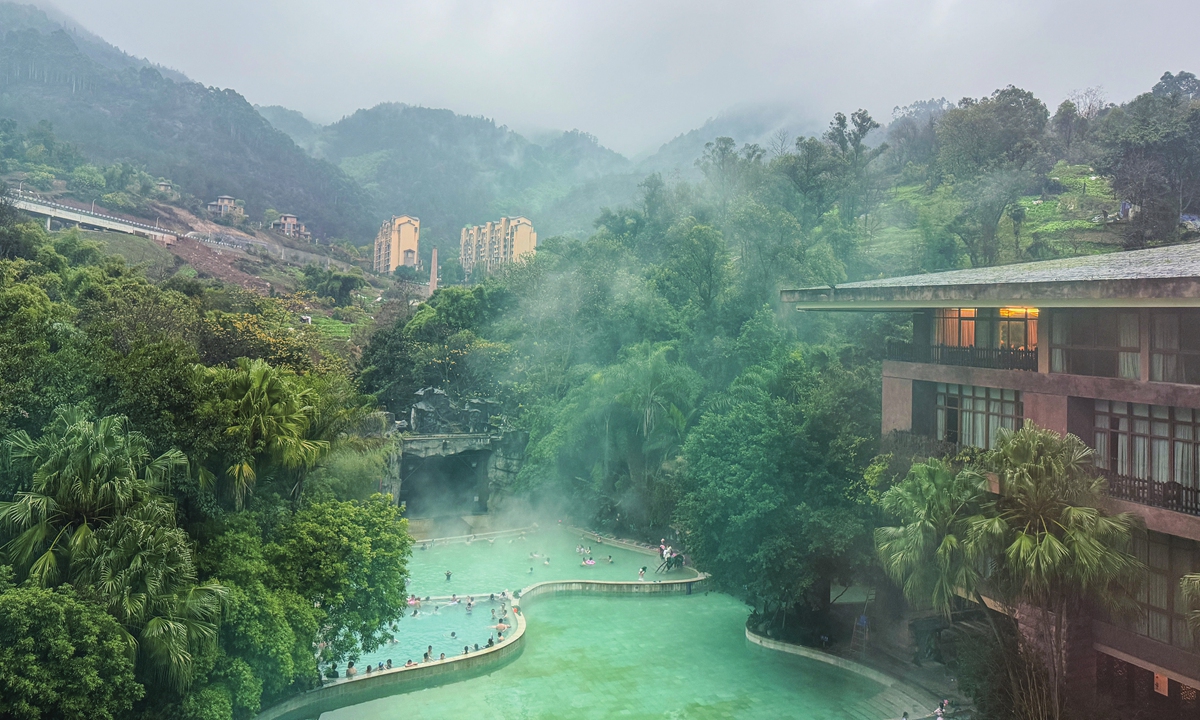
A hot spring resort in Bishan, Southwest China's Chongqing Municipality Photo: Jiang Li/GT
Widely popularThis normalization of hot spring visits is not unique to Chongqing. A week before the 2026 New Year, key hot spring resorts across China saw an 8 percent year-on-year increase in visitor numbers, with nearly 80 percent of guests choosing one- or two-day trips. Visitors aged 45 and above accounted for 65 percent of the total, according to China's state broadcaster CCTV News.
In Wuyi county, East China's Zhejiang Province, hot springs have been closely integrated with the lifestyle of the small mountainous town, primarily catering to weekend wellness trips.
On the outskirts of Hefei, East China's Anhui Province, hot spring projects are embedded in urban leisure systems, serving short trips from the metropolitan area.
In Hezhou, South China's Guangxi Zhuang Autonomous Region, the southern climate makes hot springs a favored stopover for some visitors seeking a winter escape.
Wuyi Hot Spring was first discovered by mining workers who were originally extracting fluorite. Instead, they unearthed a hot spring. Mistaking it for a geological hazard, they pumped water using dozens of pumps. Villagers collected the water for washing clothes and rinsing rice and vegetables, then the flow gradually subsided after several weeks, according to People's Daily.
Hezhou Hot Spring is one of the oldest hot springs in Guangxi. It has a flow rate of 120 tons per hour, a constant temperature of 60 C, meeting the standards of a high-quality hot spring. The water also contains 38 minerals, earning it the reputation of a "super-composite hot spring" and making it popular among local and visiting guests, according to China Travel News.
"Visitors here can not only fully immerse themselves in the hot springs, but also enjoy forest therapy, eco-tourism, and bonfire evenings," said Huang Qinglin, director of the resort office.
The resort leverages its abundant hot spring and forest resources to create a wellness destination combining sightseeing, leisure, and hot spring therapy.
In winter, all it takes is setting aside a bit of time, and the springs naturally welcome visitors, perfectly accommodating the slowed pace of weekend life.
RELATED ARTICLES