ARTS / CULTURE & LEISURE
Public art must seek careful balance between artistic freedom, popular taste
By Published: Jan 08, 2026 10:30 PM
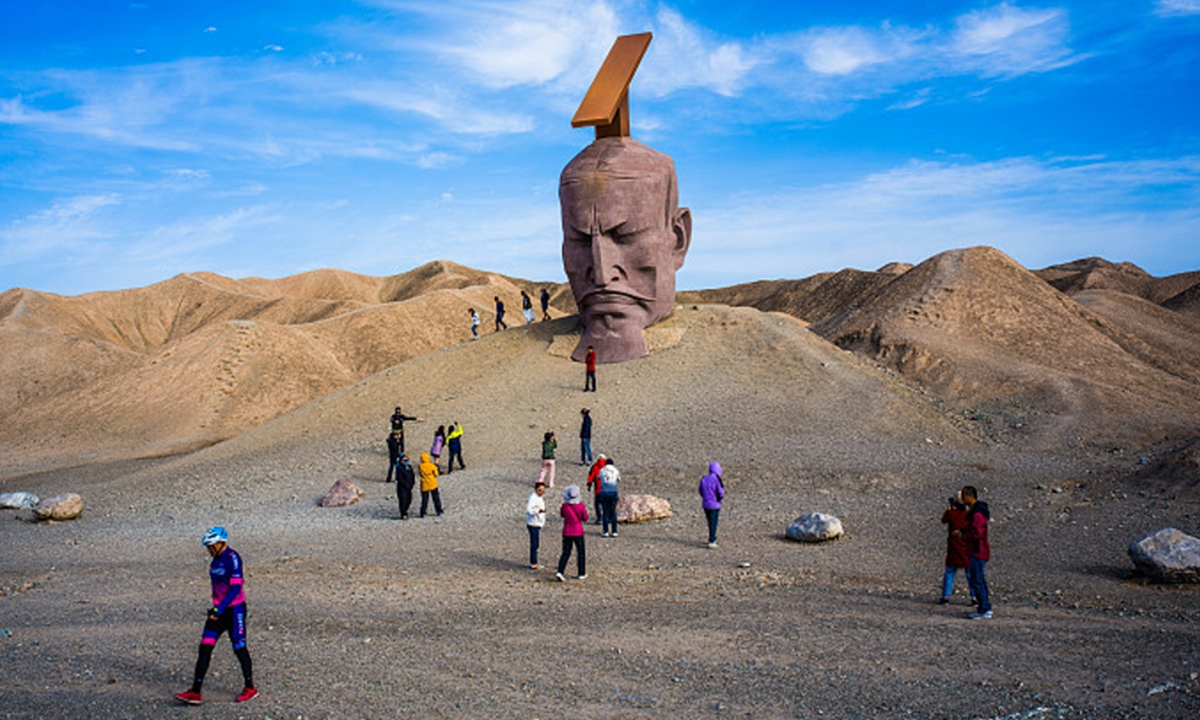
The statue of Emperor Wu of the Han Dynasty in Guazhou, Gansu Province Photo: VCG
Recently, several public sculptures around China have sparked widespread attention and debate. Among the most discussed is a statue in Guazhou county, Northwest China's Gansu Province, depicting Emperor Wu of the Han Dynasty (206BC-AD220). The sculpture features only the emperor's head above ground, with the rest of his body hidden beneath the sand. Its somber expression and unconventional form have led some netizens to question its appropriateness, with a number even interpreting it as a negative metaphor, likening it to "burying Emperor Wu alive." The controversy has become a focal point in the ongoing conversation about the collision between public art and popular aesthetics.Besides this frequently trending statue, a shopping mall in Taiyuan, North China's Shanxi Province, also found itself at the center of debate. According to China National Radio, a pink, upside-down horse sculpture - erected to celebrate the Year of the Horse - was hastily removed after several days due to public criticism. The design, featuring sunglasses and an acrobatic pose, was intended to deliver auspicious wishes through a play on homophones in Chinese, implying "instant success." However, local dialects resulted in unintended puns and negative associations, which spurred a wave of online mockery and ultimately led the mall to dismantle the piece.
These incidents highlight the recurring tension between artistic expression and public taste in shared spaces. One reason for this is the frequent divergence between artistic intention and public interpretation. The designers of the Emperor Wu sculpture hoped to symbolize "spirit above, body returned to the earth," yet for many, the immediate impression was negative. Similarly, the creator of the upside-down horse aimed to convey youthful energy, but failed to anticipate the local dialect's impact on public perception. The public tends to respond to art with instinct and association, not necessarily with contemplation, especially in the age of social media. This reality demands that public art be even more attuned to popular sentiment than works confined to museums or galleries.
Therefore, public art must seek a careful balance between artistic freedom, popular taste, and cultural identity. Recent controversies suggest that while a certain degree of creative freedom is essential, a pre-installation consultation mechanism - incorporating public participation, expert review, and cultural value assessment - should also be established, Zhang Peng, a cultural researcher and associate professor at Nanjing Normal University, told the Global Times on Thursday.
At the same time, some netizens have called for greater tolerance toward public art. They argue that art in public spaces should not be treated as a "massage chair," designed solely to provide comfort to the majority. Excessive public backlash may stifle meaningful artistic exploration. As the saying goes, "There are a thousand Hamlets in a thousand people's eyes." For example, Yang Yi, a Taiyuan resident, told the Global Times that she found the horse sculpture eye-catching and creative. Similarly, some visitors to Guazhou county remarked that the Emperor Wu statue was exploratory and interesting, integrating the natural landscape of the Hexi Corridor and fusing history with the present and culture with nature.
Zhang pointed out that such debates have a dual effect on artistic creation. On one hand, public pressure may inhibit innovation, making artists more conservative. On the other hand, public feedback can drive art to engage in deeper dialogue with society.
The crux of the matter lies in how to foster rational and constructive public discussion to help public art better balance professional artistry and popular aesthetics. Establishing transparent selection standards and evaluation procedures, introducing professional cultural critique, and soliciting community input through workshops or digital platforms before installation - rather than after controversy erupts - are measures worth promoting nationwide.
The author is a reporter with the Global Times. life@globaltimes.com.cn
RELATED ARTICLES