SPORT / FEATURE
Chinese athlete steps into ‘Power Slap’ arena, unleashing her edge
Controversial sport turns professional

China's 33-year-old mixed martial artist Ding Miao
A peculiar type of competition video has been going viral on short-video platforms. In the clips, light focuses on the center of the ring, while the stands around it are noticeably quieter than at a typical mixed martial arts match. The referee signals the fighters to take their positions. Feet planted, bodies upright, no leaning forward. A few seconds later, a slap lands, the sound exploding through the enclosed arena.There is no chasing, no grappling, not even a sequence of attacks. Victory is often decided in an instant, yet each match is drawn out through lengthy replays and discussions.
This is the scene at the World Professional Slap Championship, a professional event operated by Ultimate Fighting Championship UFC's "Power Slap" league.
The competition is known for its "simple and brutal" style. But in the ring, it resembles a meticulously calibrated system: the target of the strike, stance, body stability, and defensive reactions - all directly affect the scoring. Every slap is dissected with precision.
Reliance on rules
In October 2025, China's 33-year-old mixed martial artist Ding Miao stepped onto the stage, marking the first time a Chinese female competitor had participated in this sport. Ding told the Global Times that her career path before this had been quite unusual: After she graduated from the oil painting department of the Central Academy of Fine Arts in 2013, she joined a gaming company, and worked her way up from an art position to a 2D art director, an experience that had little to do with the fighting arena. "Novelty and challenges are what I want in life," she said.
Halfway through her professional life, she decided in 2017 to transition into a full-time mixed martial arts athlete, ultimately achieving a record of 18 wins and 8 losses in competition. "The first time I was slapped, I actually didn't feel much. It was like someone had lightly smacked my thigh, crisp and sharp," Ding said.
"The real reaction came after the match, my face swelled, bruises lasted for two weeks, and my mouth stayed crooked for even longer," she noted. "When I went to get my passport, my mouth in the photo was still crooked."
To some, the event may seem like an extreme spectacle. But for Ding, it is first and foremost a professional sport tightly defined by rules.
"It's not just slapping randomly," she emphasized. "Whether your feet move, whether you can stay standing after being hit, these determine whether your round counts as valid."
This strict reliance on rules makes the competition highly unpredictable.
"You might think it's just about who has more strength, but in reality, countless details can determine the outcome," Ding said. "Before the match, the medical check-up alone took a full five hours, eye pressure, cerebrovascular and neurological exams, even old facial injuries, every detail had to be confirmed."
Training for the slap-fighting competition is also very different from mixed martial arts. The focus is on how to face an attack head-on, maintain core stability, keep feet planted, and even reinforce facial stability using a towel combined with a dumbbell.
"Details determine success or failure, and that's what makes it a professional sport," she said.
For Ding, the appeal of slap fighting lies not only in pushing physical limits but also in the psychological and strategic dimensions of the game. "You have to anticipate every slap, its force, angle, and how your opponent will react. Winning isn't the only goal; what matters is whether you can maintain your own rhythm and judgment," she explained. "For me, there's a parallel to painting, where precision and control are key - except now the 'canvas' is our own bodies and our opponent's."
Ding does not shy away from the controversy surrounding the sport, nor does she attempt to defend it. "When mixed martial arts first emerged, it was heavily criticized as well. But over time, people realized it's a professional sport."
In her view, slap fighting is at a similar stage: Rules are still being refined, the professional framework is still developing, yet its spread and visibility have already surged far ahead. "Attention comes first, regulation follows," she said.
Ding's presence reflects a broader shift in the global sports landscape. As traditional sports reach maturity, emerging and often controversial competitions are rapidly spreading through live streaming and short-video platforms, attracting an increasing number of athletes from atypical backgrounds.
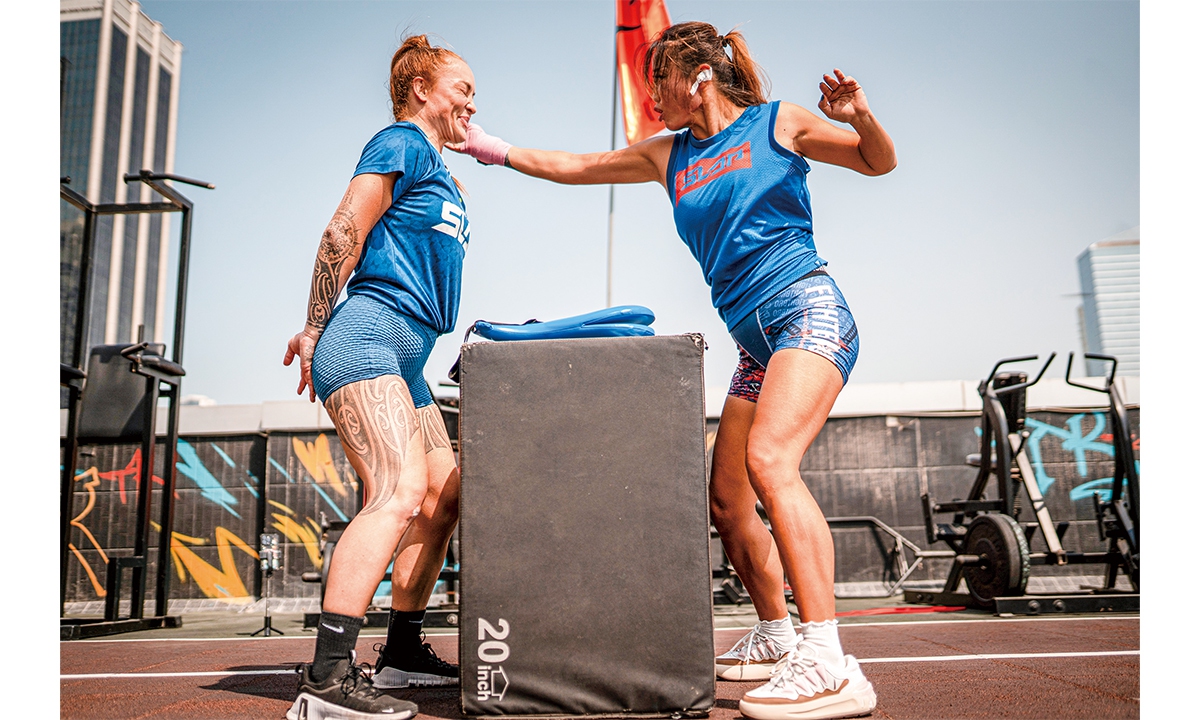
Ding Miao (right) trains slap techniques with "Power Slap" athlete Tai Emery in Dubai on October 21, 2025. Photos on this page: Courtesy of Ding Miao
Risk and craftOnce a new form of competition emerges, the question may no longer be simply "should it exist," but whether clear rules and effective protections can be established so that the discussion goes beyond shock and spectacle.
Sports commentator Guo Ai told us that many people's first reaction to the slap competition is to find it absurd, even insulting. "But from the perspective of professional sports, it's an extreme contest of both mental and physical strength," Guo said.
"Every slap has to be calculated precisely, and any small deviation can affect the outcome. Controversy exists, but that doesn't prevent it from being a legitimate competitive field, the key is that the rules must be rigorous and the athletes professionally protected for it to truly count as a sport," Guo noted.
"Ding Miao's participation is particularly interesting," he added. "She isn't from a traditional fighting background; she crossed over from the art and gaming industry. This kind of nontraditional background actually reflects changes in global sports: Emerging events are attracting different types of talent."
Guo pointed out that while the controversy and spectacle may first catch viewers' attention, for athletes this represents another kind of professional choice - an unknown path full of challenges.
Just as Ding said, she likes that feeling of not knowing what will happen next. Such uncertainty is becoming a real and viable career choice.
RELATED ARTICLES