German President's sharp critique of US foreign policy reflects Europe's growing concern over fears of a US-driven "might-makes-right" order: experts
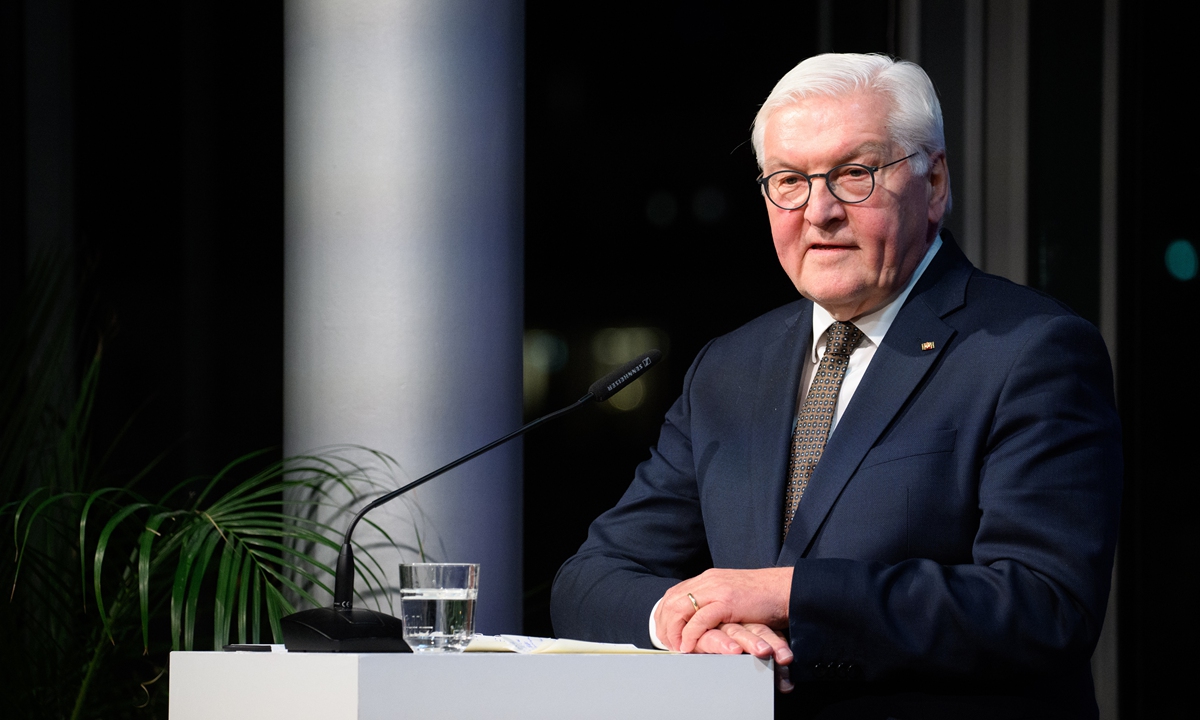
German Federal President Frank-Walter Steinmeier speaks at the Korber Foundation symposium entitled "Democracy as a Mission" marking his 70th birthday at the Akademie der Künste on Pariser Platz in Berlin, Germany, on January 7, 2026. Photo: VCG
German President Frank-Walter Steinmeier has strongly criticized US foreign policy under President Donald Trump, warning against allowing the world order to disintegrate into a "den of robbers," where the unscrupulous take what they want, Reuters reported on Thursday. Chinese experts said the remarks reflect growing anxiety in Europe, where recent US actions—including pressure related to Greenland—have deepened a sense of crisis and exposed a structural breakdown in value-based transatlantic cooperation, as Washington increasingly prioritizes pursuing self-interest over shared value.In unusually strong remarks, which appeared to refer to actions such as the ousting of Venezuelan President Nicolas Maduro over the weekend, the former foreign minister said global democracy was being attacked as never before, Reuters reported.
The Guardian reported on Thursday that Frank-Walter Steinmeier warned the postwar rules-based international order could soon disintegrate, adding that the German president was widely presumed to be referring to last weekend's US raid on Caracas and the forcible seizure of Venezuelan leader, Nicolás Maduro, and to President Trump's repeatedly stated aim of taking control of Greenland.
Steinmeier, speaking on Wednesday night at a symposium in Berlin marking his 70th birthday, said global democracy was at risk. He said that there had been a "breakdown of values" by Germany's most important partner, the US, adding that "it is about preventing the world from turning into a robber's den, where the most unscrupulous take whatever they want," according to the Guardian.
Steinmeier also said that the erosion of the world order had already reached an advanced stage. Smaller, weaker states risked becoming "completely defenceless," and entire regions could be treated "as the property of a few great powers," according to the Guardian.
According to German media outlet Die Presse, although the German president's role is largely ceremonial, his words carry significant weight, and he enjoys greater freedom to express views than active politicians.
Without directly addressing the recent US attack on Venezuela or Trump's remarks on Greenland, Steinmeier spoke of a "breach of values" by the US, Die Presse reported.
Some European leaders have sharply criticized the US because the EU has struggled to adapt to or accept changes in today's transatlantic relationship. This reflects a structural breakdown in value-based cooperation. For the US government, engagement with Europe is increasingly driven not by shared values but by what Europe can deliver in concrete terms, Jiang Feng, a research fellow at Shanghai International Studies University, told the Global Times on Friday.
The US-claimed postwar international system based on order and values is now being undermined by the US itself, while Europe remains largely anchored in a moral identity shaped by post-World War II narratives and has struggled to adapt to this fundamental rupture. It has not fully grasped that the very way it exists today is itself built on dependence on the US, Jiang said.
Steinmeier's remarks came amid a series of recent developments, including US military actions against Venezuela and Washington's claim of seeking to acquire Greenland, which have made Europe acutely aware that the set of "international rules" it has long relied on are coming under serious strain, Cui Hongjian, professor at the Academy of Regional and Global Governance at Beijing Foreign Studies University, told the Global Times on Friday.
If such US practices are allowed to continue, their impact will be felt most directly in Europe, where the majority of countries are small or medium-sized states, Cui said. This trajectory, he warned, could lead to an international order in which major powers decide the fate of smaller states, leaving their sovereignty and territorial integrity increasingly vulnerable.
Cui said Europe's long-held assumptions were shaken after the Trump administration escalated pressure and shifted its focus to Greenland, undermining the belief that Washington would restrain itself and avoid targeting its allies. The Greenland issue, he noted, exposed a reality in which the distinction between allies and non-allies has become blurred and the rules-based order no longer holds.
With the US having already used force in Venezuela and now exerting pressure over Greenland, Europe's sense of crisis has deepened, fueling fears that the international order is sliding toward a "might-makes-right" logic, the expert said.
European leaders on Tuesday issued a joint statement pushing back against US President Donald Trump's renewed interest in Greenland, saying security in the Arctic must be achieved collectively.
According to a New York Times report on Thursday local time, in an interview with the US President Donald Trump, when asked what was his higher priority, obtaining Greenland or preserving NATO, Trump declined to answer directly, but acknowledged "it may be a choice," adding that the transatlantic alliance was essentially useless without the US at its core.
The New York Times noted that "the president's insistence that Greenland must become part of the United States was a prime example of his worldview."
Reuters reported that a poll released Thursday by public broadcaster ARD showed that 76 percent of Germans surveyed now felt the US was not a partner that Germany could rely on, an increase of 3 percentage points since June 2025. Only 15 percent felt Germany could now trust the US, the lowest level recorded in the regular survey of attitudes.
The survey found 69 percent of Germans concerned about security in Europe, about the same number that thought NATO partners could not rely on the protection of the US, according to Reuters.
Cui said disappointment with the US has been mounting among both European elites and ordinary people since Trump's first term, across NATO and the broader transatlantic relationship. While some in Europe once hoped Washington would correct its course, those expectations have largely collapsed amid a series of recent hardline US actions.
European leaders have to prepare for further deterioration in US-EU ties, particularly on sensitive security issues such as Greenland, where Washington could even come to be seen as a potential adversary, the expert said.
RELATED ARTICLES