ARTS / ART
3,000-year-old ‘wildlife park’ discovered at Yinxu Ruins in Henan
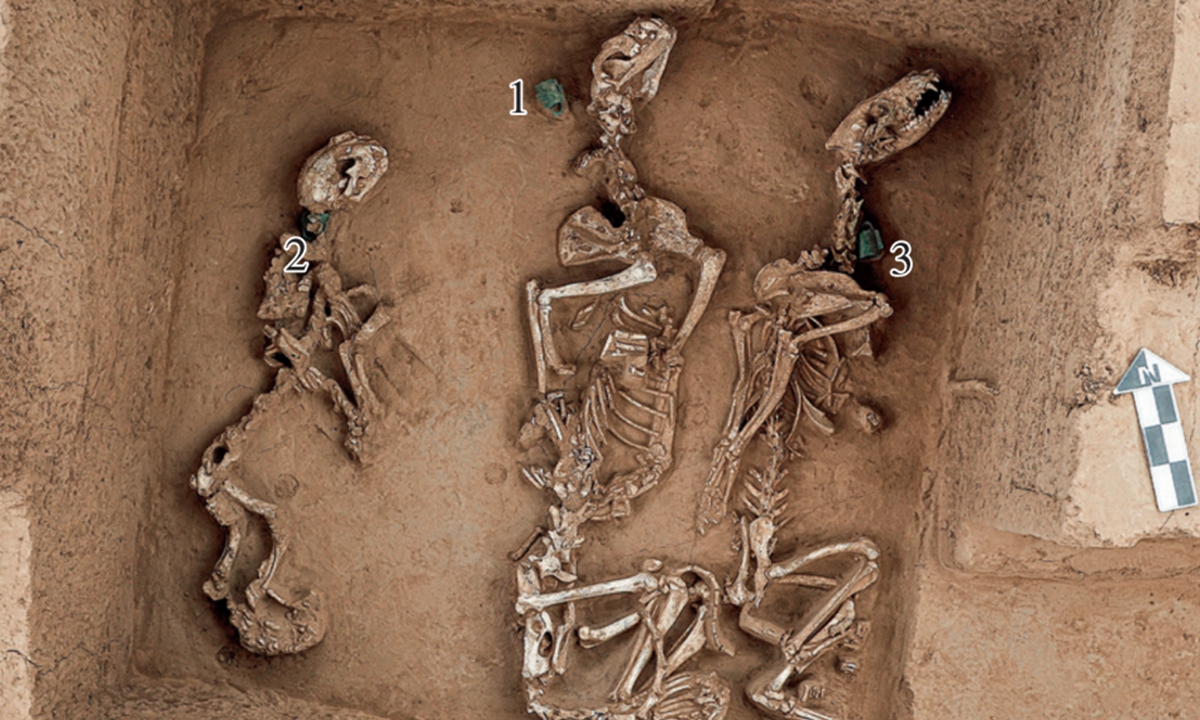
Wild animal relics discovered at the Yinxu Ruins in Anyang, Central China's Henan Province Photo: Sina Weibo
Including skeletal remains of animals such as tigers, a significant number of wild animal relics have recently been discovered at the Yinxu Ruins in Anyang, Central China's Henan Province. Such a discovery reveals a glimpse of a "wildlife park" dating back over 3,000 years to the Shang Dynasty (c.1600BC-1046BC).
This batch of animal remains was excavated from the ruins' Imperial Tombs area, which faces the Yinxu Ruins' Palace and Imperial Ancestral Shrines across the river. Such animal remains were found scattered across 19 of small and medium-sized sacrificial pits.
The unearthed wildlife skeletal remains are diverse, belonging to species such as water buffalo, deer, roe deer, wolf, tiger, leopard, fox and so forth. Birds from five genera including swans, cranes, geese, falcons, and eagles were also discovered at the site.
In addition to animal remains, experts also discovered a total of 29 bronze bells across 13 out of the 19 excavated tombs.
Zeng Yuli, an archaeological researcher specializing in ancient agricultural and animal husbandry development, told the Global Times that these bells were "used to manage and train animals." They indirectly reveal "the sophistication of animal resource management" during the Shang Dynasty.
"People at that time had already begun consciously monitoring and categorizing animal groups. The utilization of animal resources was also deeply integrated into their daily life," Zeng told the Global Times.
Some of these bronze bells were even discovered still hanging around the necks of the animals. Li Xiaomeng, a key researcher on the project, said this indicates that these animals were likely "not obtained through temporary hunting," but rather were rare and exotic creatures specifically raised in theimperial gardens or enclosures of the Shang high-ranking nobles. Li is also an assistant research fellow at the Institute of Archaeology, Chinese Academy of Social Sciences (CASS).
"The concentrated presence and standardized processing of wild animals suggest that the Shang people may have already established a comprehensive system for the acquisition, rearing, and management of wildlife," Niu Shishan, a research fellow at the Institute of Archaeology of the CASS, told the Global Times.
In addition to the findings made at smaller sacrificial pits, archaeologists also uncovered skeletal remains of humans, elephants, horses in large sacrificial pits.
Surprisingly, the number of horses in each pit was consistently even, and some of the horse skulls exhibited depressions of varying sizes on the top of the head. Niu explained that this discovery provides new clues to Shang people's custom of animal sacrifices for ritual events.
"These findings have not only given us a glimpse of the grand scenes of imperial rituals during the Shang period but also offered crucial material evidence for exploring the religious beliefs and ceremonial systems of the dynasty," Niu remarked.
Known for its unearthed oracle bone inscriptions, the Yinxu Ruins are the first late Shang Dynasty capital site documented in historical records, confirmed by archaeological excavations, and verified through oracle bone inscriptions.
In ancient oracle bone texts, it was referred to as "Dayishang," meaning the "great settlement of Shang." Niu told the Global Times that besides the animal remains currently discovered in 2024, a road network was also found in the ruins, revealing the three-horizontal and three-vertical trunk road system of the capital of "Dayishang." Within the road network, a longitudinal road that stretches 1.6 kilometers is the longest urban thoroughfare discovered at the late Shang capital to date.
"These new discoveries represent a breakthrough in the study of the planning and layout of the capital. They will advance research into the Shang Dynasty's society and culture and also provide new materials for the development of the Yinxu National Archaeological Site Park," said Niu.
RELATED ARTICLES