Trump declares national emergency to shield Venezuelan oil cash; move to ensure future revenue from Venezuelan oil under US control: expert
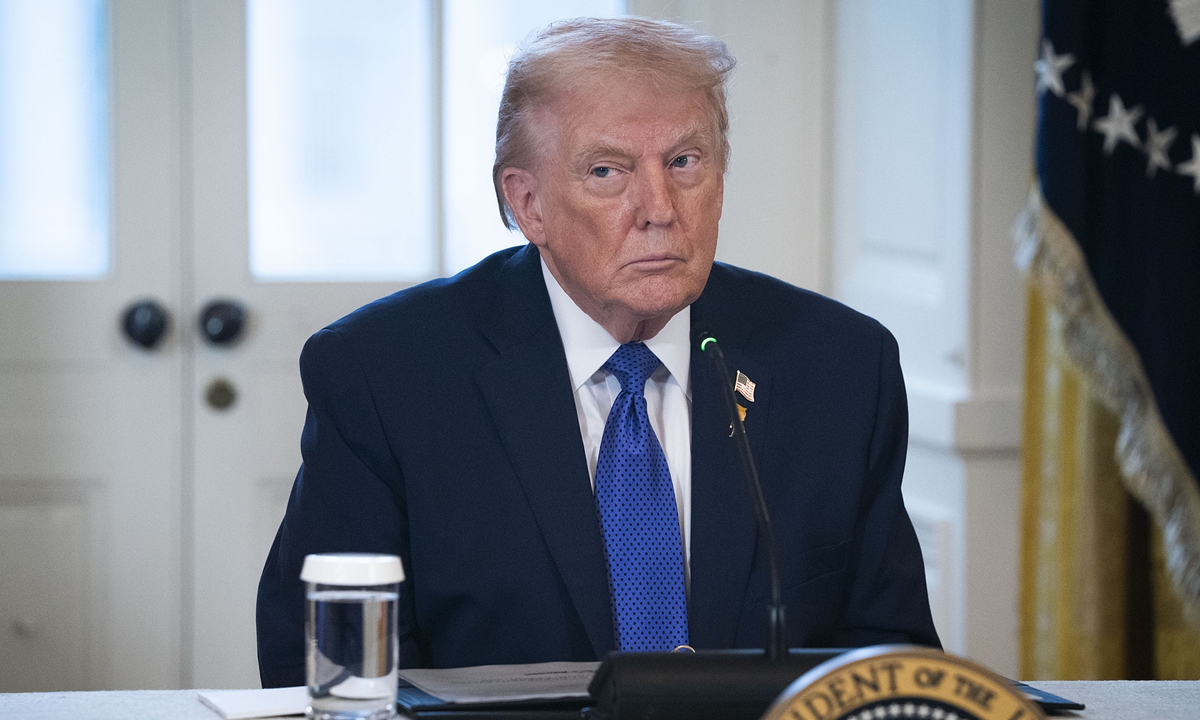
US President Donald Trump declared a national emergency on January 9, 2026. Photo: VCG
US President Donald Trump on Friday signed an executive order declaring a national emergency to "safeguard Venezuelan oil revenue held in US Treasury accounts from attachment or judicial process," ensuring the funds are preserved "to advance US foreign policy objectives," according to a release by the White House.
In effect, it places those revenues under special protection in order to prevent them from being seized by courts or creditors, according to media reports.
Any use of judicial process against the funds will interfere with efforts to "ensure economic and political stability in Venezuela," the order noted.
The order also prohibits transfers or dealings in these funds except as authorized, superseding any prior executive orders that might block or regulate them, the Xinhua News Agency reported.
The Foreign Government Deposit Funds are sovereign property of Venezuela held in US custody for governmental and diplomatic purposes, not subject to private claims, according to the White House. "The United States Government will hold the Foreign Government Deposit Funds solely in a custodial and governmental capacity, and not as a market participant," said the order.
"So we are stealing?" A US netizen named @The_Office9 commented on X.
" 'National emergency to safeguard Venezuelan oil revenue' - wait, whose oil are we safeguarding exactly? Is this what taking the oil looks like?" said another netizen @nesterrr78.
"Oh a new foreign policy[:] it's OK to rob [and] steal another country oil called justify intervention," a netizen @kks2105 also commented.
The action follows a meeting on Friday in Washington where Trump pressed top oil executives to invest in Venezuela, and was met with a cautious reception - with the chief executive of ExxonMobil describing the country as "uninvestable" without sweeping reforms, Le Monde reported.
ExxonMobil and ConocoPhillips exited in 2007 after refusing demands by then-president Hugo Chavez to cede majority control to the state. They have been fighting to recoup billions of dollars they say Venezuela owes them, the report noted.
Chevron is currently the only US firm licensed to operate in Venezuela.
Trump warned the assembled executives that, if they aren't interested in rebuilding efforts: "I got 25 people that aren't here today that are willing to take your place."
Most of the executives acknowledged the opportunity in the South American country but stopped short of making firm investment commitments, CBS News reported.
Trump signed the order nearly one week after US military forces seized Venezuelan president Nicolás Maduro and his wife on January 3.
Meanwhile, US Treasury Secretary Scott Bessent has told Reuters that additional US sanctions on Venezuela could be lifted as soon as next week to facilitate oil sales, and that he will also meet next week with the heads of the International Monetary Fund and World Bank on their re-engagement with Venezuela.
Bessent said in an interview late on Friday that almost $5 billion worth of Venezuela's currently frozen IMF Special Drawing Rights monetary assets could be deployed to help rebuild the country's economy.
The executive order issued on Friday essentially requires that future revenue from oil extraction in Venezuela be deposited in US-designated banks. However, such orders currently lack specific follow-up measures, Lü Xiang, a research fellow at the Chinese Academy of Social Sciences, told the Global Times on Sunday.
In reality, meetings with the oil industry have not resulted in any concrete plans. For businesses, a stable political environment is the primary prerequisite for investment, Lü noted.
RELATED ARTICLES