SPORT / FOOTBALL
Chinese U23 team secures critical 1-0 win over Australia
On way to breaking jinx at U23 Asian Cup
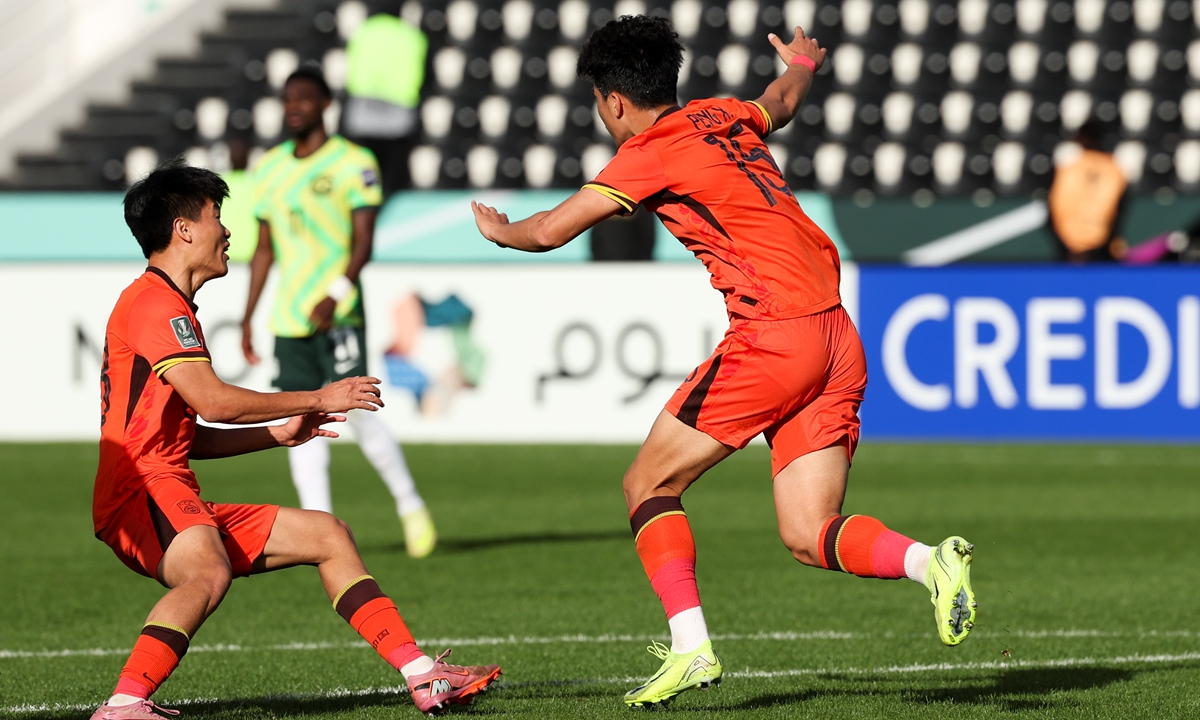
China's Peng Xiao (No.15) celebrates after scoring the goal against Australia at the Under-23 Asian Cup in Riyadh, Saudi Arabia on January 11, 2026. Photo: VCG
The Chinese national under-23 football team achieved a surprising 1-0 win over Australia at the Under-23 Asian Cup on Sunday in Riyadh, Saudi Arabia, fueling the prospect of having the Chinese team's best result at a continental tournament.A goal from defender Peng Xiao helped China achieve a 1-0 lead against the Australian under-23 team in the 43rd minute.
Peng scored a volley after picking up a deflected ball in the penalty area. This was the first goal for China at the 2026 Under-23 Asian Cup.
In the second half, keeper Li Hao's critical saves held off Australia's offensive storms, triggering the Chinese fans inside the stadium to chant his name.
The win against Australia, considered the top team in the group, is critical for China's chances of finishing in the top two of the group bracket and securing advancement to the knockout rounds.
Historically, the Chinese U23 side has failed to progress beyond the group stage in all five of its previous U23 Asian Cup finals appearances, and had never notched a victory in the second round in the group stage.
The Chinese came into the competition hoping to improve on past records.
In the 2025 U23 Asian Cup qualifiers, China and Australia played out a 0-0 draw in Xi'an, Northwest China's Shaanxi Province, with both teams advancing. Australia topped the qualifying group on goal difference and China qualified as one of the best runners-up.
The Chinese team opened their U23 Asian Cup campaign with a 0-0 stalemate against Iraq last week, missing several key opportunities while showing resilience defensively.
Australia, meanwhile, began their campaign with a win over Thailand, demonstrating the attacking intent that has posed problems for their Group D rivals.
The Chinese team will take on their last group opponents Thailand on Wednesday.
The Chinese U23 side is striving to do something that has eluded it for over a decade: advance past the group stage at the U23 Asian Cup. This would not only rewrite a statistic that has cast a long shadow over prior Chinese youth teams, but also serve as a strategic inflection point for the next generation of national team stars.
To understand why this matter resonates so deeply, one must look back at China's results in this U23 competition. Since the tournament's inception in 2013, China's U23 team has consistently struggled to make an impact. According to historical data, China's U23 side has struggled to break out of the early rounds, with only two wins among many losses in past editions, and has never advanced beyond the group stage.
This pattern isn't just about "missed opportunities" but also reflects a deeper structural challenge. Because the U23 Asian Cup has served as the Olympic qualifying path for Asian teams, consistent failure to reach the knockout rounds has meant China's U23 team has not qualified for the Olympic men's football tournament for more than a decade.
This lack of historical success isn't simply a blemish on the record. It has concrete implications for player development and national football culture: The team's young talents are repeatedly denied exposure to do-or-die knockout football.
In professional development models, the journey from prospect to proven performer passes through pressure-rich competition. For footballers, this means not just training and friendly matches, but competitive, result-oriented tournaments where the stakes are high and failure is immediate and tangible.
Elite youth tournaments like the U23 Asian Cup bring with them higher tactical demands, greater physical intensity, and psychological pressure that simply cannot be replicated in training.
China's U23 team is especially in need of this experience. Players like Wang Yudong, Kuai Jiwen and Xu Xin have shown glimpses of individual potential. Some even participated in senior World Cup qualifiers in 2025. However, talent alone is not enough. Competitive maturity, the ability to influence the outcome of tight, consequential matches, only develops through repeated exposure to high-stakes football.
There is a psychological component too. When Chinese youth teams approach big matches with a track record of early exits, pressure often mounts, and doubts can seep into players' minds before a ball is kicked.
The importance of this U23 squad extends beyond Asian Cups. Many of these players are already on the radar of the senior national team. Indeed, after this tournament window, a number of China's U23 players are expected to transition into senior team duty under head coach Shao Jiayi in international windows early in the year.
This upcoming generation, built around talented youngsters who have experience in domestic leagues and some senior caps, represents the backbone of China's next national team cycle. Their development is not just the responsibility of youth coaches.
Whether the team advances or not, the lessons learned, tactical discipline, handling pressure, adapting to dynamic match conditions, will serve these players and Chinese football far into the future. But breaking the group-stage barrier would be more than symbolic: It would be a tangible sign that the long-awaited transformation of Chinese football culture is beginning to take hold.
RELATED ARTICLES