ARTS / CULTURE & LEISURE
Traditional opera, a bridge connecting distant hearts to hometown
By Published: Jan 12, 2026 10:13 PM

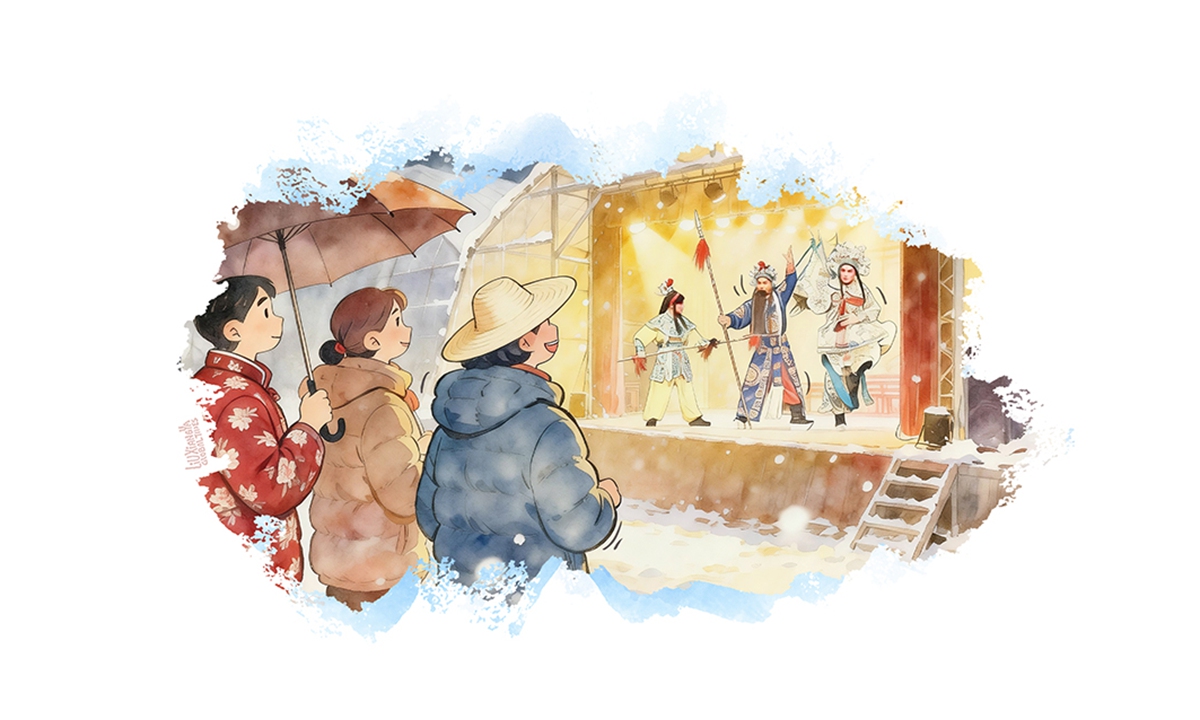
Illustration: Liu Xiangya/GT
A migrant worker from Central China's Henan Province, who had been in Beijing for over 20 years, gifted himself a rare luxury: For the first time, he spent 100 yuan ($14.30) to enter a theater and watch a Yuju Opera performance. In a video, he explained this was an early birthday gift to himself - a chance to watch a beloved hometown opera whose heroine hailed from his own Tangyin, Henan."This is also a way to promote my hometown," he shared on social media. As he spoke about opera performers from various regions, his eyes lit up with familiarity and affection.
That 100-yuan ticket for a back-row seat was, in fact, the shortest path back to his roots. In a theater far from home, he purchased not just an admission ticket, but a "spiritual ticket" connecting him to his cultural identity. The resonant melodies and familiar dialect of Yuju Opera became a bridge spanning the distance to Tangyin, reflecting the enduring charm and complex role of traditional opera in contemporary, mobile society.
For this man and countless others living away from their hometowns, traditional opera has transcended mere entertainment. It functions as a spiritual anchor and a living vessel of cultural memory.
When he enthusiastically listed local opera stars, it revealed a profound cultural phenomenon: In an era of accelerated population mobility, opera serves as a vital medium for emotional connection to one's heritage. Hearing the hometown dialect in the theater is an act of consuming cultural belonging, a spiritual ritual to ease nostalgia.
The function of opera has evolved. In traditional rural society, it served to "cultivate moral character" and "foster wholesome customs," touching upon "eternal principles of moral order," as noted by Ming Dynasty (1368-1644) scholar Qiu Jun. Today, this has transformed, offering emotional solace and affirming identity. That migrant worker's choice to watch Fuhao, a story about a hometown heroine, underscores this shift - opera has become a carrier for regional cultural identity.
The choice of this migrant worker reflects the inner needs of countless people living away from their hometowns. Traditional opera has become a living vessel for the cultural memories of wanderers far away from home, and listening to the familiar sounds of home has transformed into a spiritual ritual to ease the ache of nostalgia.
On December 14, 2025, the China Theatre Association's Plum Blossom Award Art Troupe staged a performance in Yangzhou, East China's Jiangsu Province, featuring excerpts from various operas such as Lu You and Tang Wan, Xianglin Sao, and The Peony Pavilion, gathering 16 Plum Blossom Award winners on one stage. These top-tier performers and their acts planted the seeds of drama and nurtured future audiences. They have persisted in performing across various regions for 20 years, well aware of the profound shifts in the significance of traditional opera within contemporary society.
For that migrant worker from Henan, the Yuju Opera piece Fuhao was not merely a performance - it served as a birthday gift, an antidote to nostalgia, and a declaration of identity. The emotional value of opera transcends its artistic worth. By choosing to watch a story about a hometown heroine with the hope of "promoting his hometown," the migrant worker demonstrates that traditional opera has become a carrier for regional cultural identity.
Traditional opera is undergoing a functional shift from mere "cultural entertainment" to "spiritual sustenance." Audiences no longer just watch performances; they engage in deeper interactions with performers, making opera a bond of emotional connection.
To sustain its vitality in modern society, traditional opera must innovate in both transmission methods and content expression. Only through innovation can opera culture continue to serve as a bridge linking the past and present, and connecting urban and rural communities. For instance, the Yuju Opera Troupe of Yanling County in Henan, created The Destiny of the Bride Price to address social issues like exorbitant bride prices in rural areas. This life-based approach to creation enables traditional opera to sustain a meaningful dialogue with the times.
On December 12, 2025, amid heavy snowfall in Xizhai village, Luoyang, Henan Province, the performers from the Henan Yuju Opera Theater Youth Troupe remained intently focused on their performance. Audience members stayed by the stage, holding umbrellas to stay dry - "The show hasn't stopped, how could we leave?"
A promise made in wind and snow holds that "the show must go on." Videos of the performance quickly gained traction online, with netizens praising: "The love for opera is engraved in their bones" and "Staying till the end is a mark of respect for the art."
This mutual commitment between the audiences and the performers is precisely the secret behind the enduring vitality of traditional opera over millennia.
"As much as the audience needs the performers, the performers need the audience even more," said Chen Tingting, an actress from the troupe. While applying makeup that day, her hands were so numb from the cold that she could barely squeeze out the greasepaint.
As a living vessel of this cultural imprint, traditional opera continues to resonate in new ways within the nostalgia of countless people living away from home.
The author is a reporter with the Global Times. life@globaltimes.com.cn
RELATED ARTICLES