SPORT / MISCELLANY
‘Blip’ results in Doha painful but also chance for Chinese paddlers to recalibrate
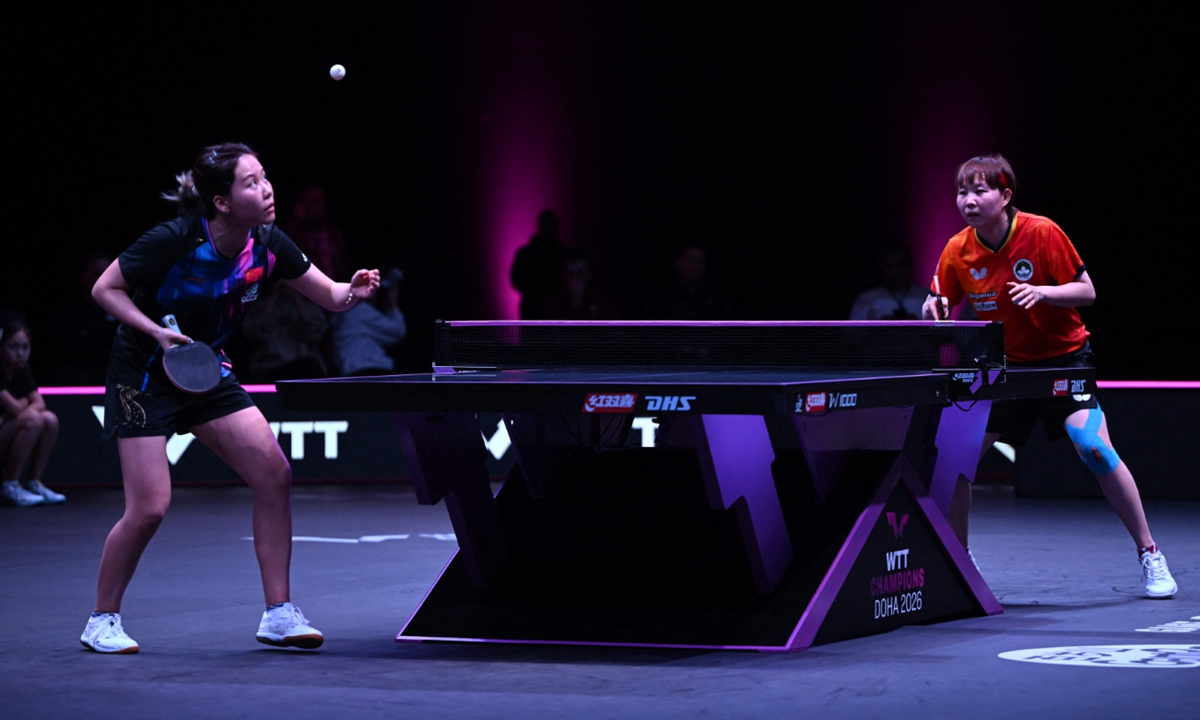
Chen Xingtong (L) hits a return against Zhu Yuling in their women's singles final match during the World Table Tennis (WTT) Champions tournament at the Infinity Arena in Doha on January 11, 2026. Photo: VCG
The 2026 WTT Champions Doha tournament concluded on Sunday with surprising scorelines for table tennis: no singles titles for the Chinese mainland team, despite sending a strong 10-player squad to one of the season's first major events.China's only runner-up finish came from Chen Xingtong in the women's singles, where she lost in the final to Zhu Yuling, who represents Macao, China. On the men's side, not a single Chinese mainland player reached the final, instead, the men's crown went to Lin Yun-ju of Chinese Taipei after he beat South Korea's Jang Woo-jin in straight sets.
The Chinese mainland players' decades-long dominance in table tennis is one of the most consistent hallmarks of modern sports: Olympic medals, world titles and WTT Tour victories have long been expected rather than questioned. In that context, Doha's results look like an embarrassing "blip" to some, but beneath the surface, it may be less a crisis than a strategic inflection point.
One obvious factor in Doha's results is player selection. China did not bring what fans would call its full first team to Doha. Notably absent were China's biggest current stars, including Sun Yingsha and Wang Chuqin, who did not compete in Doha's singles draws. While reasons range from injury to broader season planning, their absence was unquestionably felt.
From a bigger view, the national team appears to be managing a long competitive season, prioritizing major targets later in the year over immediate success in the opening event. Though WTT events carry valuable world ranking points and competitive intensity, they also arrive with tight schedules that make physical recovery a real concern. Choosing not to push top players into every event, especially early in a new competitive cycle, reflects a prioritization of long-term condition and major goals over short-term medal counts.
Coinciding with the Doha results, the Chinese Table Tennis Association on Monday announced its coaching appointments for the Los Angeles Olympic cycle, with Qin Zhijian set to serve as head coach and Xiao Zhan as deputy head coach. Wang Hao and Ma Lin remained in their roles as the men's and women's team coach respectively, indicating that the association's confidence in the existing coaching structure remains intact.
Even with a second-tier lineup, the mainland players still reached the latter stages, as Chen made the women's final and Lin reached the men's semifinals before being knocked out. Yet there were competitive warning signs. International table tennis has become more competitive and unpredictable, with more players capable of matching elite techniques. But for the Chinese mainland team, where excellence is the expectation, such results prompt legitimate questions about adaptability and depth of competitive resilience.
What's critical now is learning from this tournament without undermining confidence. The deeper lesson may be less about a singular event and more about a broader signal: The gap between China's elite and the global field has narrowed. Other players, from Asian rising stars to European veterans, are increasingly equipped with technical sophistication, consistent shot-making and mental fortitude. China must respond with equal vigor in areas of tactical diversity, match adaptability and psychological preparedness.
Growth rarely occurs without challenges. Doha's results could catalyze innovation in player development, competitive strategy and preparedness for Chinese paddlers in today's evolving table tennis. Rather than signaling decline, Doha's results can be interpreted as a reminder that even historically dominant powers must evolve in the face of rising global competition. For the Chinese national team, that evolution is not only possible, it's already underway. If this moment leads to strategic strengthening, then the pain of Doha might ultimately prove a necessary step on the road to renewed dominance.
The author is a reporter with the Global Times. life@globaltimes.com.cn
RELATED ARTICLES