ARTS / CULTURE & LEISURE
New archaeological findings confirm Qin Dynasty’s Epang Palace site built on marshland
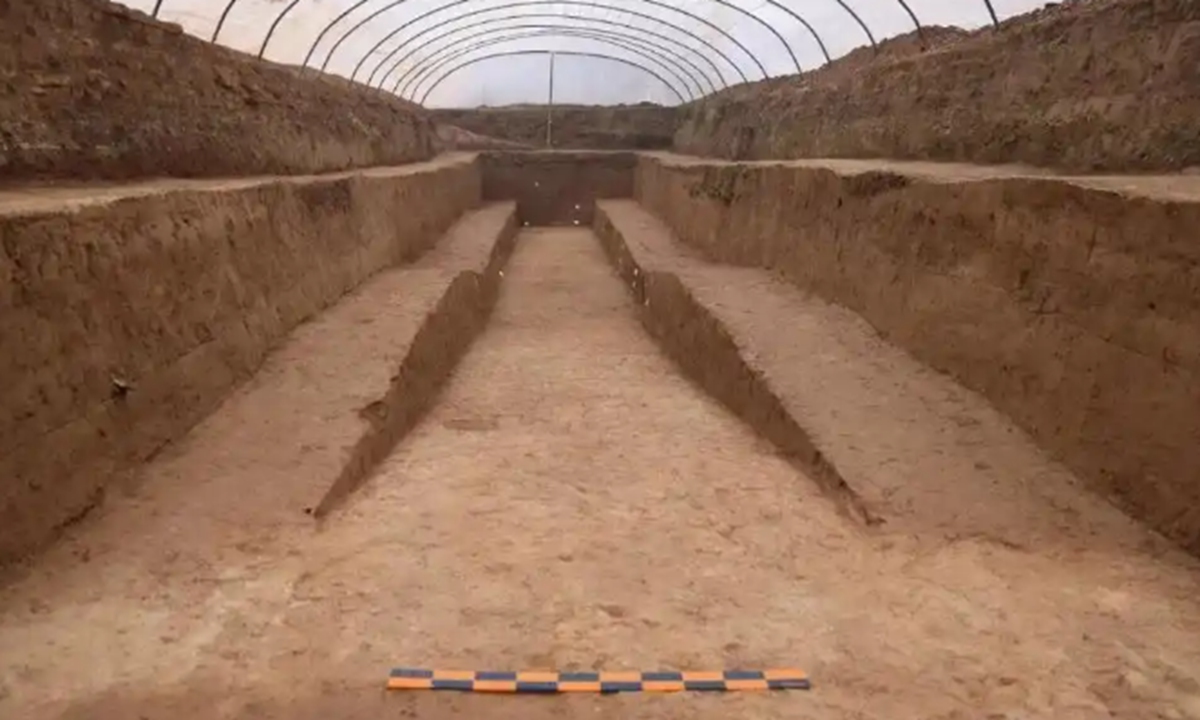
The site of the Epang Palace
New archaeological findings at the Epang Palace site in Northwest China's Shaanxi Province confirm that the palace was built on marshland. The discoveries not only reveal the ingenuity of Qin Dynasty (221BC-206BC) craftsmen in transforming wetlands into a stable foundation, but also offer important insights into the planning principles and site-selection logic of the Qin capital, the Xinhua News Agency reported on Monday.The construction of the Epang Palace begun in the 35th year of China's first Emperor Qinshihuang's reign, served as the front hall of an imperial complex. It has been associated with grandeur and magnificence.
First surveys in 1994 and large-scale surveys and partial excavations from 2002 to 2004 outlined the approximate footprint of the palace platform and confirmed that the palace was never completed and was not destroyed by fire, as some historical sources had suggested.
Investigations between 2015 and 2017 detected extensive water-deposited sediment beneath a massive platform of the Epang Palace, represented by thick layers of black silt.
During the latest 2025 excavation, archaeologists uncovered continuous layers of black silt resting on yellow soil beneath the Epang Palace platform. Measurements of the silt layer's base showed a distinct slope, slanting from south to north.
"Preliminary excavations confirm that this area was a large pond or lake before the palace was constructed," said Chen Yijiang, an associate researcher at the Xi'an Institute of Cultural Heritage and Archaeology.
Remarkably, the thickness of the silt beneath the platform was nearly uniform across different locations. "This was the result of deliberate human intervention," said Liu Rui, an associate researcher of the Institute of Archaeology, Chinese Academy of Social Sciences (CASS).
"Before construction, Qin craftsmen first drained the water from the pond and then leveled the silt to a consistent thickness, removing more from deeper central areas and less from the shallower edges. This created a foundation trench that deepened gradually from the outside inward, upon which the rammed-earth platform was built layer by layer. This also explains why the fill is thicker in the center and thinner at the edges," added Liu.
The excavation also revealed two layers of hardened surfaces, rammed-earth blocks from different construction phases, and clear tool marks, allowing for the reconstruction of the complete construction of the Epang Palace platform. The findings represent a major breakthrough in the study of large elevated structures from the Warring States (475BC-221BC) and Qin-Han (206BC-AD220) periods, Xinhua reported.
"On the lower hardened surface, we discovered multiple southeast-northwest wheel ruts as well as tool marks left during construction," said He Jiahuan, an associate researcher of the Institute of Archaeology, CASS.
"Earlier excavations had uncovered several layers of 'road earth' within the platform, thought to have been formed by workers' footsteps and vehicle traffic during rammed-earth construction. The discovery of these two hardened layers further confirms the staged construction of the Epang Palace platform, with the lower layer likely serving as a transport pathway during the early phases of construction."
Perhaps more intriguingly, the team found a clear north-south dividing line within the same rammed-earth layer where soil color and compaction patterns differed on either side.
"This line shows there were actually two construction teams working from east and west toward the center," Liu said. "This preserves direct evidence of the division of labor and collaboration in large-scale Qin projects, making it extremely valuable."
The excavation not only precisely identified the location of the southern edge of the Epang Palace platform, providing accurate data for studies of the palace's layout, but also revealed the construction sequence and building techniques in greater detail, according to Xinhua.
RELATED ARTICLES