ARTS / ART
Tianjin Customs transfers 97 seized relics to museum, including national treasures barred from export
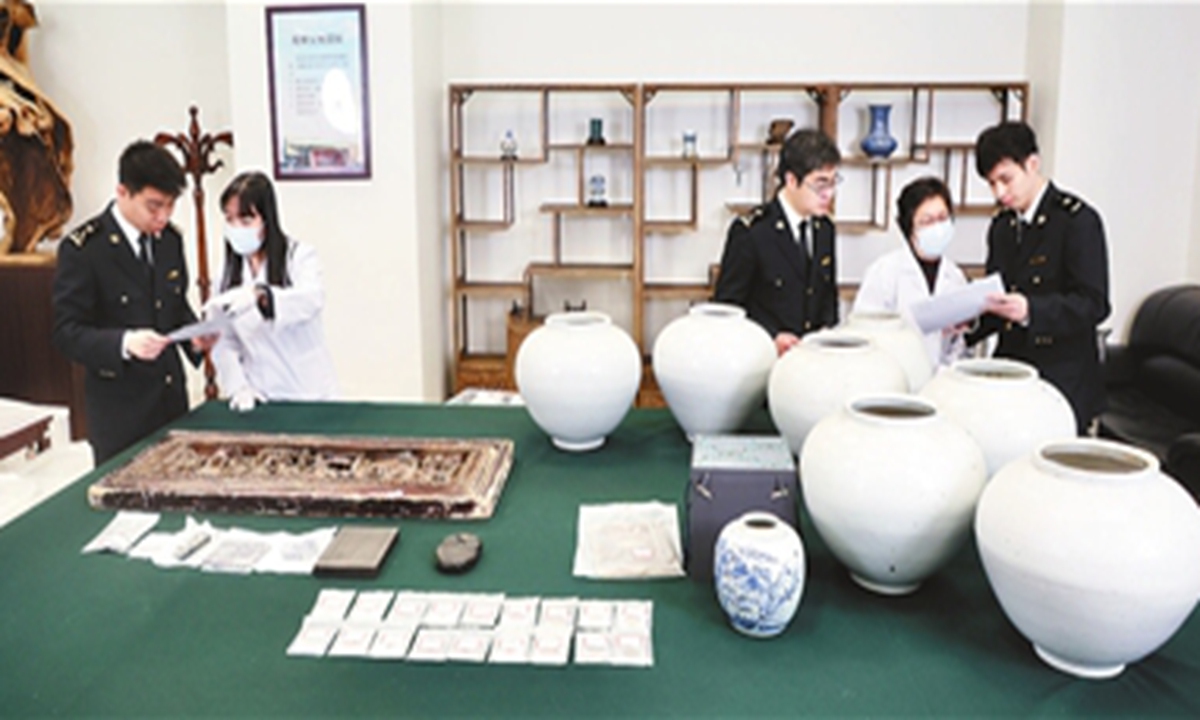
Staff members of Tianjin Customs inspect on cultural relics before their transfer to Tianjin Museum. Photo: Courtesy of Sun Liwei with People.cn
A total of 97 artifacts, including national treasures barred from being taken out of China, recently went through the Tianjin Customs to be delivered to the Tianjin Museum. These artifacts were from a batch of smuggled cultural relics previously seized by customs authorities.This batch of relics includes a white-glazed porcelain jar, ancient coins, blue-and-white porcelain jars and shards, a floral-patterned lidded jar, inkstones, a bronze tripod censer and more. These relics originate from various historical periods, with a significant number of pieces dating back to the Qing Dynasty (1644-1911) and the period of The Republic of China (1912-1949).
Among these relics, six of them, such as an inkstone bearing the mark of "Yao Wentian" are classified as general cultural relics prohibited from being taken out of the country. The mark of "Yao Wentian" relates to a "Qing Dynasty Zhuangyuan (lit: top scorer in the Qing Dynasty's imperial examinations," cultural historian Luo Yixin, told the Global Times. "Yao was renowned for his calligraphy, especially the style of Chinese regular script."
At the time of their discovery, some of these cultural relics were concealed within shipping containers, while others were hidden inside outbound mail parcels. Lawbreakers attempted to evade customs supervision by means such as false item descriptions and mixing the relics with daily-use objects, the Beijing News reported.
The inkstone bearing the "Yao Wentian" mark was a typical case among them. It was "intercepted through the examination of an outbound postal parcel," said Wei Chao, a third-level officer from the mail supervision section of Tianjin Customs.
During the inspection, the X-ray image of the mail parcel showed clear characteristics of an artware vessel. Subsequent physical examination revealed items such as jade carvings, bronze objects, and inkstones inside, suspected to be cultural relics.
Tianjin Customs immediately contacted a group of experts for on-site identification. It was confirmed that six items, including the inkstone inscribed with "Yao Wentian," were general cultural relics barred from export.
The customs-to-museum transfer of this batch of recovered relics marks the first handover of seized smuggled cultural relics by Tianjin Customs to local cultural heritage authorities in 2026. Subsequently, the museum will strictly and systematically carry out all necessary accession procedures, including the registration and documentation of the collections.
Meanwhile, research will be conducted on these items, involving comparative studies with existing museum holdings. Looking forward, if relevant themes will arise in future exhibition planning, these objects will be incorporated into the displays, enhancing the current collections.
"This batch of nearly one hundred artifacts received by Tianjin Museum has further enriched our collection. We will strictly carry out the accession, registration, and cataloguing procedures, manage them by category according to the type of artifacts, and ensure the safety of the artifacts," said Li Jun, the deputy director of the Artifact Research Department of Tianjin Museum.
Li also mentioned that the Museum will apply these relics to use in social education activities, the museum aims to further explore the historical value of these artifacts.
RELATED ARTICLES