ARTS / CULTURE & LEISURE
China’s only surviving Tang Dynasty gilded armor brought back to life
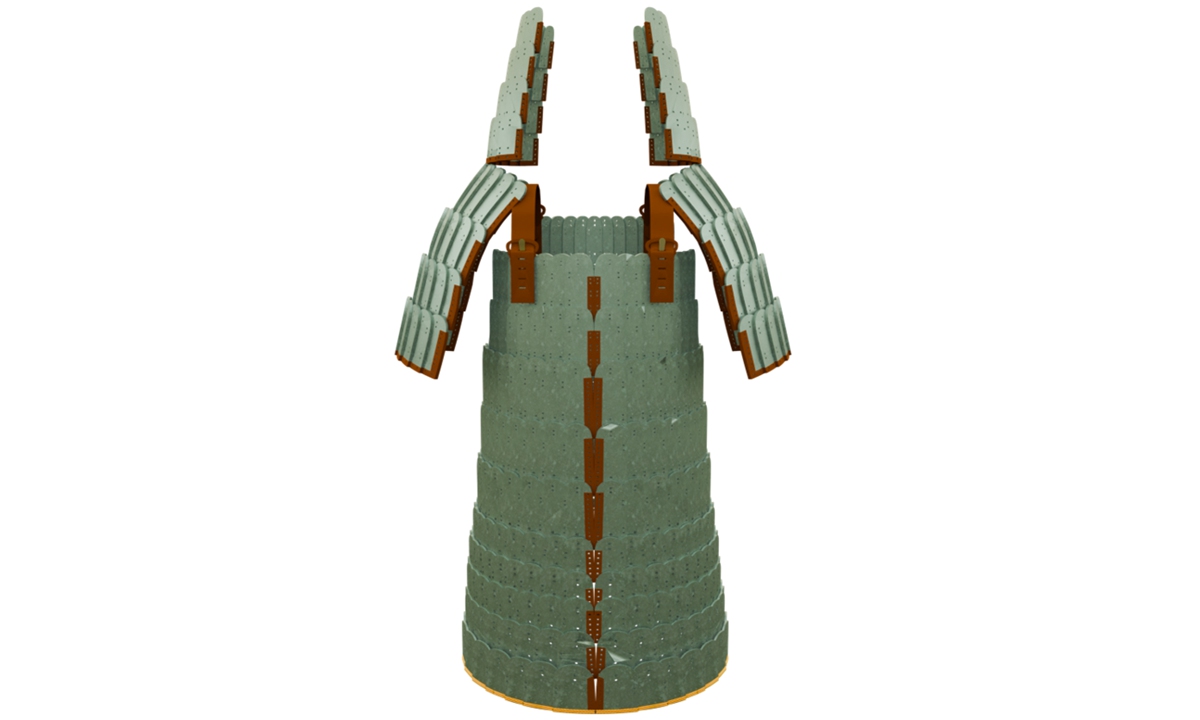
Photo: Courtesy of Key Laboratory of Archaeological Sciences and Cultural Heritage at CASS
The simulated restoration of a gilded bronze armor from the Tang Dynasty (618-907), the only one of its kind in China, as well as the discovery of the world's oldest surviving tie-dyed textile, is among a series of groundbreaking archaeological and cultural preservation achievements that were unveiled by the Chinese Academy of Social Sciences (CASS) at a press conference on Wednesday.After four years of conservation and restoration efforts, the gilded bronze armor, one of the artifacts unearthed from the Xuewei No.1 Tomb in Dulan County, Northwest China's Qinghai Province and the only surviving Tang Dynasty gilded armor in China, has been restored to showcase the ceremonial style of the Tuyuhun Kingdom during the Tang Dynasty. The restored artifacts also include a set of Tang Dynasty lacquered horse armor, according to a press release sent to the Global Times by the Key Laboratory of Archaeological Sciences and Cultural Heritage at CASS.
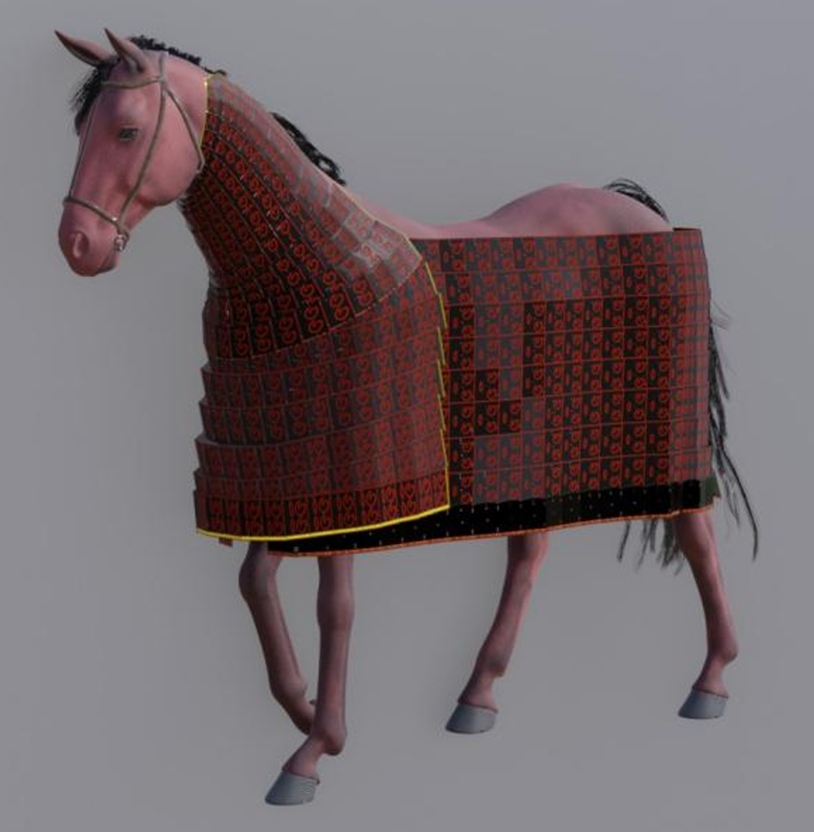
Photo: Courtesy of Key Laboratory of Archaeological Sciences and Cultural Heritage at CASS
Han Jianhua, a research fellow at the Institute of Archaeology of CASS, told the Global Times that the restoration provides detailed and reliable materials for deepening the understanding of funeral rituals, ethnic exchanges and integration, and production techniques on the Qinghai-Xizang Plateau.The tomb in Qinghai dates back approximately 1,300 years. It yielded a disordered accumulation of bronze armor and lacquered horse armor fragments with no discernible structural relationships upon excavation, each fragment at risk of crumbling upon the slightest touch. Through 3D scanning to document the original spatial data of the fragments, alongside scanning electron microscopy and ultra-depth microscopy to analyze their manufacturing techniques and composition, a reconstructed visual representation was ultimately achieved, according to the press release.
The successful restoration of the armors has solidified the technical framework and research methodology for future laboratory archaeology, while also transforming the working mindset of field archaeologists, Han noted.
A lacquered tray also unearthed from the Xuewei Tomb, once used to hold grapes, has been scientifically analyzed and confirmed to have been crafted using the Tang Dynasty's top-level gold and silver flat-cutting technique, according to the press release.
A fragment of tie-dyed fabric has been verified using techniques such as carbon-14, dating to be no later than the year 750, making it the earliest known physical example of tie-dyed fabric in the world.
This demonstrates that China was a major origin of this classical textile technique, which was practiced globally. Originating from the ancient southwestern regions of China, the technique was transported to Chang'an (now Xi'an, Northwest China's Shaanxi Province) and surrounding areas through the tributary system and trade networks. Scientific archaeology has revealed a historical landscape of ethnic exchanges, interactions, and integration during the Tang Dynasty.
Using multidisciplinary scientific methods, including dendrochronology, experts have for the first time identified ancient tree remains unearthed at the Shi'ao Site in East China's Zhejiang Province, dating back approximately 4,500 years. These remains represent the earliest and most accurately identified waxberry species in China, providing significant insights into the dietary patterns and subsistence economy of the Liangzhu culture period.
In addition to the cultural relic restoration and historical research and interpretation, the released achievements also include the launch of the China animal resource specimen bank. Specimens such as China's earliest domesticated dog, unearthed from the Nanzhuangtou site in North China's Hebei Province and China's earliest domesticated pig unearthed from the Jiahu site in Central China's Henan Province, are housed at the facility.
The specimen bank brings together ancient animal bones excavated from 121 sites across the country over the past 60 years, along with modern animal specimens, totaling more than 100,000 items. It provides a complete chronological sequence of archaeological evidence for the study of Chinese civilization.
RELATED ARTICLES