ARTS / CULTURE & LEISURE
Nie Weiping: A legendary life devoted to Weiqi
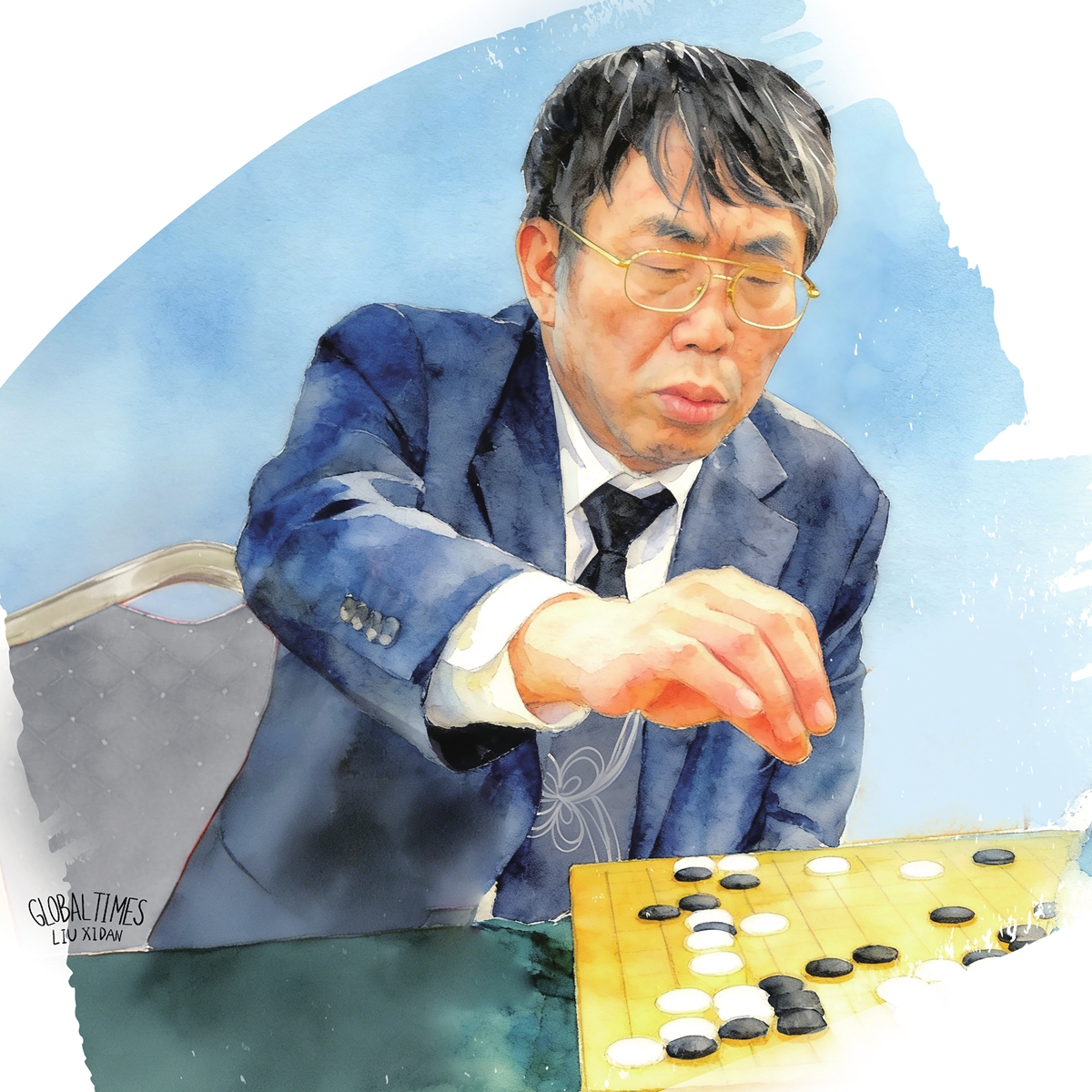
Illustration: Liu Xiadan/GT
Nie Weiping, honorary president of the Chinese Weiqi Association (CWA) and revered as the "Weiqi Sage," passed away in Beijing on Wednesday night after succumbing to illness despite medical treatment. He was 73 years old, according to a statement issued by the CWA on Thursday.Nie Yunfei, the daughter of Nie Weiping, said in an obituary on Thursday that her father dedicated his entire life to the popularization, promotion and development of the game of Weiqi (Go) in China.
"After suffering a sudden cerebral infarction in March 2025, Nie had been undergoing rehabilitation and was recuperating. I had planned to visit him earlier, but unexpectedly learned of the news today, which is deeply heartbreaking and regrettable," Chen Zhao, a friend of Nie and one of the founders of an elite Chinese Weiqi tournament, told the Global Times on Thursday.
"It was under the whirlwind impacts of Nie that we co-founded the Chinese Weiqi Mingren Tournament with the CWA in 1988. The event has now been held for more than three decades, and over the years I also became a close friend of Nie's," Chen recalled.
Born on August 17, 1952, Nie rose to fame in the global Weiqi landscape after leading China to victories at the China-Japan Go Challenge Series in the 1980s, beating several top Japanese players.
Facing Japan's Koichi Kobayashi during the China-Japan Go Challenge Series in 1985, then 33-year-old Nie wore a tracksuit borrowed from China's national table tennis team. He later said that seeing the word "China" printed on the outfit ignited his fighting spirit, and that he hoped to inspire himself with the ethos of paddler Rong Guotuan - China's first world champion - who once said, "How many times in life do you really get the chance to give it your all?"
Nie ultimately defeated Kobayashi, marking the first time a Chinese Weiqi player had beaten a Japanese opponent. He notched up a stunning 11-game winning streak during the challenge, powering the Chinese team to three consecutive title wins. His feats electrified audiences at home and abroad, igniting a surge of national pride and patriotic fervor, and earning him the nickname "Whirlwind Nie."
Regarded as a turning point in the history of Weiqi competition between China and Japan, the three consecutive championships greatly boosted the morale of the Chinese nation, and as a result, Weiqi swept across the country, nurturing countless enthusiasts and players throughout China.
In 1988, he was honored as "Weiqi Sage" by China's sports authority for his accomplishments.
"This is something that I have taken pride in for decades, and also something that has made me uneasy for decades," Nie told the Beijing News in 2020. He recalled that in his youth, he accepted the title of "Weiqi Sage" with a sense of ease and confidence, only gradually coming to realize just how profound the recognition and rewards bestowed by the country truly were.
"What left the deepest impression on me was Nie's style of play - grand and imposing, yet flexible. His play reflected his character. Nie possessed an exceptionally strong sense of the overall position and strategic vision," Chen noted.
In 2013, Nie underwent surgery for rectal cancer. In his view, his ability to recover was largely related to the mental resilience he had cultivated through years of rigorous Weiqi practice.
"Shortly after the surgery, Nie learned of a tournament that we organized and insisted on commentating on the games despite inconveniences. His lifelong devotion to Weiqi, his indomitable fighting spirit, and his foundational contributions to the development of Chinese Weiqi will be remembered forever," Chen said.
Chen said that it was impossible to hold many national Weiqi tournaments without the help of Nie throughout these years. He was consistently invited to provide live game commentary for the tournaments and the competitions contributed to nurturing a wealth of talent, including Chang Hao, the current chairman of the CWA.
"Anything that benefits the promotion of Weiqi, I am willing to devote myself to," Nie often mentioned on many occasions. As a key driver in bringing Weiqi to the general public in China, his role in popularizing the game was undeniably historic. Since 1998, Nie had established many Weiqi halls, dedicated to teaching and promoting the game to young generations.
Chinese Weiqi player Ke Jie, who began studying at Nie Weiping's Weiqi hall at the age of 7, posted "Rest in peace, Elder Nie" via Sina Weibo.
As his daughter said in the obituary, "My father's life was a legendary one, and above all, a life devoted to passion."
As China's Weiqi community mourns his passing, Nie's spirit lives on in every move played, every young player nurtured, and every corner of the world touched by the game he devoted his life to.
The author is a reporter with the Global Times. life@globaltimes.com.cn
RELATED ARTICLES