BRASIL 247 / MORE
Brazil's 2025 grain harvest hits record high as 2026 outlook points to slight decline
Grain output reached 346.1 million tonnes in 2025, while an initial estimate indicates a 1.8 percent drop in the next agricultural cycle
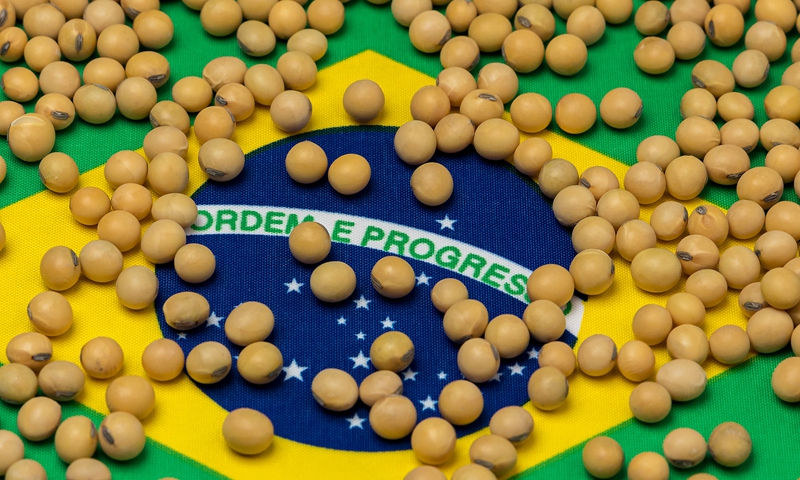
Photo: CFP
By Brasil 247 - Brazil's grain production reached an unprecedented level in 2025, marking the highest volume recorded since the historical series began in 1975. The result reflects strong performance across the country's main crops, driven by technological advances in agriculture and broadly favorable weather conditions throughout the year.
According to data from the Systematic Survey of Agricultural Production (LSPA), released on Wednesday by the Brazilian Institute of Geography and Statistics (IBGE), total output of cereals, legumes, and oilseeds reached 346.1 million tonnes in 2025. The same survey presented the third forecast for the 2026 harvest, with an initial estimate of 339.8 million tonnes, representing a 1.8 percent decrease compared with the record level achieved in 2025, IBGE said.
In absolute terms, the 2025 harvest exceeded previous results by a wide margin. Soybeans stood out, reaching 166.1 million tonnes, an increase of 14.6 percent compared with 2024. Corn production totaled 141.7 million tonnes, cotton reached 9.9 million tonnes, sorghum 5.4 million tonnes, and canephora coffee 1.3 million tonnes, all at record levels, according to IBGE data.
The production increase was accompanied by an expansion in harvested area, estimated at 81.6 million hectares in 2025, up 3.2 percent year on year. There were significant increases in planted areas of cotton, rice, soybeans, corn, and sorghum, while beans and wheat recorded declines. Even so, the growth in area was well below the sharp rise in output observed over the past decade.
In historical comparison, the volume harvested in 2025 was more than double that of 2012, when Brazil produced 162.0 million tonnes of grains. Over the same 13-year period, planted area expanded by 66.8 percent, highlighting substantial productivity gains in Brazilian agriculture, IBGE figures showed.
Carlos Alfredo Guedes, IBGE's agriculture manager, said the performance reflects sustained investment in innovation. "Productivity gains are the result of years of research by institutions such as Embrapa, which developed varieties adapted to Brazil's different biomes. They also stem from farmers' decisions to invest increasingly in advanced technologies to reach the maximum productive potential of crops," Guedes said, according to IBGE.
He added that the 2025 record was strongly influenced by soybeans, corn, and cotton, which benefited from especially favorable weather conditions throughout the agricultural cycle.
Regionally, the Center-West maintained its leadership in national production, accounting for 51.6 percent of the total harvested in 2025, or 178.7 million tonnes. The South followed with 24.9 percent, equivalent to 86.3 million tonnes. The Southeast, Northeast, and North regions accounted for 9.0 percent, 8.0 percent, and 6.5 percent, respectively, IBGE reported.
At the state level, Mato Grosso remained Brazil's largest grain producer, responsible for 32.0 percent of national output. Paraná, Goiás, Rio Grande do Sul, Mato Grosso do Sul, and Minas Gerais followed. Together, these six states accounted for 79.7 percent of Brazil's total grain production in 2025.
For 2026, IBGE projects a modest decline in output to 339.8 million tonnes, a reduction of 6.3 million tonnes compared with 2025. Guedes said the expected decrease is mainly linked to corn, sorghum, and rice. "Because 2025 was a very strong year for these crops, we are starting from a high comparison base. Some crops will still be planted in the second harvest, so estimates depend on planting windows and weather conditions. In addition, profit margins are lower due to low prices, which has discouraged farmers from expanding planted area and investment," he said.
The forecast points to production growth in states such as Rio Grande do Sul, Paraná, Piauí, and Rondônia, while declines are expected in major agricultural regions including Mato Grosso, Goiás, Mato Grosso do Sul, Minas Gerais, Bahia, and other states.
From 2026 onward, the LSPA will also incorporate canola and sesame, crops that have been gaining importance in Brazilian agriculture. Established in 1972, the IBGE survey tracks national agricultural production on a monthly basis, from planting intentions to the end of the harvest, providing a detailed picture of sector dynamics and outlooks for future crops.
(Reported by Brasil 247 on Jan 15, 2026)
