Israel reportedly criticizes US Gaza executive board composition for failing to coordinate with Israel; Chinese expert says US’ board serves to advance its own perceived interests
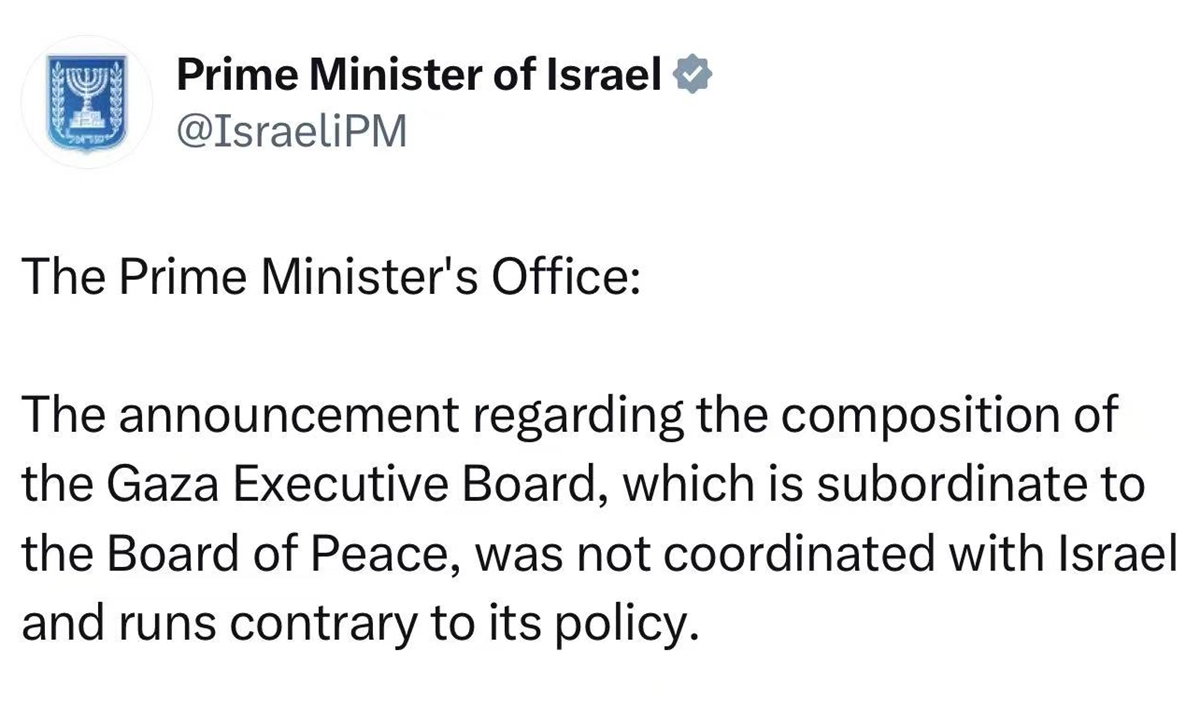
Photo: Screenshot from Israel Prime Minister's X account, on January 17, 2026
Israeli Prime Minister Benjamin Netanyahu's office rarely criticized on Saturday over Trump administration's announcement this week on the composition of a Gaza executive board, claiming it was not coordinated with Israel and ran counter to government policy, media reported.
The response by Netanyahu came after the announcement by the Washington's so-called Gaza "board of peace", meant to temporarily oversee governance and reconstruction in the strip, The Guardian reported on Saturday.
The White House and other sources announced a flurry of appointments and invitations to the organization over the last two days, including Turkish president Recep Tayyip Erdoğan, the Egyptian president Abdel Fatah al-Sisi, former UK prime minister Tony Blair and the president of Argentina, Javier Milei, the report said.
The rare criticism from Israel of its close ally in Washington didn't have details. Saturday's statement also said Netanyahu has told the foreign ministry to contact Secretary of State Marco Rubio, per AP.
Another report by Bloomberg noted that the Trump administration is asking countries that want a permanent spot on his new Board of Peace to contribute at least $1 billion.
According to a draft charter for the proposed group seen by Bloomberg, President Donald Trump would serve as its inaugural chairman and would decide on who is invited to be members. Decisions would be taken by a majority, with each member state present getting one vote, but all would be subject to the chairman's approval, per the report.
In letters sent Friday to various world leaders inviting them to be "founding members" of the board, Trump claimed the body would "embark on a bold new approach to resolving global conflict," per AP News.
Invitation letters from Trump to Argentine President Javier Milei and Paraguay's leader Santiago Peña, that were posted Saturday to their official social media accounts note that Trump's 20-point Gaza ceasefire plan, which includes the creation of the Board of Peace, was endorsed by the UN Security Council and indicates that the panel of world leaders may not confine their work to Gaza, according to the report by AP News.
Other leaders whose governments have confirmed receiving invitation letters include Canadian Prime Minister Mark Carney, Egyptian President Abdel-Fattah el-Sissi and Turkish President Recep Tayyip Erdogan. It was not immediately clear how many or which other leaders would receive invitations, the report said.
A report by The Times of Israel noted that the inclusion of prominent officials from Qatar and Turkey — two countries who have been highly critical of Israel's prosecution of the war in Gaza — is likely to upset Jerusalem.
Also, a report by AP News titled "Board of Peace for Gaza is forming with ambitions for a wider mandate of other conflicts" said that the board which was initially seen as a mechanism focused on ending the Israel-Hamas war in Gaza, is taking shape with ambitions to have a far broader mandate of other global crises, potentially rivaling the United Nations in what would be a major upheaval to the post-World War II international order.
US President's apparent aspirations to turn to the Board of Peace into an international institution that could provide an alternative to the United Nations is sure to be controversial and opposed by numerous countries, which hold veto power in the UN Security Council and have significant interests in opposing any radical change in the world order, the report said.
Smaller nations, per the report, are also likely to have objections as the UN system has given them at least a voice in major international decisions since the end of the Second World War.
"This is a US shortcut in an attempt to wield its veto power on world affairs," Daniel Forti, head of UN affairs at the International Crisis Group, said.
The US' move serves to advance US president's perceived regional and strategic interests, particularly in the Middle East, where the US has long sought influence and access to funding, Lü Xiang, a research fellow at the Chinese Academy of Social Sciences, told the Global Times on Sunday.
In the case of Gaza, if there is any prospect for peace or post-conflict reconstruction, US President would likely want to involve Middle Eastern actors who are generally aligned with US positions, the expert noted.
RELATED ARTICLES